




Young’s double-slit experiment is carried out by using green, red, and blue light, and one color at a time. The fringe widths recorded are ${{\beta }_{G}},{{\beta }_{R}},{{\beta }_{B}}$ respectively. Then,
A. ${{\beta }_{G}}>{{\beta }_{R}}>{{\beta }_{B}}$
B. ${{\beta }_{B}}>{{\beta }_{G}}>{{\beta }_{R}}$
C. ${{\beta }_{R}}>{{\beta }_{B}}>{{\beta }_{G}}$
D. ${{\beta }_{R}}>{{\beta }_{G}}>{{\beta }_{B}}$
Answer
 Verified
606k+ views
Hint: Young’s double-slit experiment is an experiment in which a monochromatic beam of light is passed through two slits to observe the overlapping pattern of the diffracted light over a screen. The bending of light over the edges of a material is known as diffraction. It depends on the size of the opening of the slit.
Complete answer:
Young’s double-slit experiment helps us to understand the wave theory of light. According to the overlapping dark and light fringes having identical width are formed on the screen which is kept at a certain distance from the source. For better understanding, we can refer to the diagram shown here,
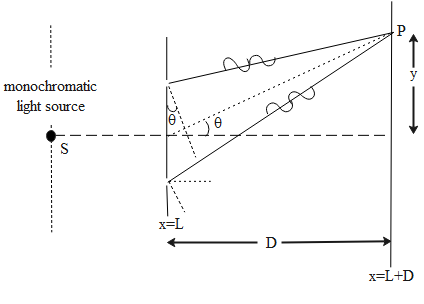
The width of the fringe is denoted by $\beta $. The value $\beta $ is dependent on the wavelength of the source of light, the distance between the two slits ($d$), and the distance between the screen and the source ($D$).
Mathematically,
$\beta =\dfrac{\lambda D}{d}$
As per the condition mentioned in the question. Three sources of light (red, green, blue)are used one by one in a particular young’s double-slit experiment set up. So the value of the distance between the two slits ($d$), and the distance between the screen and the source ($D$) will be constant in all the tree sources.
Thus we can say that the fringe with the overlapping pattern will be directly proportional to the source of light.
$\beta \propto \lambda $
According to the visible light spectrum, red has the highest wavelength, green has a wavelength greater than that of blue.
Thus here we can conclude that the relation between the fringe widths of these sources of light will be
${{\beta }_{R}}>{{\beta }_{G}}>{{\beta }_{B}}$
So, the correct answer is “Option D”.
Note:
Young’s double-slit experiment was first performed, by using light, by Sir Thomas Young in 1801, for the demonstration of the wave behavior of light. In that era, it was postulated that the light is constituted by either particles or waves. Afterward, it was concluded that light has both particle and wave-like nature. Both theories are taken into account for the explanation of different characteristics of light.
Complete answer:
Young’s double-slit experiment helps us to understand the wave theory of light. According to the overlapping dark and light fringes having identical width are formed on the screen which is kept at a certain distance from the source. For better understanding, we can refer to the diagram shown here,
The width of the fringe is denoted by $\beta $. The value $\beta $ is dependent on the wavelength of the source of light, the distance between the two slits ($d$), and the distance between the screen and the source ($D$).
Mathematically,
$\beta =\dfrac{\lambda D}{d}$
As per the condition mentioned in the question. Three sources of light (red, green, blue)are used one by one in a particular young’s double-slit experiment set up. So the value of the distance between the two slits ($d$), and the distance between the screen and the source ($D$) will be constant in all the tree sources.
Thus we can say that the fringe with the overlapping pattern will be directly proportional to the source of light.
$\beta \propto \lambda $
According to the visible light spectrum, red has the highest wavelength, green has a wavelength greater than that of blue.
Thus here we can conclude that the relation between the fringe widths of these sources of light will be
${{\beta }_{R}}>{{\beta }_{G}}>{{\beta }_{B}}$
So, the correct answer is “Option D”.
Note:
Young’s double-slit experiment was first performed, by using light, by Sir Thomas Young in 1801, for the demonstration of the wave behavior of light. In that era, it was postulated that the light is constituted by either particles or waves. Afterward, it was concluded that light has both particle and wave-like nature. Both theories are taken into account for the explanation of different characteristics of light.
Recently Updated Pages
Master Class 12 Business Studies: Engaging Questions & Answers for Success

Master Class 12 Biology: Engaging Questions & Answers for Success
Master Class 12 Chemistry: Engaging Questions & Answers for Success
Class 12 Question and Answer - Your Ultimate Solutions Guide
Master Class 11 Social Science: Engaging Questions & Answers for Success
Master Class 11 English: Engaging Questions & Answers for Success
Trending doubts
Which are the Top 10 Largest Countries of the World?
Draw a labelled sketch of the human eye class 12 physics CBSE
Differentiate between homogeneous and heterogeneous class 12 chemistry CBSE
Sulphuric acid is known as the king of acids State class 12 chemistry CBSE
Why is the cell called the structural and functional class 12 biology CBSE
Which is the correct genotypic ratio of mendel dihybrid class 12 biology CBSE