




You notice that the young leaves of your tomato plant are very yellow. What type of deficiency does this suggest?
A) Nitrogen
B) Carbon
C) Water
D) Iron
Answer
 Verified
567.9k+ views
Hint: It is the micronutrient which is very essential for the formation of chlorophyll. This nutrient is required in large amounts than other micronutrients. It is a part of proteins that help in the transfer of electrons such as cytochromes.
Complete answer:
Some nutrients are required for the proper growth and metabolism of the plants. These are called essential nutrients. When the plants do not get the essential nutrients in the required amount, their growth is stopped. The plants show deficiency symptoms that may be specific to a particular nutrient or not. The deficiency symptoms first appear as morphological changes and if the plant does not get that nutrient, it dies.
Nitrogen is a macronutrient that is absorbed by plants in the form of nitrate. The deficiency of nitrogen in tomato plants causes chlorosis (yellowing) of the leaves. The chlorophyll is lost from the leaves and it appears pale green-yellow in colour. In old leaves, the symptoms first appear and with time it drops from the plant when it turns yellow-brown.
The deficiency of water decreases the potassium and calcium ions concentration in the tomato plant. The plant would rot and mould due to less water availability. Generally, carbon deficiency is not seen in tomato plants.
The deficiency of iron in tomato plants causes chlorosis of the leaves. The symptoms first appear in young leaves causes them to become completely yellow. As iron has less mobility, the symptoms are shown in the youngest leaves. The plants absorb iron in the form of ferric ions.
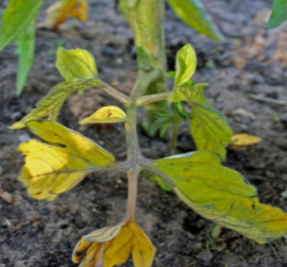
Thus, the answer to the above question is (D) Iron. This is because the deficiency of iron causes chlorosis in young leaves while deficiency of nitrogen causes chlorosis in old leaves.
Note: There are two types of nutrients on the basis of their requirements by plants- macronutrients and micronutrients. The nutrients that are required by plants in large amounts are called macronutrients. They are present in more than 10 mmoles per kg of dry matter. On the other hand, micronutrients are required in very small amounts and they are present in plants in less than 10 mmoles per kg of dry matter.
Complete answer:
Some nutrients are required for the proper growth and metabolism of the plants. These are called essential nutrients. When the plants do not get the essential nutrients in the required amount, their growth is stopped. The plants show deficiency symptoms that may be specific to a particular nutrient or not. The deficiency symptoms first appear as morphological changes and if the plant does not get that nutrient, it dies.
Nitrogen is a macronutrient that is absorbed by plants in the form of nitrate. The deficiency of nitrogen in tomato plants causes chlorosis (yellowing) of the leaves. The chlorophyll is lost from the leaves and it appears pale green-yellow in colour. In old leaves, the symptoms first appear and with time it drops from the plant when it turns yellow-brown.
The deficiency of water decreases the potassium and calcium ions concentration in the tomato plant. The plant would rot and mould due to less water availability. Generally, carbon deficiency is not seen in tomato plants.
The deficiency of iron in tomato plants causes chlorosis of the leaves. The symptoms first appear in young leaves causes them to become completely yellow. As iron has less mobility, the symptoms are shown in the youngest leaves. The plants absorb iron in the form of ferric ions.
Thus, the answer to the above question is (D) Iron. This is because the deficiency of iron causes chlorosis in young leaves while deficiency of nitrogen causes chlorosis in old leaves.
Note: There are two types of nutrients on the basis of their requirements by plants- macronutrients and micronutrients. The nutrients that are required by plants in large amounts are called macronutrients. They are present in more than 10 mmoles per kg of dry matter. On the other hand, micronutrients are required in very small amounts and they are present in plants in less than 10 mmoles per kg of dry matter.
Recently Updated Pages
If x a + bt + ct2 where x is in meters and t is in class 11 physics CBSE

A car covers the first half distance between two places class 11 physics CBSE
The resultant of two vectors overrightarrow P and overrightarrow class 11 physics CBSE
Find the value of cos 135 class 11 maths CBSE
A mass M is held in place by an applied force F and class 11 physics CBSE
A solution of glucose in water is labelled as 10 dfracwv class 11 chemistry CBSE
Trending doubts
One Metric ton is equal to kg A 10000 B 1000 C 100 class 11 physics CBSE
Find the value of the expression given below sin 30circ class 11 maths CBSE
What do you mean by retardation What is its SI uni class 11 physics CBSE
Draw a diagram of nephron and explain its structur class 11 biology CBSE
10 examples of friction in our daily life
Difference between physical and chemical change class 11 chemistry CBSE