




Write the value of ${{\tan }^{-1}}\sqrt{3}-{{\cot }^{-1}}\left( -\sqrt{3} \right)$ .
Answer
 Verified
595.5k+ views
Hint: The above question is related to inverse trigonometric function and for solving the problem, you need to put the value $ta{{n}^{-1}}\sqrt{3}$. For finding the value of ${{\cot }^{-1}}\left( -\sqrt{3} \right)$ , use the property that ${{\cot }^{-1}}\left( -x \right)=\pi -{{\cot }^{-1}}x$ , followed by putting the value of ${{\cot }^{-1}}\sqrt{3}$ to get the answer.
Complete step-by-step answer:
Before starting with the solution to the above question, we will first talk about the required details of different inverse trigonometric ratios. So, we must remember that inverse trigonometric ratios are completely different from trigonometric ratios and have many constraints related to their range and domain. So, to understand these constraints and the behaviour of inverse trigonometric functions, let us look at a graph of ${{\cot }^{-1}}x$ .
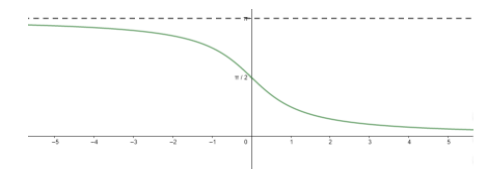
So, looking at the above graphs, we can draw the conclusion that ${{\cot }^{-1}}x$ is defined for all real values of x, i.e., the domain of the function ${{\cot }^{-1}}x$ is all real numbers while its range comes out to be $\left( 0,\pi \right)$ .
Now moving to the solution to the above question, we will start with the simplification of the expression given in the question.
${{\tan }^{-1}}\sqrt{3}-{{\cot }^{-1}}\left( -\sqrt{3} \right)$
We know that ${{\cot }^{-1}}\left( -x \right)=\pi -{{\cot }^{-1}}x$ . So, using this property in our expression, we get
${{\tan }^{-1}}\sqrt{3}-\left( \pi -{{\cot }^{-1}}\sqrt{3} \right)$
We also know that $ta{{n}^{-1}}\sqrt{3}=\dfrac{\pi }{3}\text{ and co}{{\text{t}}^{-1}}\sqrt{3}=\dfrac{\pi }{6}$ , and $\sqrt{3}$ also lies in their domains as well. So, using this value in our expression, we get
$\dfrac{\pi }{3}-\left( \pi -\dfrac{\pi }{6} \right)=\dfrac{\pi }{3}-\dfrac{5\pi }{6}=\dfrac{2\pi -5\pi }{6}=-\dfrac{\pi }{2}$
Therefore, the value of ${{\tan }^{-1}}\sqrt{3}-{{\cot }^{-1}}\left( -\sqrt{3} \right)$ is equal to $-\dfrac{\pi }{2}$ .
Note: It is important that you need to remember ${{\cot }^{-1}}\left( -x \right)=\pi -{{\cot }^{-1}}x$ , ${{\sec }^{-1}}\left( -x \right)=\pi -{{\sec }^{-1}}x$ and ${{\cos }^{-1}}\left( -x \right)=\pi -{{\cos }^{-1}}x$ , while for other inverse trigonometric functions the negative sign comes out of the function directly, i.e., they are odd functions. Also, be careful about the range and domain of different trigonometric inverse functions as they are very confusing and may lead to errors.
Complete step-by-step answer:
Before starting with the solution to the above question, we will first talk about the required details of different inverse trigonometric ratios. So, we must remember that inverse trigonometric ratios are completely different from trigonometric ratios and have many constraints related to their range and domain. So, to understand these constraints and the behaviour of inverse trigonometric functions, let us look at a graph of ${{\cot }^{-1}}x$ .
So, looking at the above graphs, we can draw the conclusion that ${{\cot }^{-1}}x$ is defined for all real values of x, i.e., the domain of the function ${{\cot }^{-1}}x$ is all real numbers while its range comes out to be $\left( 0,\pi \right)$ .
Now moving to the solution to the above question, we will start with the simplification of the expression given in the question.
${{\tan }^{-1}}\sqrt{3}-{{\cot }^{-1}}\left( -\sqrt{3} \right)$
We know that ${{\cot }^{-1}}\left( -x \right)=\pi -{{\cot }^{-1}}x$ . So, using this property in our expression, we get
${{\tan }^{-1}}\sqrt{3}-\left( \pi -{{\cot }^{-1}}\sqrt{3} \right)$
We also know that $ta{{n}^{-1}}\sqrt{3}=\dfrac{\pi }{3}\text{ and co}{{\text{t}}^{-1}}\sqrt{3}=\dfrac{\pi }{6}$ , and $\sqrt{3}$ also lies in their domains as well. So, using this value in our expression, we get
$\dfrac{\pi }{3}-\left( \pi -\dfrac{\pi }{6} \right)=\dfrac{\pi }{3}-\dfrac{5\pi }{6}=\dfrac{2\pi -5\pi }{6}=-\dfrac{\pi }{2}$
Therefore, the value of ${{\tan }^{-1}}\sqrt{3}-{{\cot }^{-1}}\left( -\sqrt{3} \right)$ is equal to $-\dfrac{\pi }{2}$ .
Note: It is important that you need to remember ${{\cot }^{-1}}\left( -x \right)=\pi -{{\cot }^{-1}}x$ , ${{\sec }^{-1}}\left( -x \right)=\pi -{{\sec }^{-1}}x$ and ${{\cos }^{-1}}\left( -x \right)=\pi -{{\cos }^{-1}}x$ , while for other inverse trigonometric functions the negative sign comes out of the function directly, i.e., they are odd functions. Also, be careful about the range and domain of different trigonometric inverse functions as they are very confusing and may lead to errors.
Recently Updated Pages
Complete reduction of benzene diazonium chloride with class 12 chemistry CBSE

How can you identify optical isomers class 12 chemistry CBSE
The coating formed on the metals such as iron silver class 12 chemistry CBSE
Metals are refined by using different methods Which class 12 chemistry CBSE
What do you understand by denaturation of proteins class 12 chemistry CBSE
Assertion Nitrobenzene is used as a solvent in FriedelCrafts class 12 chemistry CBSE
Trending doubts
Which are the Top 10 Largest Countries of the World?
What are the major means of transport Explain each class 12 social science CBSE
Draw a labelled sketch of the human eye class 12 physics CBSE
Differentiate between insitu conservation and exsitu class 12 biology CBSE
Draw a neat and well labeled diagram of TS of ovary class 12 biology CBSE
RNA and DNA are chiral molecules their chirality is class 12 chemistry CBSE