




Write the value of \[{{\tan }^{-1}}\dfrac{a}{b}-{{\tan }^{-1}}\dfrac{a-b}{a+b}\] .
Answer
 Verified
667.5k+ views
Hint: The above question is related to inverse trigonometric function and looking at the form of the equation, it is very clear that you have to use the formula ${{\tan }^{-1}}A-{{\tan }^{-1}}B={{\tan }^{-1}}\dfrac{A-B}{1+AB}$ . After that you need to simplify the expression by taking the LCM and eliminating the possible terms. Finally you need to use the value ${{\tan }^{-1}}1=45{}^\circ $ to reach the final answer.
Complete step by step answer:
Before starting with the solution to the above question, we will first talk about the required details of different inverse trigonometric ratios. So, we must remember that inverse trigonometric ratios are completely different from trigonometric ratios and have many constraints related to their range and domain. So, to understand these constraints and the behaviour of inverse trigonometric functions, let us look at the graph of ${{\tan }^{-1}}x$ as well.
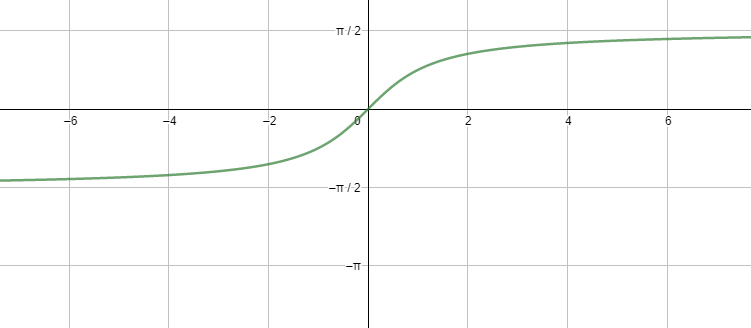
So, looking at the above graphs, we can draw the conclusion that ${{\tan }^{-1}}x$ is defined for all real values of x, i.e., the domain of the function ${{\tan }^{-1}}x$ is all real numbers while its range comes out to be $\left( -\dfrac{\pi }{2},\dfrac{\pi }{2} \right)$ .
Now moving to the solution to the above question, we will start with the simplification of the expression given in the question.
\[{{\tan }^{-1}}\dfrac{a}{b}-{{\tan }^{-1}}\dfrac{a-b}{a+b}\]
Now, we know ${{\tan }^{-1}}A-{{\tan }^{-1}}B={{\tan }^{-1}}\dfrac{A-B}{1+AB}$ , we get
\[{{\tan }^{-1}}\dfrac{\dfrac{a}{b}-\dfrac{a-b}{a+b}}{1+\dfrac{a\left( a-b \right)}{b\left( a+b \right)}}\]
$={{\tan }^{-1}}\left( \dfrac{\dfrac{a\left( a+b \right)-b(a-b)}{b\left( a+b \right)}}{\dfrac{b(a+b)+a\left( a-b \right)}{b\left( a+b \right)}} \right)$
$={{\tan }^{-1}}\left( \dfrac{{{a}^{2}}+ab-ab+{{b}^{2}}}{{{a}^{2}}+{{b}^{2}}+ab-ab} \right)$
$={{\tan }^{-1}}\left( \dfrac{{{a}^{2}}+{{b}^{2}}}{{{a}^{2}}+{{b}^{2}}} \right)$
$={{\tan }^{-1}}1$
We know that the value of ${{\tan }^{-1}}1$ is equal to $\dfrac{\pi }{4}$ . So, we can say that that the value of \[{{\tan }^{-1}}\dfrac{a}{b}-{{\tan }^{-1}}\dfrac{a-b}{a+b}\] comes to be equal to $\dfrac{\pi }{4}$ .
Note: Be careful about the signs in the formula ${{\tan }^{-1}}A-{{\tan }^{-1}}B={{\tan }^{-1}}\dfrac{A-B}{1+AB}$ , as students many a times get confused and take the formula as ${{\tan }^{-1}}A-{{\tan }^{-1}}B={{\tan }^{-1}}\dfrac{A+B}{1-AB}$ . Remembering the domain and range of the trigonometric inverse function ${{\tan }^{-1}}x$ is very important.
Complete step by step answer:
Before starting with the solution to the above question, we will first talk about the required details of different inverse trigonometric ratios. So, we must remember that inverse trigonometric ratios are completely different from trigonometric ratios and have many constraints related to their range and domain. So, to understand these constraints and the behaviour of inverse trigonometric functions, let us look at the graph of ${{\tan }^{-1}}x$ as well.
So, looking at the above graphs, we can draw the conclusion that ${{\tan }^{-1}}x$ is defined for all real values of x, i.e., the domain of the function ${{\tan }^{-1}}x$ is all real numbers while its range comes out to be $\left( -\dfrac{\pi }{2},\dfrac{\pi }{2} \right)$ .
Now moving to the solution to the above question, we will start with the simplification of the expression given in the question.
\[{{\tan }^{-1}}\dfrac{a}{b}-{{\tan }^{-1}}\dfrac{a-b}{a+b}\]
Now, we know ${{\tan }^{-1}}A-{{\tan }^{-1}}B={{\tan }^{-1}}\dfrac{A-B}{1+AB}$ , we get
\[{{\tan }^{-1}}\dfrac{\dfrac{a}{b}-\dfrac{a-b}{a+b}}{1+\dfrac{a\left( a-b \right)}{b\left( a+b \right)}}\]
$={{\tan }^{-1}}\left( \dfrac{\dfrac{a\left( a+b \right)-b(a-b)}{b\left( a+b \right)}}{\dfrac{b(a+b)+a\left( a-b \right)}{b\left( a+b \right)}} \right)$
$={{\tan }^{-1}}\left( \dfrac{{{a}^{2}}+ab-ab+{{b}^{2}}}{{{a}^{2}}+{{b}^{2}}+ab-ab} \right)$
$={{\tan }^{-1}}\left( \dfrac{{{a}^{2}}+{{b}^{2}}}{{{a}^{2}}+{{b}^{2}}} \right)$
$={{\tan }^{-1}}1$
We know that the value of ${{\tan }^{-1}}1$ is equal to $\dfrac{\pi }{4}$ . So, we can say that that the value of \[{{\tan }^{-1}}\dfrac{a}{b}-{{\tan }^{-1}}\dfrac{a-b}{a+b}\] comes to be equal to $\dfrac{\pi }{4}$ .
Note: Be careful about the signs in the formula ${{\tan }^{-1}}A-{{\tan }^{-1}}B={{\tan }^{-1}}\dfrac{A-B}{1+AB}$ , as students many a times get confused and take the formula as ${{\tan }^{-1}}A-{{\tan }^{-1}}B={{\tan }^{-1}}\dfrac{A+B}{1-AB}$ . Remembering the domain and range of the trigonometric inverse function ${{\tan }^{-1}}x$ is very important.
Recently Updated Pages
What is BLO What is the full form of BLO class 8 social science CBSE

Explain the Treaty of Vienna of 1815 class 10 social science CBSE
10 examples of friction in our daily life
Draw a diagram of nephron and explain its structur class 11 biology CBSE
Write structures of the following compounds i 2 Chloro3methylpentane class 11 chemistry CBSE
A Paragraph on Pollution in about 100-150 Words
Trending doubts
Draw a labelled sketch of the human eye class 12 physics CBSE
Which are the Top 10 Largest Countries of the World?
Differentiate between homogeneous and heterogeneous class 12 chemistry CBSE
Draw ray diagrams each showing i myopic eye and ii class 12 physics CBSE
Which is the correct genotypic ratio of mendel dihybrid class 12 biology CBSE
What is the Full Form of PVC, PET, HDPE, LDPE, PP and PS ?