




Write the molecular formula of the \[{2^{nd}}\] and \[{3^{rd}}\] number of the homologous series whose first member is ethene.
Answer
 Verified
645.9k+ views
Hint: Alkanes are aliphatic organic compounds which have a minimum of 1 and maximum ‘n’ number of carbon atoms. Also, only sigma bonds are present in alkanes. This means that alkanes are formed only with single bonds, and not double or triple bonds.
Complete step by step answer:
Alkane is a homologous series with the general formula of \[{C_n}{H_{2n}}\].
Now, from the very first and simplest alkane methane, the molecular formula is different from the \[ - C{H_2}\] unit.
Now from ethane the molecular formula of the \[{2^{nd}}\] and \[{3^{rd}}\] number of the homologous series are, \[{C_3}{H_6},{C_4}{H_8}\].
Additional information:
If organic compounds contain one principal functional group then the longest continuous chain of carbon atoms having that functional group is selected. Functional groups are specific substituents in the molecules that are responsible for the characteristic chemical reactions of those molecules.
The IUPAC nomenclature of organic chemistry is a system of organic chemical compounds in the nomenclature of chemicals as stated by the International Union of Pure and Applied Chemistry. Informally we call it Blue Book. The book mentions certain rules for the naming of compounds having functional groups.
As per IUPAC rules, the first thing is to select the longest continuous chain. Then this chain is numbered and the numbering should begin from the end which is close to the substituent groups. Each substituent group has a certain assigned name whose numbering depends on the position of the carbon it has been attached to. These groups are generally arranged alphabetically.
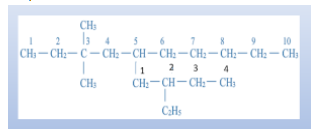
For example, 5-(2-ethylbutyl)-3,3-dimethyldecane has a parent carbon chain called decade I.e. have 10 carbons in the chain. On its third carbon, two methyl groups are attached as mentioned \[\left( {3,3} \right)\]. And on its fifth carbon, a butyl chain is bonded to which another ethyl chain is attached at the second position of the butyl chain. From all this, we get the structure of the compound as
Note: IUPAC names are combined with the primary prefix, root word, and primary suffix. By this, each compound can be named unique. Primary prefixes are used to indicate the origin of the compound in IUPAC nomenclature. Prefixes are used to differentiate the cyclic and acyclic molecules in IUPAC nomenclature.
Complete step by step answer:
Alkane is a homologous series with the general formula of \[{C_n}{H_{2n}}\].
Now, from the very first and simplest alkane methane, the molecular formula is different from the \[ - C{H_2}\] unit.
Now from ethane the molecular formula of the \[{2^{nd}}\] and \[{3^{rd}}\] number of the homologous series are, \[{C_3}{H_6},{C_4}{H_8}\].
Additional information:
If organic compounds contain one principal functional group then the longest continuous chain of carbon atoms having that functional group is selected. Functional groups are specific substituents in the molecules that are responsible for the characteristic chemical reactions of those molecules.
The IUPAC nomenclature of organic chemistry is a system of organic chemical compounds in the nomenclature of chemicals as stated by the International Union of Pure and Applied Chemistry. Informally we call it Blue Book. The book mentions certain rules for the naming of compounds having functional groups.
As per IUPAC rules, the first thing is to select the longest continuous chain. Then this chain is numbered and the numbering should begin from the end which is close to the substituent groups. Each substituent group has a certain assigned name whose numbering depends on the position of the carbon it has been attached to. These groups are generally arranged alphabetically.
For example, 5-(2-ethylbutyl)-3,3-dimethyldecane has a parent carbon chain called decade I.e. have 10 carbons in the chain. On its third carbon, two methyl groups are attached as mentioned \[\left( {3,3} \right)\]. And on its fifth carbon, a butyl chain is bonded to which another ethyl chain is attached at the second position of the butyl chain. From all this, we get the structure of the compound as
Note: IUPAC names are combined with the primary prefix, root word, and primary suffix. By this, each compound can be named unique. Primary prefixes are used to indicate the origin of the compound in IUPAC nomenclature. Prefixes are used to differentiate the cyclic and acyclic molecules in IUPAC nomenclature.
Recently Updated Pages
If x a + bt + ct2 where x is in meters and t is in class 11 physics CBSE

A car covers the first half distance between two places class 11 physics CBSE
The resultant of two vectors overrightarrow P and overrightarrow class 11 physics CBSE
Find the value of cos 135 class 11 maths CBSE
A mass M is held in place by an applied force F and class 11 physics CBSE
A solution of glucose in water is labelled as 10 dfracwv class 11 chemistry CBSE
Trending doubts
One Metric ton is equal to kg A 10000 B 1000 C 100 class 11 physics CBSE
Find the value of the expression given below sin 30circ class 11 maths CBSE
What do you mean by retardation What is its SI uni class 11 physics CBSE
Draw a diagram of nephron and explain its structur class 11 biology CBSE
10 examples of friction in our daily life
Difference between physical and chemical change class 11 chemistry CBSE