



Write the main product of the following reaction?
(I)
(II)
(III)
Answer
 Verified
601.5k+ views
Hint: Benzene is an organic compound hence. This reaction falls under organic compound reaction. Hence bond creation and breaking in organic compound reaction should be taken in consideration while solving.
Complete step by step answer:
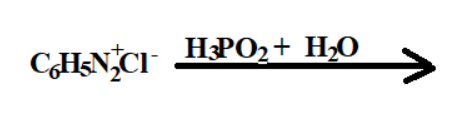
(I)
First of all let's see the IUPAC name and structure of the reactants
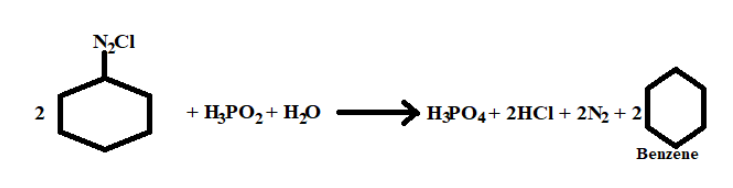
1. The first reactant is \[{C_6}{H_5}N_2^ + C{l^ - }\] it-s IUPAC name is Benzenediazonium chloride
2. The second reactant is ${H_3}P{O_2}$ and its IUPAC name is Hypo phosphorous acid
3. The third reactant is ${H_{_2}}O$ its IUPAC name is dihydrogen oxide.
Reaction :-
1. The first reactant the diazonium is a very good leaving element, its positively charged. While breaking bond with phenyl it takes away two electrons with it.
2. Now the phenyl has developed two positive charge ions and the incoming element has to be nucleophile.
3. The first incoming element that is hypophosphorous acid breaks its bond with one of the hydrogen attached with oxygen and gives one of its electrons of oxygen to the phenyl ion.
4. The water present in acidic medium breaks bond with one of its hydrogen with oxygen and gives its electron to phenyl by forming covalent bond.
5. Hence after the full reaction the final result is formation of phenol, along with formation of by products like nitrogen gas and Hcl acid.
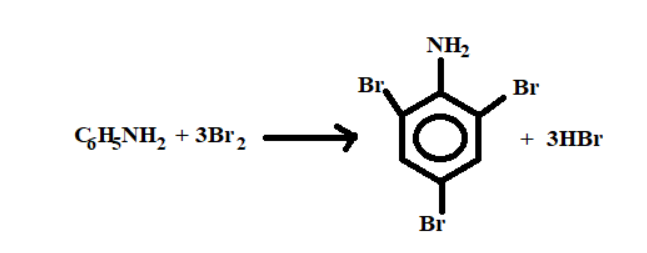
(II) Now the IUPAC name of Reactants are
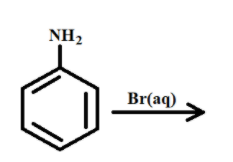
1. The first reactant is ${C_6}{H_5}N{H_2}$, its IUPAC name is Aniline
2. The second reactant is $Br_2$, its IUPAC name is Bromine.
3. The third reactant is water.
Reaction:-
1. The Aniline present in the aqueous medium breaks the hydrogen bonds and has 2 valence electrons .
2. The Bromine present in the solution forms 2 covalent bonds with the valance electrons of the phenyl.
3. The final compound formed after chemical reaction is 2,4,6-tribromoaniline and its bi-products are hydromronine.
(iii) Now the IUPAC name of Reactants are
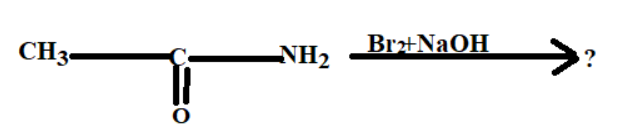
1. The first reactant is $C{H_3}CON{H_2}$, its IUPAC name is Acetamide
2. The second reactant is $Br_2$, its IUPAC name is Bromine.
3. NaOH third reactant is sodium hydroxide.
Reaction:-
1. The Acetamide present in the aqueous medium breaks the covalent bond with carbon monoxide and forms methylamine.
2. The Bromine present in the solution forms an ionic bond with the sodium atom.
3. The final compound formed after chemical reaction is 2methylamine and its bi-products are sodium bromide and sodium carbonate.

Note:
While solving the question students tend to make mistakes in bond breaking, creation, electron transfer and overall charge determination of the compound. Hence proper schematic solution to be provided with keeping in track of electron and charge transfer.
Complete step by step answer:
(I)
First of all let's see the IUPAC name and structure of the reactants
1. The first reactant is \[{C_6}{H_5}N_2^ + C{l^ - }\] it-s IUPAC name is Benzenediazonium chloride
2. The second reactant is ${H_3}P{O_2}$ and its IUPAC name is Hypo phosphorous acid
3. The third reactant is ${H_{_2}}O$ its IUPAC name is dihydrogen oxide.
Reaction :-
1. The first reactant the diazonium is a very good leaving element, its positively charged. While breaking bond with phenyl it takes away two electrons with it.
2. Now the phenyl has developed two positive charge ions and the incoming element has to be nucleophile.
3. The first incoming element that is hypophosphorous acid breaks its bond with one of the hydrogen attached with oxygen and gives one of its electrons of oxygen to the phenyl ion.
4. The water present in acidic medium breaks bond with one of its hydrogen with oxygen and gives its electron to phenyl by forming covalent bond.
5. Hence after the full reaction the final result is formation of phenol, along with formation of by products like nitrogen gas and Hcl acid.
(II) Now the IUPAC name of Reactants are
1. The first reactant is ${C_6}{H_5}N{H_2}$, its IUPAC name is Aniline
2. The second reactant is $Br_2$, its IUPAC name is Bromine.
3. The third reactant is water.
Reaction:-
1. The Aniline present in the aqueous medium breaks the hydrogen bonds and has 2 valence electrons .
2. The Bromine present in the solution forms 2 covalent bonds with the valance electrons of the phenyl.
3. The final compound formed after chemical reaction is 2,4,6-tribromoaniline and its bi-products are hydromronine.
(iii) Now the IUPAC name of Reactants are
1. The first reactant is $C{H_3}CON{H_2}$, its IUPAC name is Acetamide
2. The second reactant is $Br_2$, its IUPAC name is Bromine.
3. NaOH third reactant is sodium hydroxide.
Reaction:-
1. The Acetamide present in the aqueous medium breaks the covalent bond with carbon monoxide and forms methylamine.
2. The Bromine present in the solution forms an ionic bond with the sodium atom.
3. The final compound formed after chemical reaction is 2methylamine and its bi-products are sodium bromide and sodium carbonate.
Note:
While solving the question students tend to make mistakes in bond breaking, creation, electron transfer and overall charge determination of the compound. Hence proper schematic solution to be provided with keeping in track of electron and charge transfer.
Recently Updated Pages
Three beakers labelled as A B and C each containing 25 mL of water were taken A small amount of NaOH anhydrous CuSO4 and NaCl were added to the beakers A B and C respectively It was observed that there was an increase in the temperature of the solutions contained in beakers A and B whereas in case of beaker C the temperature of the solution falls Which one of the following statements isarecorrect i In beakers A and B exothermic process has occurred ii In beakers A and B endothermic process has occurred iii In beaker C exothermic process has occurred iv In beaker C endothermic process has occurred

Master Class 12 Social Science: Engaging Questions & Answers for Success
Master Class 12 Physics: Engaging Questions & Answers for Success
Master Class 12 Maths: Engaging Questions & Answers for Success
Master Class 12 Economics: Engaging Questions & Answers for Success
Master Class 12 Chemistry: Engaging Questions & Answers for Success
Three beakers labelled as A B and C each containing 25 mL of water were taken A small amount of NaOH anhydrous CuSO4 and NaCl were added to the beakers A B and C respectively It was observed that there was an increase in the temperature of the solutions contained in beakers A and B whereas in case of beaker C the temperature of the solution falls Which one of the following statements isarecorrect i In beakers A and B exothermic process has occurred ii In beakers A and B endothermic process has occurred iii In beaker C exothermic process has occurred iv In beaker C endothermic process has occurred
Master Class 12 Social Science: Engaging Questions & Answers for Success
Master Class 12 Physics: Engaging Questions & Answers for Success
Trending doubts
Which are the Top 10 Largest Countries of the World?
Draw a labelled sketch of the human eye class 12 physics CBSE
Differentiate between homogeneous and heterogeneous class 12 chemistry CBSE
What are the major means of transport Explain each class 12 social science CBSE
Sulphuric acid is known as the king of acids State class 12 chemistry CBSE
Why should a magnesium ribbon be cleaned before burning class 12 chemistry CBSE