




Write the expression of current in terms of time.
A. $i = {i_0}\dfrac{t}{{{t_0}}}$
B. $i = {i_0}(1 + \dfrac{t}{{{t_0}}})$
C. $i = {i_0}(\dfrac{t}{{{t_0}}} - 1)$
D. $i = {i_0}(1 - \dfrac{t}{{{t_0}}})$
Answer
 Verified
500.7k+ views
Hint: In order to solve this question we need to understand current. So electric current is defined as the number of charges flowing in unit area and in unit interval of time. Actually when a wire is subjected to potential difference then an electric field is set up in the wire which binds the electrons to move in opposite direction hence electric current moves in direction of decreasing potential or in the direction of the electric field. Straight line equation can be written in terms of slope or tangent of angle that it makes with the x-axis.
Complete step by step answer:
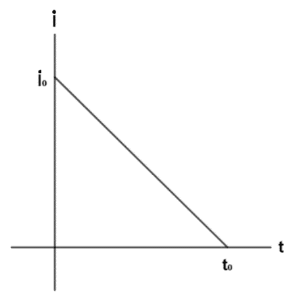
In the given figure, the curve shown is straight line having slope, “m” which is equal to, $m = \dfrac{{{y_2} - {y_1}}}{{{x_2} - {x_1}}}$ where the two points on line are $({x_1},{y_1}) = ({t_0},0)$ and $({x_2},{y_2}) = (0,{i_0})$ on putting these values we get, So slope is given as,
\[m = \dfrac{{{i_0} - 0}}{{0 - {t_0}}} = - \dfrac{{{i_0}}}{{{t_0}}}\]
Also from figure, y intercept of this straight line is, $c = {i_0}$
Since we know, standard equation of straight line having y intercept is given as, $y = mx + c$
Here, “m” is the slope of the straight line and “c” is the intercept of the straight line (the point where it intersects with the y-axis).
So putting values we get,
$y = - \dfrac{{{i_0}}}{{{t_0}}}x + {i_0}$
Since above straight line is made in “I” and “t” axis so, $y = i$ and $x = t$
So final equation is,
$i = - \dfrac{{{i_0}}}{{{t_0}}}t + {i_0}$
$\therefore i = {i_0}( - \dfrac{t}{{{t_0}}} + 1)$
The correct option is D.
Note: It should be remembered that electric current flows only due to potential difference, this fact is false rather it is not always the case, electric current can flow without the potential difference, it just requires the charge to flow from a unit area and in a unit interval of time. The slope of a line physically means how much the tangent of the angle made by the line with positive X axis in anticlockwise manner.
Complete step by step answer:
In the given figure, the curve shown is straight line having slope, “m” which is equal to, $m = \dfrac{{{y_2} - {y_1}}}{{{x_2} - {x_1}}}$ where the two points on line are $({x_1},{y_1}) = ({t_0},0)$ and $({x_2},{y_2}) = (0,{i_0})$ on putting these values we get, So slope is given as,
\[m = \dfrac{{{i_0} - 0}}{{0 - {t_0}}} = - \dfrac{{{i_0}}}{{{t_0}}}\]
Also from figure, y intercept of this straight line is, $c = {i_0}$
Since we know, standard equation of straight line having y intercept is given as, $y = mx + c$
Here, “m” is the slope of the straight line and “c” is the intercept of the straight line (the point where it intersects with the y-axis).
So putting values we get,
$y = - \dfrac{{{i_0}}}{{{t_0}}}x + {i_0}$
Since above straight line is made in “I” and “t” axis so, $y = i$ and $x = t$
So final equation is,
$i = - \dfrac{{{i_0}}}{{{t_0}}}t + {i_0}$
$\therefore i = {i_0}( - \dfrac{t}{{{t_0}}} + 1)$
The correct option is D.
Note: It should be remembered that electric current flows only due to potential difference, this fact is false rather it is not always the case, electric current can flow without the potential difference, it just requires the charge to flow from a unit area and in a unit interval of time. The slope of a line physically means how much the tangent of the angle made by the line with positive X axis in anticlockwise manner.
Recently Updated Pages
Master Class 12 Economics: Engaging Questions & Answers for Success

Master Class 12 Physics: Engaging Questions & Answers for Success
Master Class 12 English: Engaging Questions & Answers for Success
Master Class 12 Social Science: Engaging Questions & Answers for Success
Master Class 12 Maths: Engaging Questions & Answers for Success
Master Class 12 Business Studies: Engaging Questions & Answers for Success
Trending doubts
Which are the Top 10 Largest Countries of the World?
What are the major means of transport Explain each class 12 social science CBSE
Draw a labelled sketch of the human eye class 12 physics CBSE
Why cannot DNA pass through cell membranes class 12 biology CBSE
Differentiate between insitu conservation and exsitu class 12 biology CBSE
Draw a neat and well labeled diagram of TS of ovary class 12 biology CBSE