




Write the definition of electric potential. Calculate the electric potential due to a point charge Q at a distance r from it. Draw a graph between electric potential V and the distance r for a point charge Q.
Answer
 Verified
609.9k+ views
Hint:Work done is the measure of electric potential($V$) in our case.
Work done by a unit charge to move from infinity to the specific distance r due to a point charge Q at a distance r is $V = - \mathop \smallint \nolimits_ \propto ^r Edx$.
Complete step by step answer:
Definition:The amount of work done due to the movement of a unit charge from an arbitrary point to a particular point because of the electric field generated by a point charge in that specific space is called electric potential.
Let us consider a point charge Q is there in space resulting in an electric field around it.
So the work done to bring a unit charge from an arbitrary point to the specific point( distance r from the charge Q ) can be calculated.
$V = - \mathop \smallint \nolimits_ \propto ^r Edx$ (where E is the electric field, and $dx$ is displacement negative sign is because the work is done against the electric field E)
$V = - \mathop \smallint \nolimits_ \propto ^r \dfrac{Q}{{4\pi {\varepsilon _0}{x^2}}}dx$ (Since electric field due to a point charge Q at a distance x is $E = \dfrac{Q}{{4\pi {\varepsilon _0}{x^2}}}$)
$V = - \dfrac{Q}{{4\pi {\varepsilon _0}}}\mathop \smallint \nolimits_ \propto ^r \dfrac{1}{{{x^2}}}dx$
$V = - \dfrac{Q}{{4\pi {\varepsilon _0}}}\left[ {\dfrac{1}{x}} \right]_ \propto ^r$
$V = \dfrac{Q}{{4\pi {\varepsilon _0}}}\left[ {\dfrac{1}{r} - \dfrac{1}{ \propto }} \right]$ (say $\dfrac{1}{ \propto } = 0$)
$V = \dfrac{Q}{{4\pi {\varepsilon _0}r}}$
Electric potential due to a point charge Q at a distance r from it is $V = \dfrac{Q}{{4\pi {\varepsilon _0}r}}$
Now the plot between the electrical potential V and the distance r for a point charge Q is shown below
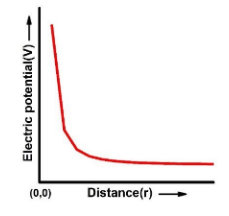
Note:Electrical potential is inversionally proportional to the squared distance from the charge and the SI unit of electric potential is volt.
Work done by a unit charge to move from infinity to the specific distance r due to a point charge Q at a distance r is $V = - \mathop \smallint \nolimits_ \propto ^r Edx$.
Complete step by step answer:
Definition:The amount of work done due to the movement of a unit charge from an arbitrary point to a particular point because of the electric field generated by a point charge in that specific space is called electric potential.
Let us consider a point charge Q is there in space resulting in an electric field around it.
So the work done to bring a unit charge from an arbitrary point to the specific point( distance r from the charge Q ) can be calculated.
$V = - \mathop \smallint \nolimits_ \propto ^r Edx$ (where E is the electric field, and $dx$ is displacement negative sign is because the work is done against the electric field E)
$V = - \mathop \smallint \nolimits_ \propto ^r \dfrac{Q}{{4\pi {\varepsilon _0}{x^2}}}dx$ (Since electric field due to a point charge Q at a distance x is $E = \dfrac{Q}{{4\pi {\varepsilon _0}{x^2}}}$)
$V = - \dfrac{Q}{{4\pi {\varepsilon _0}}}\mathop \smallint \nolimits_ \propto ^r \dfrac{1}{{{x^2}}}dx$
$V = - \dfrac{Q}{{4\pi {\varepsilon _0}}}\left[ {\dfrac{1}{x}} \right]_ \propto ^r$
$V = \dfrac{Q}{{4\pi {\varepsilon _0}}}\left[ {\dfrac{1}{r} - \dfrac{1}{ \propto }} \right]$ (say $\dfrac{1}{ \propto } = 0$)
$V = \dfrac{Q}{{4\pi {\varepsilon _0}r}}$
Electric potential due to a point charge Q at a distance r from it is $V = \dfrac{Q}{{4\pi {\varepsilon _0}r}}$
Now the plot between the electrical potential V and the distance r for a point charge Q is shown below
Note:Electrical potential is inversionally proportional to the squared distance from the charge and the SI unit of electric potential is volt.
Recently Updated Pages
Master Class 12 Business Studies: Engaging Questions & Answers for Success

Master Class 12 Biology: Engaging Questions & Answers for Success
Master Class 12 Chemistry: Engaging Questions & Answers for Success
Class 12 Question and Answer - Your Ultimate Solutions Guide
Master Class 11 Social Science: Engaging Questions & Answers for Success
Master Class 11 English: Engaging Questions & Answers for Success
Trending doubts
Which is more stable and why class 12 chemistry CBSE
Which are the Top 10 Largest Countries of the World?
Draw a labelled sketch of the human eye class 12 physics CBSE
Differentiate between homogeneous and heterogeneous class 12 chemistry CBSE
What are the major means of transport Explain each class 12 social science CBSE
Sulphuric acid is known as the king of acids State class 12 chemistry CBSE