



Write the converse of the Pythagoras Theorem and prove it.
Answer
 Verified
695.4k+ views
Hint: Let’s consider a two triangles PQR and ABC, such that $\angle Q={{90}^{\circ }}$ and AB = PQ and BC = QR then find out using Pythagoras theorem AC = PR, then use congruence to prove that $\angle B={{90}^{\circ }}$ .
Complete step-by-step answer:
The statement of the common Pythagoras theorem is that in a triangle, if the square of one side is equal to the sum of the squares of the other two sides, then the angle opposite to that side is the right angle.
Now we will prove it.
Consider a triangle ABC in which $A{{C}^{2}}=A{{B}^{2}}+B{{C}^{2}}$.
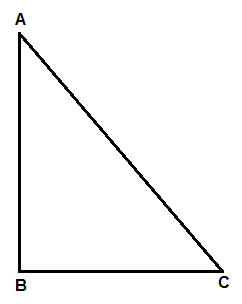
In this we have to prove that angle of B is ${{90}^{\circ }}.$
Now we will start by constructing a triangle PQR which is right angled at Q such that PQ = AB and QR = BC, as shown below:
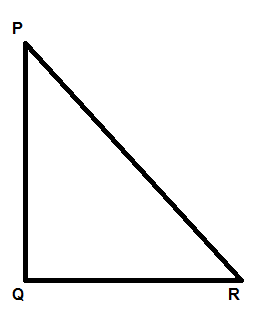
So, by using Pythagoras theorem in triangle PQR we can say that,
$P{{R}^{2}}=P{{Q}^{2}}+Q{{R}^{2}}$ as the angle Q is ${{90}^{\circ }}$ .
Now by constructing we said that PQ = AB and QR = BC then,
$P{{R}^{2}}=A{{B}^{2}}+B{{C}^{2}}$
So, we can say that $P{{R}^{2}}=A{{C}^{2}}$ as $A{{C}^{2}}=A{{B}^{2}}+A{{C}^{2}}$ was given.
Hence, PR = AC.
Now in triangle ABC and PQR we can say that,
i) AB = PQ which can be said by construction.
ii) BC = QR which can also be said by construction.
iii) AC = PR which is proved in the above section.
So, we can say that the triangle ABC and triangle PQR is congruent to each other using side-side –side congruence.
So, we can say that all sides and angles are equal by CPCT, i.e., corresponding part of concurrent triangle.
So, $\angle B=\angle Q$ as we proved that triangle ABC and triangle PQR is congruent to each other.
We know $\angle Q={{90}^{\circ }}$ by construction, therefore we can say that $\angle B={{90}^{\circ }}$.
Hence the converse of Pythagoras theorem is proved.
Note: Students generally get confused while proving congruence of two triangles. They should know the rules of congruence by heart to prove these types of questions. This is a theorem, so proving it should not be a problem after the lesson is completed. Generally students don’t construct a triangle and get confused about how to prove this.
Complete step-by-step answer:
The statement of the common Pythagoras theorem is that in a triangle, if the square of one side is equal to the sum of the squares of the other two sides, then the angle opposite to that side is the right angle.
Now we will prove it.
Consider a triangle ABC in which $A{{C}^{2}}=A{{B}^{2}}+B{{C}^{2}}$.
In this we have to prove that angle of B is ${{90}^{\circ }}.$
Now we will start by constructing a triangle PQR which is right angled at Q such that PQ = AB and QR = BC, as shown below:
So, by using Pythagoras theorem in triangle PQR we can say that,
$P{{R}^{2}}=P{{Q}^{2}}+Q{{R}^{2}}$ as the angle Q is ${{90}^{\circ }}$ .
Now by constructing we said that PQ = AB and QR = BC then,
$P{{R}^{2}}=A{{B}^{2}}+B{{C}^{2}}$
So, we can say that $P{{R}^{2}}=A{{C}^{2}}$ as $A{{C}^{2}}=A{{B}^{2}}+A{{C}^{2}}$ was given.
Hence, PR = AC.
Now in triangle ABC and PQR we can say that,
i) AB = PQ which can be said by construction.
ii) BC = QR which can also be said by construction.
iii) AC = PR which is proved in the above section.
So, we can say that the triangle ABC and triangle PQR is congruent to each other using side-side –side congruence.
So, we can say that all sides and angles are equal by CPCT, i.e., corresponding part of concurrent triangle.
So, $\angle B=\angle Q$ as we proved that triangle ABC and triangle PQR is congruent to each other.
We know $\angle Q={{90}^{\circ }}$ by construction, therefore we can say that $\angle B={{90}^{\circ }}$.
Hence the converse of Pythagoras theorem is proved.
Note: Students generally get confused while proving congruence of two triangles. They should know the rules of congruence by heart to prove these types of questions. This is a theorem, so proving it should not be a problem after the lesson is completed. Generally students don’t construct a triangle and get confused about how to prove this.

Recently Updated Pages
Master Class 10 Computer Science: Engaging Questions & Answers for Success

Master Class 12 Physics: Engaging Questions & Answers for Success
Master Class 12 Social Science: Engaging Questions & Answers for Success
Master Class 12 English: Engaging Questions & Answers for Success
Master Class 12 Maths: Engaging Questions & Answers for Success
Master Class 12 Business Studies: Engaging Questions & Answers for Success
Trending doubts
100 million is equal to begingathered A 1 crore B -class-7-maths-CBSE
List of coprime numbers from 1 to 100 class 7 maths CBSE
Full Form of IASDMIPSIFSIRSPOLICE class 7 social science CBSE
The plural of Chief is Chieves A True B False class 7 english CBSE
What is the use of kink in a clinical thermometer class 7 physics CBSE
What is BLO What is the full form of BLO class 8 social science CBSE