




Write any two uses of pedigree study in human genetics.
Answer
 Verified
615.9k+ views
Hint: Pedigree study is a hierarchical model to represent the flow of a particular trait down a family tree. It is made up of several symbols and lines representing genetic relationships.
Complete answer:
The two uses of pedigree study in human genetics are:
- It is a visual tool for documenting the biological relationship in families and determining the mode of inheritance of genetic diseases.
- These are often constructed by medical geneticists and practitioners to identify the persons who are the carriers of a particular disease and those that are affected. It also helps them to predict the affected individuals of progeny.
Some expected patterns of inheritance that can be observed in the pedigree are:
- Autosomal recessive inheritance: Such type of traits often skips generations with an equal number of males and females affected. All the children will be affected when both the parents are diseased.
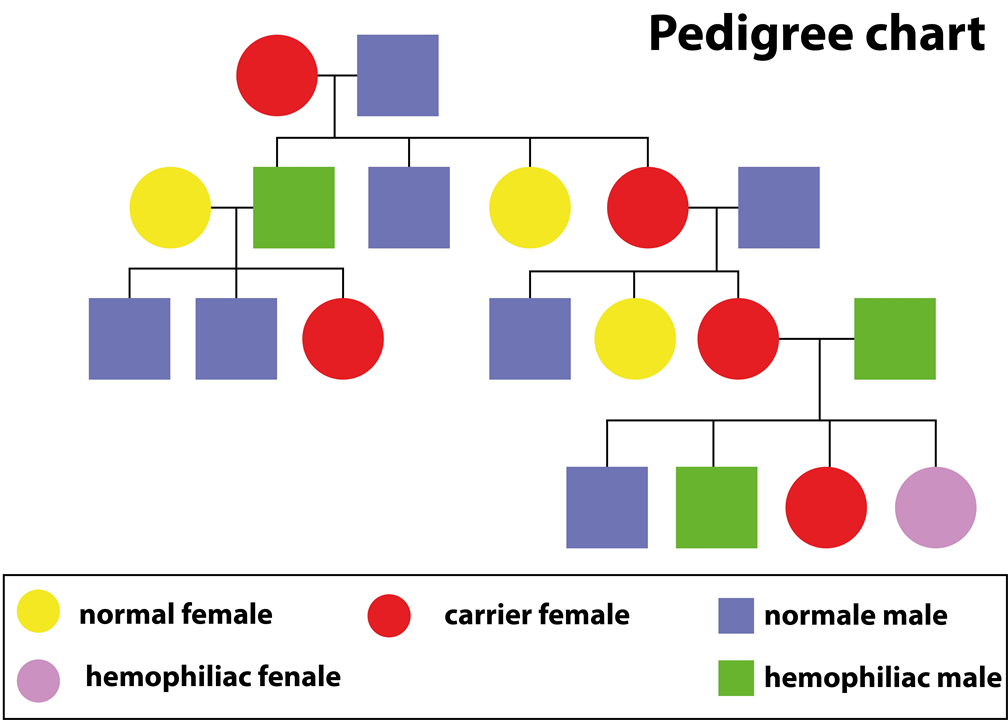
- Autosomal dominant inheritance: In such inheritance, the traits do not skip generations. The distribution of the trait among both the sexes are almost equal. Also, when an affected person mates with an unaffected individual, half of its offspring will be affected too.
- Sex-linked recessive inheritance: The affected individuals are mostly male with no skipping in generations by the trait concerned. The affected males come only from an affected mother while an affected female can come from both an affected mother or father. Also, an affected father results in all of his daughters being affected but neither of his sons.
Note: Some symbols used in the pedigree are:
- Squares represent males while circles represent females. A horizontal line between these two symbols stands for their marriage.
- Vertical lines extending downwards represent their children. Thus, the newer generation can be found at the bottom of a pedigree while the older generations are found at the top of a generation.
- A fully shaded symbol denotes an affected individual while an unshaded symbol means a healthy individual. A partly shaded symbol denotes the carrier of a trait.
Complete answer:
The two uses of pedigree study in human genetics are:
- It is a visual tool for documenting the biological relationship in families and determining the mode of inheritance of genetic diseases.
- These are often constructed by medical geneticists and practitioners to identify the persons who are the carriers of a particular disease and those that are affected. It also helps them to predict the affected individuals of progeny.
Some expected patterns of inheritance that can be observed in the pedigree are:
- Autosomal recessive inheritance: Such type of traits often skips generations with an equal number of males and females affected. All the children will be affected when both the parents are diseased.
- Autosomal dominant inheritance: In such inheritance, the traits do not skip generations. The distribution of the trait among both the sexes are almost equal. Also, when an affected person mates with an unaffected individual, half of its offspring will be affected too.
- Sex-linked recessive inheritance: The affected individuals are mostly male with no skipping in generations by the trait concerned. The affected males come only from an affected mother while an affected female can come from both an affected mother or father. Also, an affected father results in all of his daughters being affected but neither of his sons.
Note: Some symbols used in the pedigree are:
- Squares represent males while circles represent females. A horizontal line between these two symbols stands for their marriage.
- Vertical lines extending downwards represent their children. Thus, the newer generation can be found at the bottom of a pedigree while the older generations are found at the top of a generation.
- A fully shaded symbol denotes an affected individual while an unshaded symbol means a healthy individual. A partly shaded symbol denotes the carrier of a trait.
Recently Updated Pages
Master Class 12 Economics: Engaging Questions & Answers for Success

Master Class 12 English: Engaging Questions & Answers for Success
Master Class 12 Social Science: Engaging Questions & Answers for Success
Master Class 12 Maths: Engaging Questions & Answers for Success
Master Class 12 Physics: Engaging Questions & Answers for Success
Master Class 9 General Knowledge: Engaging Questions & Answers for Success
Trending doubts
Which are the Top 10 Largest Countries of the World?
Draw a labelled sketch of the human eye class 12 physics CBSE
Differentiate between homogeneous and heterogeneous class 12 chemistry CBSE
Sulphuric acid is known as the king of acids State class 12 chemistry CBSE
Why is the cell called the structural and functional class 12 biology CBSE
Draw ray diagrams each showing i myopic eye and ii class 12 physics CBSE