




Write a short note on the ribosome?
Answer
 Verified
626.7k+ views
Hint: Ribosome is the granular structure first observed under the electron microscope as dense particles by George Palade (1953). They are composed of ribonucleic acid (RNA) and proteins and are not surrounded by any membrane.
Complete answer: Location: Ribosomes are found in all kinds of cells prokaryotic as well as eukaryotic. In prokaryotic cells, they float freely in the cytoplasm.
In a eukaryotic cell, they occur free in the cytoplasmic matrix and also attached to the outer surface of the rough endoplasmic reticulum and nuclear envelope. The ribosome is actively synthesizing cells, such as liver cells, pancreatic cells endocrine cells, lymphocytes, and meristematic cells. The ribosomes are also found in the matrix of mitochondria and the stroma of plastids in the eukaryotic cells.
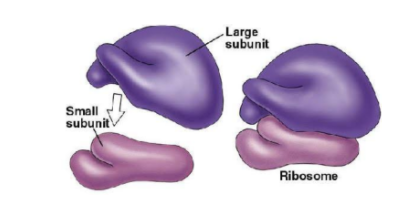
Types of the ribosome: The eukaryotic ribosome is the 80S while the prokaryotic ribosome is 70S. Here s stands for the sedimentation coefficient it is indirectly a measure of density and size.
Both 70S and 50S are composed of two subunits.
Chemical composition: A ribosome consists of a highly folded rRNA molecule and many attached proteins and Mg2+ ions.
Functions of ribosomes: Ribosome provides space for the synthesis of proteins in the cell.
Hence are called protein factories of the cell. Ribosome furnishes enzymes and factors needed for the formation of polypeptides. Ribosome also provides sites for the attachment of tRNA and mRNA which participate in protein synthesis. Forms the site for the synthesis of the polypeptide.
Note: Escherichia coli cell may have 20,000 to 30,000 ribosomes and a eukaryotic cell may contain up to half a million ribosomes.
Complete answer: Location: Ribosomes are found in all kinds of cells prokaryotic as well as eukaryotic. In prokaryotic cells, they float freely in the cytoplasm.
In a eukaryotic cell, they occur free in the cytoplasmic matrix and also attached to the outer surface of the rough endoplasmic reticulum and nuclear envelope. The ribosome is actively synthesizing cells, such as liver cells, pancreatic cells endocrine cells, lymphocytes, and meristematic cells. The ribosomes are also found in the matrix of mitochondria and the stroma of plastids in the eukaryotic cells.
Types of the ribosome: The eukaryotic ribosome is the 80S while the prokaryotic ribosome is 70S. Here s stands for the sedimentation coefficient it is indirectly a measure of density and size.
Both 70S and 50S are composed of two subunits.
Chemical composition: A ribosome consists of a highly folded rRNA molecule and many attached proteins and Mg2+ ions.
Functions of ribosomes: Ribosome provides space for the synthesis of proteins in the cell.
Hence are called protein factories of the cell. Ribosome furnishes enzymes and factors needed for the formation of polypeptides. Ribosome also provides sites for the attachment of tRNA and mRNA which participate in protein synthesis. Forms the site for the synthesis of the polypeptide.
Note: Escherichia coli cell may have 20,000 to 30,000 ribosomes and a eukaryotic cell may contain up to half a million ribosomes.
Recently Updated Pages
Master Class 11 English: Engaging Questions & Answers for Success

Master Class 11 Social Science: Engaging Questions & Answers for Success
Master Class 11 Maths: Engaging Questions & Answers for Success
Master Class 11 Biology: Engaging Questions & Answers for Success
Master Class 11 Physics: Engaging Questions & Answers for Success
Master Class 11 Chemistry: Engaging Questions & Answers for Success
Trending doubts
Difference Between Plant Cell and Animal Cell
Fill the blanks with the suitable prepositions 1 The class 9 english CBSE
What is pollution? How many types of pollution? Define it
Name 10 Living and Non living things class 9 biology CBSE
What is the full form of pH?
On an outline map of India show its neighbouring c class 9 social science CBSE