




Write a short note on the Perkin reaction.
Answer
 Verified
624k+ views
Hint: Organic reactions are the reactions involving organic compounds. Organic compounds are formed from carbon and its derivatives. Perkin reaction is also an example of organic reaction.
Complete step by step answer:
Perkin reaction is an organic reaction which is used to make cinnamic acids. It gives $\alpha ,\beta - $ unsaturated aromatic acid by the aldol condensation of an aromatic aldehyde and acid anhydride. This reaction occurs in the presence of alkali, which acts as a base catalyst in the reaction. So basically this is an aldol reaction.
Reaction:

The mechanism of reaction:
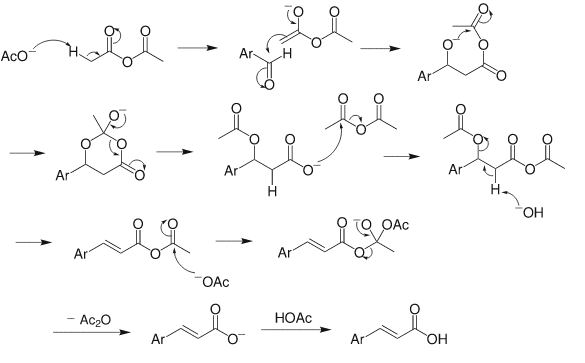
The mechanism of this reaction is long. It starts from the attacking of base on anhydride resulting in carbanion. Now this anion attacks on the carbon of aldehyde. This produces an intermediate and finally it produces unsaturated anhydride with the elimination of hydroxyl groups. Now the product is hydrolyzed and we finally get $\alpha ,\beta - $ unsaturated acid.
Note:
The mechanism of this Perkin’s reaction is not universally accepted due to some variations in mechanism of the reaction. It includes reactions between Aromatic aldehydes, aliphatic acid anhydride and the alkali salt.
Complete step by step answer:
Perkin reaction is an organic reaction which is used to make cinnamic acids. It gives $\alpha ,\beta - $ unsaturated aromatic acid by the aldol condensation of an aromatic aldehyde and acid anhydride. This reaction occurs in the presence of alkali, which acts as a base catalyst in the reaction. So basically this is an aldol reaction.
Reaction:
The mechanism of reaction:
The mechanism of this reaction is long. It starts from the attacking of base on anhydride resulting in carbanion. Now this anion attacks on the carbon of aldehyde. This produces an intermediate and finally it produces unsaturated anhydride with the elimination of hydroxyl groups. Now the product is hydrolyzed and we finally get $\alpha ,\beta - $ unsaturated acid.
Note:
The mechanism of this Perkin’s reaction is not universally accepted due to some variations in mechanism of the reaction. It includes reactions between Aromatic aldehydes, aliphatic acid anhydride and the alkali salt.
Recently Updated Pages
Master Class 12 Economics: Engaging Questions & Answers for Success

Master Class 12 English: Engaging Questions & Answers for Success
Master Class 12 Social Science: Engaging Questions & Answers for Success
Master Class 12 Maths: Engaging Questions & Answers for Success
Master Class 12 Physics: Engaging Questions & Answers for Success
Master Class 12 Business Studies: Engaging Questions & Answers for Success
Trending doubts
Which are the Top 10 Largest Countries of the World?
Draw a labelled sketch of the human eye class 12 physics CBSE
Differentiate between homogeneous and heterogeneous class 12 chemistry CBSE
Why is the cell called the structural and functional class 12 biology CBSE
Draw ray diagrams each showing i myopic eye and ii class 12 physics CBSE
Which is the correct genotypic ratio of mendel dihybrid class 12 biology CBSE