




Write a short note in the simple harmonic of the pendulum.
Answer
 Verified
542.7k+ views
Hint: The force is acting on the mass. Split the force due to gravity into two perpendicular components Equate the restoring force of the mass to the $x$ component of the force and the acceleration is directly proportional to the displacement of the mass from the mean position.
Formula used:
\[T = mg{\text{ }}cos\left( c \right)\]
\[F{\text{ }} = {\text{ }} - mg{\text{ }}sin\left( c \right)\]
$F = ma$
Complete step-by-step solution:
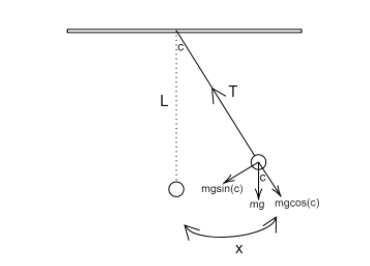
Let us consider a simple pendulum with a mass, $m$ swinging by a massless string. Let the string be displaced by a small angle $c$. Let the length of the simple pendulum be $L$. Let $T$ be the tension on the string. Let us consider the case where the angle made by the string to the normal is $c$. Force due to gravity can be split into two perpendicular components: ${G_x}$ and ${G_y}$ where,
\[\begin{array}{*{20}{l}}
{{G_x}{\text{ }} = mgsin\left( c \right)} \\
{{G_y} = mg{\text{ }}cos\left( c \right)}
\end{array}\]
The tension on the string is balanced by the $y$
component of force due to gravity. So,
\[T = mg{\text{ }}cos\left( c \right)\]
And$x$ a component of force due to gravity acts as the restoring force. So,
\[F{\text{ }} = {\text{ }} - mg{\text{ }}sin\left( c \right)\]
Since the angle made is very small, we can do an approximation as follows.
\[sin\left( c \right) \approx c\]
The angle can be written as arc length divided by the radius of a circle. Using this relation in the given diagram, we get
$c = \dfrac{l}{x}$
Therefore, substituting this value of angle into the equation of restoring force, we get
\[F = - mg\dfrac{1}{x}\]
According to Newton's second law,
$F = ma$
Equating the above equations for the force, we get
$ma = - mg\dfrac{x}{l}$
Canceling the common term of mass on both sides, we get an equation for acceleration as follows,
$a = - \dfrac{g}{l}x$
$ \Rightarrow a\alpha - x$
And this is precisely the condition for a simple harmonic oscillator; that is, acceleration is directly proportional to the displacement from the mean position. Thus, the oscillation of a simple pendulum is an example of a simple harmonic oscillator
Note: We have made two approximations in the above proof. We have assumed the string to be massless and we have assumed the angle displaced to be very small for our convenience. It doesn't necessarily work for other cases.
Formula used:
\[T = mg{\text{ }}cos\left( c \right)\]
\[F{\text{ }} = {\text{ }} - mg{\text{ }}sin\left( c \right)\]
$F = ma$
Complete step-by-step solution:
Let us consider a simple pendulum with a mass, $m$ swinging by a massless string. Let the string be displaced by a small angle $c$. Let the length of the simple pendulum be $L$. Let $T$ be the tension on the string. Let us consider the case where the angle made by the string to the normal is $c$. Force due to gravity can be split into two perpendicular components: ${G_x}$ and ${G_y}$ where,
\[\begin{array}{*{20}{l}}
{{G_x}{\text{ }} = mgsin\left( c \right)} \\
{{G_y} = mg{\text{ }}cos\left( c \right)}
\end{array}\]
The tension on the string is balanced by the $y$
component of force due to gravity. So,
\[T = mg{\text{ }}cos\left( c \right)\]
And$x$ a component of force due to gravity acts as the restoring force. So,
\[F{\text{ }} = {\text{ }} - mg{\text{ }}sin\left( c \right)\]
Since the angle made is very small, we can do an approximation as follows.
\[sin\left( c \right) \approx c\]
The angle can be written as arc length divided by the radius of a circle. Using this relation in the given diagram, we get
$c = \dfrac{l}{x}$
Therefore, substituting this value of angle into the equation of restoring force, we get
\[F = - mg\dfrac{1}{x}\]
According to Newton's second law,
$F = ma$
Equating the above equations for the force, we get
$ma = - mg\dfrac{x}{l}$
Canceling the common term of mass on both sides, we get an equation for acceleration as follows,
$a = - \dfrac{g}{l}x$
$ \Rightarrow a\alpha - x$
And this is precisely the condition for a simple harmonic oscillator; that is, acceleration is directly proportional to the displacement from the mean position. Thus, the oscillation of a simple pendulum is an example of a simple harmonic oscillator
Note: We have made two approximations in the above proof. We have assumed the string to be massless and we have assumed the angle displaced to be very small for our convenience. It doesn't necessarily work for other cases.
Recently Updated Pages
Three beakers labelled as A B and C each containing 25 mL of water were taken A small amount of NaOH anhydrous CuSO4 and NaCl were added to the beakers A B and C respectively It was observed that there was an increase in the temperature of the solutions contained in beakers A and B whereas in case of beaker C the temperature of the solution falls Which one of the following statements isarecorrect i In beakers A and B exothermic process has occurred ii In beakers A and B endothermic process has occurred iii In beaker C exothermic process has occurred iv In beaker C endothermic process has occurred

Master Class 11 Social Science: Engaging Questions & Answers for Success
Master Class 11 Physics: Engaging Questions & Answers for Success
Master Class 11 Maths: Engaging Questions & Answers for Success
Master Class 11 Economics: Engaging Questions & Answers for Success
Master Class 11 Computer Science: Engaging Questions & Answers for Success
Three beakers labelled as A B and C each containing 25 mL of water were taken A small amount of NaOH anhydrous CuSO4 and NaCl were added to the beakers A B and C respectively It was observed that there was an increase in the temperature of the solutions contained in beakers A and B whereas in case of beaker C the temperature of the solution falls Which one of the following statements isarecorrect i In beakers A and B exothermic process has occurred ii In beakers A and B endothermic process has occurred iii In beaker C exothermic process has occurred iv In beaker C endothermic process has occurred
Master Class 11 Social Science: Engaging Questions & Answers for Success
Master Class 11 Physics: Engaging Questions & Answers for Success
Trending doubts
One Metric ton is equal to kg A 10000 B 1000 C 100 class 11 physics CBSE
There are 720 permutations of the digits 1 2 3 4 5 class 11 maths CBSE
State and prove Bernoullis theorem class 11 physics CBSE
Draw a diagram of a plant cell and label at least eight class 11 biology CBSE
Difference Between Prokaryotic Cells and Eukaryotic Cells
1 Quintal is equal to a 110 kg b 10 kg c 100kg d 1000 class 11 physics CBSE