




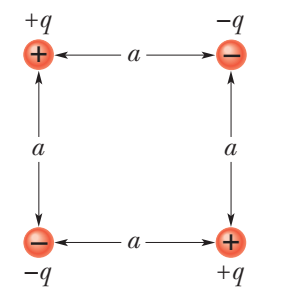
How much work is required to set up the arrangement of the belowfigure if q = 2.30 pC, a = 64.0 cm, and the particles are initially infinitely far apart and at rest?
Answer
 Verified
606.9k+ views
Hint: The work done in bringing charge from an infinity to a certain point needs a maximum amount of potential energy. The work depends on the force between the two charges and the distance between them. This will help you in answering this question.
Complete answer:
In the following diagram, the charges are labelled:
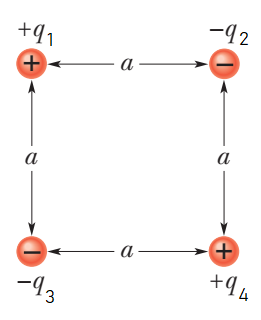
The distance between the charges ${{q}_{1}}$and ${{q}_{4}}$is $\sqrt{2}a$. Similarly, the distance between the charges ${{q}_{3}}$and ${{q}_{2}}$is $\sqrt{2}a$.
Thus the work done is the potential energy between the charges.
${{U}_{1}}$ is the potential energy between the charges ${{q}_{1}}$and ${{q}_{2}}$.
${{U}_{2}}$ is the potential energy between the charges ${{q}_{1}}$and ${{q}_{3}}$.
${{U}_{3}}$ is the potential energy between the charges ${{q}_{4}}$and ${{q}_{2}}$.
${{U}_{4}}$ is the potential energy between the charges ${{q}_{3}}$and ${{q}_{4}}$.
${{U}_{5}}$ is the potential energy between the charges ${{q}_{1}}$and ${{q}_{4}}$.
${{U}_{6}}$ is the potential energy between the charges ${{q}_{3}}$and ${{q}_{2}}$.
Here, ${{q}_{1}}={{q}_{2}}={{q}_{3}}={{q}_{4}}={{q}_{5}}={{q}_{6}}=q$
Thus, the total work done is,
$W={{U}_{1}}+{{U}_{2}}+{{U}_{3}}+{{U}_{4}}+{{U}_{5}}+{{U}_{6}}........(i)$
${{U}_{1}}={{U}_{2}}={{U}_{3}}={{U}_{4}}=\dfrac{-k{{q}^{2}}}{a}..........(ii)$
Where $k=\dfrac{1}{4\pi {{\varepsilon }_{0}}}$
${{U}_{5}}={{U}_{6}}=\dfrac{k{{q}^{2}}}{a\sqrt{2}}...........(iii)$
From (i), (ii) and (iii), we get,
$\begin{align}
& W=\dfrac{-k{{q}^{2}}}{a}+\dfrac{-k{{q}^{2}}}{a}+\dfrac{-k{{q}^{2}}}{a}+\dfrac{-k{{q}^{2}}}{a}+\dfrac{k{{q}^{2}}}{a\sqrt{2}}+\dfrac{k{{q}^{2}}}{a\sqrt{2}} \\
& W=\dfrac{-4k{{q}^{2}}}{a}+\dfrac{2k{{q}^{2}}}{a\sqrt{2}} \\
& W=\dfrac{-4k{{q}^{2}}}{a}+\dfrac{\sqrt{2}k{{q}^{2}}}{a} \\
& W=\dfrac{k{{q}^{2}}(\sqrt{2}-4)}{a} \\
\end{align}$
By substituting the value, we get,
$\begin{align}
& W=\dfrac{1}{4\pi {{\varepsilon }_{0}}}\times {{(2.30\times {{10}^{-12}})}^{2}}\times \dfrac{1}{64\times {{10}^{-2}}}\times (\sqrt{2}-4) \\
& W=-1.92\times {{10}^{-13}}J \\
\end{align}$
The work done to set up the experiment will be $-1.92\times {{10}^{-13}}J.$
Note:
The potential energy depends on the sign of the charge too. Though the value of the work done is negative which is absurd since it is a scalar quantity. The work done comes out to be negative because it is against the electrostatic force.
Complete answer:
In the following diagram, the charges are labelled:
The distance between the charges ${{q}_{1}}$and ${{q}_{4}}$is $\sqrt{2}a$. Similarly, the distance between the charges ${{q}_{3}}$and ${{q}_{2}}$is $\sqrt{2}a$.
Thus the work done is the potential energy between the charges.
${{U}_{1}}$ is the potential energy between the charges ${{q}_{1}}$and ${{q}_{2}}$.
${{U}_{2}}$ is the potential energy between the charges ${{q}_{1}}$and ${{q}_{3}}$.
${{U}_{3}}$ is the potential energy between the charges ${{q}_{4}}$and ${{q}_{2}}$.
${{U}_{4}}$ is the potential energy between the charges ${{q}_{3}}$and ${{q}_{4}}$.
${{U}_{5}}$ is the potential energy between the charges ${{q}_{1}}$and ${{q}_{4}}$.
${{U}_{6}}$ is the potential energy between the charges ${{q}_{3}}$and ${{q}_{2}}$.
Here, ${{q}_{1}}={{q}_{2}}={{q}_{3}}={{q}_{4}}={{q}_{5}}={{q}_{6}}=q$
Thus, the total work done is,
$W={{U}_{1}}+{{U}_{2}}+{{U}_{3}}+{{U}_{4}}+{{U}_{5}}+{{U}_{6}}........(i)$
${{U}_{1}}={{U}_{2}}={{U}_{3}}={{U}_{4}}=\dfrac{-k{{q}^{2}}}{a}..........(ii)$
Where $k=\dfrac{1}{4\pi {{\varepsilon }_{0}}}$
${{U}_{5}}={{U}_{6}}=\dfrac{k{{q}^{2}}}{a\sqrt{2}}...........(iii)$
From (i), (ii) and (iii), we get,
$\begin{align}
& W=\dfrac{-k{{q}^{2}}}{a}+\dfrac{-k{{q}^{2}}}{a}+\dfrac{-k{{q}^{2}}}{a}+\dfrac{-k{{q}^{2}}}{a}+\dfrac{k{{q}^{2}}}{a\sqrt{2}}+\dfrac{k{{q}^{2}}}{a\sqrt{2}} \\
& W=\dfrac{-4k{{q}^{2}}}{a}+\dfrac{2k{{q}^{2}}}{a\sqrt{2}} \\
& W=\dfrac{-4k{{q}^{2}}}{a}+\dfrac{\sqrt{2}k{{q}^{2}}}{a} \\
& W=\dfrac{k{{q}^{2}}(\sqrt{2}-4)}{a} \\
\end{align}$
By substituting the value, we get,
$\begin{align}
& W=\dfrac{1}{4\pi {{\varepsilon }_{0}}}\times {{(2.30\times {{10}^{-12}})}^{2}}\times \dfrac{1}{64\times {{10}^{-2}}}\times (\sqrt{2}-4) \\
& W=-1.92\times {{10}^{-13}}J \\
\end{align}$
The work done to set up the experiment will be $-1.92\times {{10}^{-13}}J.$
Note:
The potential energy depends on the sign of the charge too. Though the value of the work done is negative which is absurd since it is a scalar quantity. The work done comes out to be negative because it is against the electrostatic force.
Recently Updated Pages
Basicity of sulphurous acid and sulphuric acid are

Master Class 12 Economics: Engaging Questions & Answers for Success
Master Class 12 Biology: Engaging Questions & Answers for Success
Master Class 11 English: Engaging Questions & Answers for Success
Master Class 11 Physics: Engaging Questions & Answers for Success
Master Class 11 Computer Science: Engaging Questions & Answers for Success
Trending doubts
Which are the Top 10 Largest Countries of the World?
Differentiate between homogeneous and heterogeneous class 12 chemistry CBSE
Give 10 examples of unisexual and bisexual flowers
Draw the diagram of the chloroplast class 12 biology CBSE
Lipids are insoluble in water because they are A Neutral class 12 biology CBSE
Decomposer also called as ATransducers BReducers CMicroconsumer class 12 biology CBSE