




Why is bithionol added to soap?
Answer
 Verified
660.3k+ views
HINT: Bithionol is an aromatic compound. It contains two aromatic rings bonded with a sulphur atom in between along with other groups like hydroxyl and chlorine. It is used in medicated soaps and it also reduces the consequence of bacterial decomposition on skin.
COMPLETE STEP BY STEP SOLUTION: We know that soap is a mixture of sodium or potassium salts of various naturally occurring fatty acids. It is used in a variety of cleansing and lubricating products. Soap is created by mixing of fats and oils with a base whereas a detergent is made by combining chemical compounds in a mixer.
When we use soap for cleaning, it solubilizes the dirt particle which then can be separated and hence leaves the substance clean.
When we use soap as a surfactant in hand washing, it lathers with a little water and kills microorganisms by destroying their membrane lipid bilayer and denaturing their proteins.
It also emulsifies oils and hence enables them to be carried away under running water.
Now let us discuss why bithionol is added in soaps.
Bithionol acts as an antibacterial, anthelmintic and algaecide. It has two aromatic rings with a sulphur atom bonded between them and to the phenyl ring multiple chlorine and hydroxyl groups are attached. These functional groups are capable of polar as well as hydrophobic and ionic interactions.
We can draw its structure as-
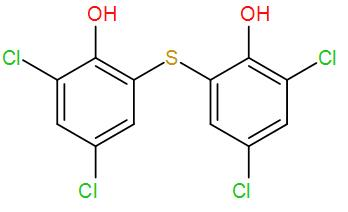
Bithionol is an aromatic compound and it is added to soaps as a disinfectant. It also reduces the odour which is produced by the bacterial decomposition of organic matter present on our skin. This is the required answer.
NOTE: Bithionol was formerly added in soaps as antiseptic and also in cosmetics but the US FDA banned it due to its photosensitizing effects. Photosensitivity is the amount to which an object reacts upon receiving photons like from visible light. Bithionol was found to cause photocontact sensitization.
COMPLETE STEP BY STEP SOLUTION: We know that soap is a mixture of sodium or potassium salts of various naturally occurring fatty acids. It is used in a variety of cleansing and lubricating products. Soap is created by mixing of fats and oils with a base whereas a detergent is made by combining chemical compounds in a mixer.
When we use soap for cleaning, it solubilizes the dirt particle which then can be separated and hence leaves the substance clean.
When we use soap as a surfactant in hand washing, it lathers with a little water and kills microorganisms by destroying their membrane lipid bilayer and denaturing their proteins.
It also emulsifies oils and hence enables them to be carried away under running water.
Now let us discuss why bithionol is added in soaps.
Bithionol acts as an antibacterial, anthelmintic and algaecide. It has two aromatic rings with a sulphur atom bonded between them and to the phenyl ring multiple chlorine and hydroxyl groups are attached. These functional groups are capable of polar as well as hydrophobic and ionic interactions.
We can draw its structure as-
Bithionol is an aromatic compound and it is added to soaps as a disinfectant. It also reduces the odour which is produced by the bacterial decomposition of organic matter present on our skin. This is the required answer.
NOTE: Bithionol was formerly added in soaps as antiseptic and also in cosmetics but the US FDA banned it due to its photosensitizing effects. Photosensitivity is the amount to which an object reacts upon receiving photons like from visible light. Bithionol was found to cause photocontact sensitization.
Recently Updated Pages
Master Class 12 Physics: Engaging Questions & Answers for Success

Master Class 12 Social Science: Engaging Questions & Answers for Success
Master Class 12 English: Engaging Questions & Answers for Success
Master Class 12 Maths: Engaging Questions & Answers for Success
Master Class 12 Business Studies: Engaging Questions & Answers for Success
Master Class 12 Chemistry: Engaging Questions & Answers for Success
Trending doubts
Draw a labelled sketch of the human eye class 12 physics CBSE
Which are the Top 10 Largest Countries of the World?
Draw ray diagrams each showing i myopic eye and ii class 12 physics CBSE
One megawatt is equal to how many units of electri class 12 physics CBSE
Which is the correct genotypic ratio of mendel dihybrid class 12 biology CBSE
Give 10 examples of unisexual and bisexual flowers