




Which vertebra has the odontoid process?
(a) 7th vertebra of Frog
(b) Second vertebra of Frog
(c) Second cervical vertebra of mammal
(d) Second thoracic vertebra of mammal
Answer
 Verified
603.6k+ views
Hint: It is called axis and allows rotation of c-spine. Atlas sits directly on top of the axis. It also accounts for half of all rotation occurring on the neck and has a vertical process called dens.
Complete Step by Step Answer:
- The C1 vertebra is also known as the atlas, it sits at the base of the skull and forms the atlanto occipital joint, and the next vertebra C2 is also known as the axis, it forms the atlantoaxial joint.
- Mammals like humans the second cervical vertebra C2 of the spine, by the atlantoaxial joint forms a pivot upon which the first cervical vertebra (the Atlas) carries the rotation of the head.
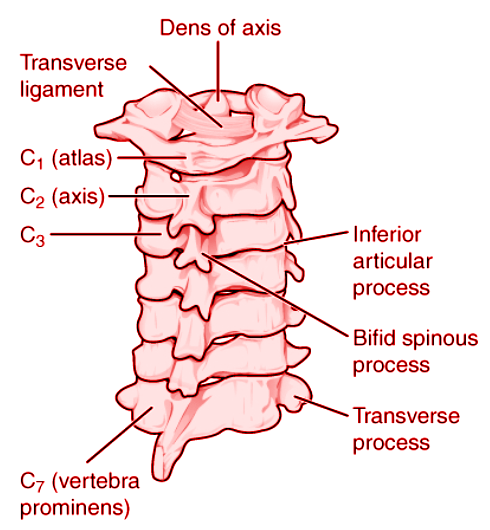
The most important characteristic of this bone (C2) is a strong odontoid process known as a den which rises from the upper surface of the body.
The Odontoid process is a projection of the axis, a second cervical vertebra, and joins the main body of the vertebra.
So, the correct answer is, ”Second cervical vertebra of mammal”.
Additional information:
- Cervical vertebra C1 and C2, located at the base of the skull and forms the top of the spine (neck).
- Due to its close proximity to the spinal cord and brain, life- threatening fractures can occur when a huge force acts on its anatomical structure.
- These vertebrae are uniquely shaped and have vertebral foramen (spaces within the bone) which allows the vertebral arteries to reach through to the brain and supply it with blood.
- Hence it is clear that the second cervical vertebra of mammal has the odontoid process.
Note: For the movement of the head and neck, first, three cervical vertebrae are very important. The sensation for the upper part of the head is controlled by the C2. Whereas, the front and back parts of the head are controlled by the C3.
Complete Step by Step Answer:
- The C1 vertebra is also known as the atlas, it sits at the base of the skull and forms the atlanto occipital joint, and the next vertebra C2 is also known as the axis, it forms the atlantoaxial joint.
- Mammals like humans the second cervical vertebra C2 of the spine, by the atlantoaxial joint forms a pivot upon which the first cervical vertebra (the Atlas) carries the rotation of the head.
The most important characteristic of this bone (C2) is a strong odontoid process known as a den which rises from the upper surface of the body.
The Odontoid process is a projection of the axis, a second cervical vertebra, and joins the main body of the vertebra.
So, the correct answer is, ”Second cervical vertebra of mammal”.
Additional information:
- Cervical vertebra C1 and C2, located at the base of the skull and forms the top of the spine (neck).
- Due to its close proximity to the spinal cord and brain, life- threatening fractures can occur when a huge force acts on its anatomical structure.
- These vertebrae are uniquely shaped and have vertebral foramen (spaces within the bone) which allows the vertebral arteries to reach through to the brain and supply it with blood.
- Hence it is clear that the second cervical vertebra of mammal has the odontoid process.
Note: For the movement of the head and neck, first, three cervical vertebrae are very important. The sensation for the upper part of the head is controlled by the C2. Whereas, the front and back parts of the head are controlled by the C3.
Recently Updated Pages
Master Class 11 English: Engaging Questions & Answers for Success

Master Class 11 Maths: Engaging Questions & Answers for Success
Class 11 Question and Answer - Your Ultimate Solutions Guide
Master Class 11 Biology: Engaging Questions & Answers for Success
Master Class 11 Physics: Engaging Questions & Answers for Success
Master Class 11 Accountancy: Engaging Questions & Answers for Success
Trending doubts
Differentiate between an exothermic and an endothermic class 11 chemistry CBSE
One Metric ton is equal to kg A 10000 B 1000 C 100 class 11 physics CBSE
Difference Between Prokaryotic Cells and Eukaryotic Cells
There are 720 permutations of the digits 1 2 3 4 5 class 11 maths CBSE
Draw a diagram of a plant cell and label at least eight class 11 biology CBSE
1 Quintal is equal to a 110 kg b 10 kg c 100kg d 1000 class 11 physics CBSE