




Which type of reproduction is found in Hydra?
A. Polyembryony
B. Sexual and Asexual both
C. Parthenogenesis
D. None of the above
Answer
 Verified
604.8k+ views
Hint: Hydra is a fresh water living organism which usually divides with the asexual mode of replication that is, budding. During unfavorable conditions, Hydra chooses a different mode of reproduction, i.e. Sexual mode of reproduction. It depends on the conditions of the environment, whether the reproduction will take place with the help of sexual or asexual mode.
Complete answer:
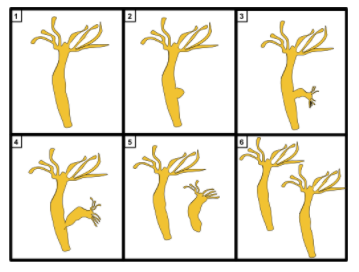
Hydra is an organism of fresh-water. They are native to temperate and tropical regions. Hydra commonly divides with the help of asexual reproduction i.e. budding. When the environment conditions are favorable and enough food is available, Hydra tends to form a bud on its body surface which attaches itself to the parent till it matures. After the bud develops into a fully grown and mature Hydra, it detaches itself from the parent’s body. This asexual reproduction in Hydra helps to produce its offspring which is identical or a clone of the parent.
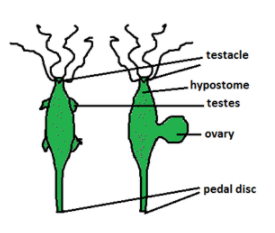
However during unfavorable conditions, Hydra can also reproduce sexually. During unfavorable conditions, a bud develops on Hydra’s body which further matures into a testicle or an ovary.
Although most of the Hydra species are hermaphrodites i.e. both sex organs are present on the same Hydra, for example- Hydra circumcincta but some species of Hydra are monoecious i.e. they develop testes and ovary on different hydra individuals.
These individuals develop sperms and release them into the water. They freely swim inside the water until they fertilize the egg of an ovary of another Hydra individual. This fertilization results in the formation of the zygote which has a really thick coating upon it. This outer coating helps the zygote to survive the bad conditions inside water while the parent Hydra dies. The fertilized egg, after the favorable conditions reappear, they become a nymph Hydra and eventually develop into the adult Hydra.
Hence, the correct answer is option (B).
Note: Hydra belongs to phylum Cnidaria and class Hydrozoa. This organism is quite an interesting one because it does not seem to age at all. Tentacles present on the topmost part of Hydra help them to interact with their environment and help in their survival from predators.
In Sexual Reproduction, after the polyp is formed, it might further evolve to a structure called “medusa”.
This is the stage when hydra develops sex organs for sexual reproduction. But if favorable conditions are available, the medusa stage might not be observed in the polyp.
Complete answer:
Hydra is an organism of fresh-water. They are native to temperate and tropical regions. Hydra commonly divides with the help of asexual reproduction i.e. budding. When the environment conditions are favorable and enough food is available, Hydra tends to form a bud on its body surface which attaches itself to the parent till it matures. After the bud develops into a fully grown and mature Hydra, it detaches itself from the parent’s body. This asexual reproduction in Hydra helps to produce its offspring which is identical or a clone of the parent.
However during unfavorable conditions, Hydra can also reproduce sexually. During unfavorable conditions, a bud develops on Hydra’s body which further matures into a testicle or an ovary.
Although most of the Hydra species are hermaphrodites i.e. both sex organs are present on the same Hydra, for example- Hydra circumcincta but some species of Hydra are monoecious i.e. they develop testes and ovary on different hydra individuals.
These individuals develop sperms and release them into the water. They freely swim inside the water until they fertilize the egg of an ovary of another Hydra individual. This fertilization results in the formation of the zygote which has a really thick coating upon it. This outer coating helps the zygote to survive the bad conditions inside water while the parent Hydra dies. The fertilized egg, after the favorable conditions reappear, they become a nymph Hydra and eventually develop into the adult Hydra.
Hence, the correct answer is option (B).
Note: Hydra belongs to phylum Cnidaria and class Hydrozoa. This organism is quite an interesting one because it does not seem to age at all. Tentacles present on the topmost part of Hydra help them to interact with their environment and help in their survival from predators.
In Sexual Reproduction, after the polyp is formed, it might further evolve to a structure called “medusa”.
This is the stage when hydra develops sex organs for sexual reproduction. But if favorable conditions are available, the medusa stage might not be observed in the polyp.
Recently Updated Pages
Master Class 12 Business Studies: Engaging Questions & Answers for Success

Master Class 12 Biology: Engaging Questions & Answers for Success
Master Class 12 Chemistry: Engaging Questions & Answers for Success
Class 12 Question and Answer - Your Ultimate Solutions Guide
Master Class 11 English: Engaging Questions & Answers for Success
Master Class 11 Social Science: Engaging Questions & Answers for Success
Trending doubts
Which are the Top 10 Largest Countries of the World?
Draw a labelled sketch of the human eye class 12 physics CBSE
Differentiate between homogeneous and heterogeneous class 12 chemistry CBSE
Why is the cell called the structural and functional class 12 biology CBSE
Draw ray diagrams each showing i myopic eye and ii class 12 physics CBSE
Which is the correct genotypic ratio of mendel dihybrid class 12 biology CBSE