




Which statement is/are correct?
\[\begin{align}
& (i)-In\text{ oxymercuration and demercuration reaction, the electrophile is AcO}{{\text{H}}^{-}} \\
& (ii)-In\text{ this reaction, H}{{\text{g}}^{+}}is\text{ reduced to H}{{\text{g}}^{0}} \\
& (iii)-In\text{ this reaction, H}{{\text{g}}^{+2}}\text{ is reduced to H}{{\text{g}}^{+}} \\
& (iv)\text{ - In this reaction, H}{{\text{g}}^{+2}}is\text{ reduced to H}{{\text{g}}^{0}} \\
\end{align}\]
(A)-(i) and (iv)
(B)-(i) and (ii)
(C)-(i) and (iii)
(D)-(iv)
Answer
 Verified
612.6k+ views
Hint: oxymercuration is first step and demercuration is second step. Mercuric acetate is added as reagent.Hydroxyl group is added across an alkene according to markovnikov rule. Oxymercuration is the addition of oxygen and mercury. Demercuration is removal of mercury.
Complete step by step answer:
-Mercuric acetate acts as reagent Mercuric acetate $Hg{{(OAc)}_{2}}$ is in equilibrium with mercuric acetate ion$H{{g}^{+}}OAc$$H{{g}^{+}}OAc$. Mercuric acetate ion attacks $\pi $ bond of alkene. $AcO{{H}^{-}}$acts as electrophile
An electrophile is an electron deficient molecule.
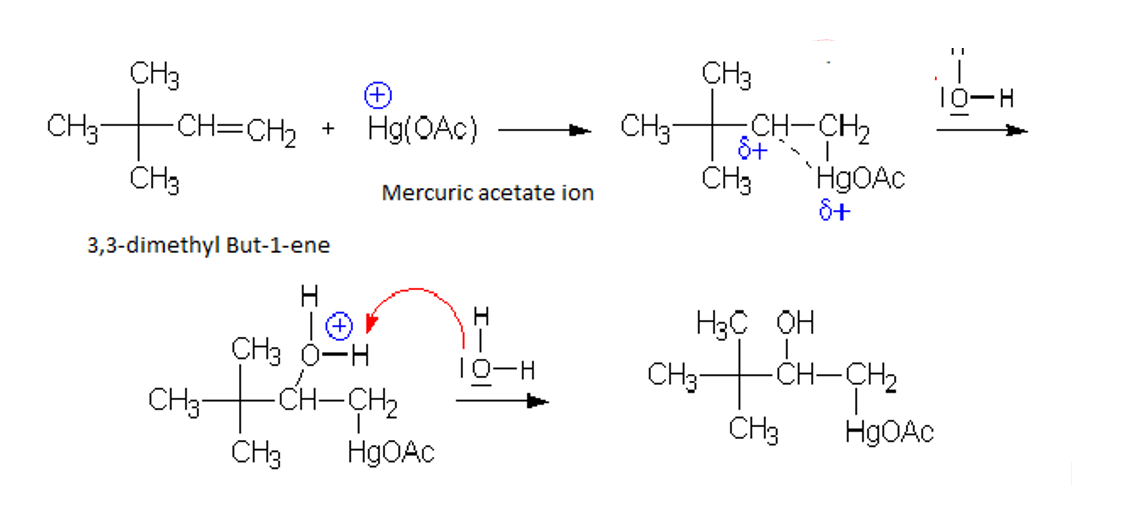 Three membered ring of mercurinium ion is formed, which gets opened by attack of water
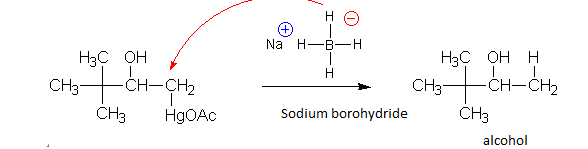
Oxymercuration is followed by reductive demercuration. It is treated with sodium borohydride. Sodium borohydride acts as a reducing agent, so Mercury acetoxy group is replaced with hydrogen and elemental mercury is formed.
In mercury acetate, mercury is present as $H{{g}^{+2}}$ and oxymercuration followed by demercuration results in formation of elemental mercury.
So, In oxymercuration and Demercuration , $AcO{{H}^{-}}$ acts as electrophile and $H{{g}^{+2}}$ is reduced to Hg.
The addition of $H{{g}^{+}}OAc$ takes place according to markovnikov rule.
Markovnikov rule states, In an unsymmetrical alkene, negative part of reagent i.e. $O{{H}^{-}}$ is added to a carbon atom having less number of hydrogen atoms across double bonds.
Markovnikov rule is used to determine major products.
Note: alkenes do not undergo hydration reaction easily under mild conditions, carbocation rearrangement can also be used but it gives low yield. Oxymercuration and demercuration is faster and yield is high. Also, this method is useful because strong acids are not used.
Complete step by step answer:
-Mercuric acetate acts as reagent Mercuric acetate $Hg{{(OAc)}_{2}}$ is in equilibrium with mercuric acetate ion$H{{g}^{+}}OAc$$H{{g}^{+}}OAc$. Mercuric acetate ion attacks $\pi $ bond of alkene. $AcO{{H}^{-}}$acts as electrophile
An electrophile is an electron deficient molecule.
Oxymercuration is followed by reductive demercuration. It is treated with sodium borohydride. Sodium borohydride acts as a reducing agent, so Mercury acetoxy group is replaced with hydrogen and elemental mercury is formed.
In mercury acetate, mercury is present as $H{{g}^{+2}}$ and oxymercuration followed by demercuration results in formation of elemental mercury.
So, In oxymercuration and Demercuration , $AcO{{H}^{-}}$ acts as electrophile and $H{{g}^{+2}}$ is reduced to Hg.
The addition of $H{{g}^{+}}OAc$ takes place according to markovnikov rule.
Markovnikov rule states, In an unsymmetrical alkene, negative part of reagent i.e. $O{{H}^{-}}$ is added to a carbon atom having less number of hydrogen atoms across double bonds.
Markovnikov rule is used to determine major products.
Note: alkenes do not undergo hydration reaction easily under mild conditions, carbocation rearrangement can also be used but it gives low yield. Oxymercuration and demercuration is faster and yield is high. Also, this method is useful because strong acids are not used.
Recently Updated Pages
Master Class 12 Business Studies: Engaging Questions & Answers for Success

Master Class 12 Biology: Engaging Questions & Answers for Success
Master Class 12 Chemistry: Engaging Questions & Answers for Success
Class 12 Question and Answer - Your Ultimate Solutions Guide
Master Class 11 Social Science: Engaging Questions & Answers for Success
Master Class 11 English: Engaging Questions & Answers for Success
Trending doubts
Which is more stable and why class 12 chemistry CBSE
Which are the Top 10 Largest Countries of the World?
Draw a labelled sketch of the human eye class 12 physics CBSE
Differentiate between homogeneous and heterogeneous class 12 chemistry CBSE
What are the major means of transport Explain each class 12 social science CBSE
Sulphuric acid is known as the king of acids State class 12 chemistry CBSE