




Which statement about enzymes is not correct?
A.Enzymes are in colloidal state
B.Enzymes are catalysts
C.Enzymes can catalyze any reaction
D.Urease is an enzyme
Answer
 Verified
583.8k+ views
Hint: Enzymes are basically proteins made from amino acids. These are pivotal in all living entities which govern all the biological processes. Moreover, the majority of enzymes are proteins with catalytic capabilities crucial to perform different processes.
Complete step by step answer:
Basically, Enzymes are biological polymers that catalyze biochemical reactions. The metabolic processes and other chemical reactions in the cell are carried out by a set of enzymes that are necessary to sustain life. They are a linear chain of amino acids which further give rise to a three-dimensional structure. Now, to catalyze the reaction, an enzyme will bind to one or more reactant molecules known as enzyme substrates and further these substrates come together to create one large molecule. The mechanism is as shown:
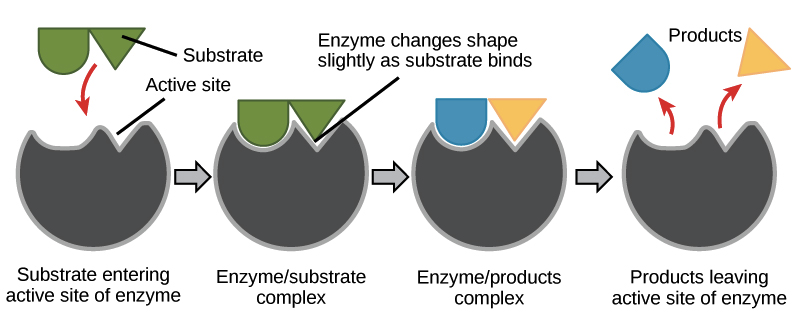
Now, enzymes are in a colloidal state. They are shape selective and further catalyze a specific reaction in which they are suitable. But they cannot catalyze any reaction. Like all catalysts, they increase the reaction rate by lowering its activation energy. So, on the basis of word done at the molecular level, they are classified into six different types:
1.Hydrolases
2.Oxidoreductases
3.Transferases
4.Isomerases
5.Ligases
6.Lyases
One common example of enzyme is Urease. This enzyme catalyzes the hydrolysis of urea to ammonia and carbon dioxide. Therefore, we have seen that all the options are correct except option C.
Hence, option C is correct.
Note: There are approximately 1300 different types of enzymes found in the human body. Some of the digestive enzymes are pepsin, amylase, trypsin, pancreatic lipase, Ribonuclease and many more. These enzymes further help to break down proteins, large starch molecules and fats in the different parts of the human body.
Complete step by step answer:
Basically, Enzymes are biological polymers that catalyze biochemical reactions. The metabolic processes and other chemical reactions in the cell are carried out by a set of enzymes that are necessary to sustain life. They are a linear chain of amino acids which further give rise to a three-dimensional structure. Now, to catalyze the reaction, an enzyme will bind to one or more reactant molecules known as enzyme substrates and further these substrates come together to create one large molecule. The mechanism is as shown:
Now, enzymes are in a colloidal state. They are shape selective and further catalyze a specific reaction in which they are suitable. But they cannot catalyze any reaction. Like all catalysts, they increase the reaction rate by lowering its activation energy. So, on the basis of word done at the molecular level, they are classified into six different types:
1.Hydrolases
2.Oxidoreductases
3.Transferases
4.Isomerases
5.Ligases
6.Lyases
One common example of enzyme is Urease. This enzyme catalyzes the hydrolysis of urea to ammonia and carbon dioxide. Therefore, we have seen that all the options are correct except option C.
Hence, option C is correct.
Note: There are approximately 1300 different types of enzymes found in the human body. Some of the digestive enzymes are pepsin, amylase, trypsin, pancreatic lipase, Ribonuclease and many more. These enzymes further help to break down proteins, large starch molecules and fats in the different parts of the human body.
Recently Updated Pages
Master Class 12 Economics: Engaging Questions & Answers for Success

Master Class 12 Physics: Engaging Questions & Answers for Success
Master Class 12 English: Engaging Questions & Answers for Success
Master Class 12 Social Science: Engaging Questions & Answers for Success
Master Class 12 Maths: Engaging Questions & Answers for Success
Master Class 12 Business Studies: Engaging Questions & Answers for Success
Trending doubts
Which are the Top 10 Largest Countries of the World?
What are the major means of transport Explain each class 12 social science CBSE
Draw a labelled sketch of the human eye class 12 physics CBSE
Why cannot DNA pass through cell membranes class 12 biology CBSE
Differentiate between insitu conservation and exsitu class 12 biology CBSE
Draw a neat and well labeled diagram of TS of ovary class 12 biology CBSE