




Which RNA molecules are involved in the synthesis (making) of a protein?
Answer
 Verified
508.2k+ views
Hint: When it comes to the structure of RNA (Ribonucleic Acid), it is quite similar to DNA. RNA, on the other hand, is a single-stranded molecule as opposed to DNA. The backbone of an RNA strand is composed of sugar (ribose) and phosphate groups that alternate. There are four bases attached to each sugar which are adenine (A), uracil (U), cytosine (C), and guanine (G). It is recognized that the cell has three kinds of RNA, which are the messenger RNA (mRNA), transfer RNA (tRNA) and ribosomal RNA (rRNA).
Complete answer:
To translate genetic information from DNA into the proteins that conduct most of the work in a cell, molecular machinery consisting of RNA and protein are used in all living cells. However, it is RNA and not proteins which are responsible for this protein-making mechanism (protein synthesis) known as a ribosome. RNA gives the ribosome its fundamental structure and functional core.
Image showing RNA and DNA
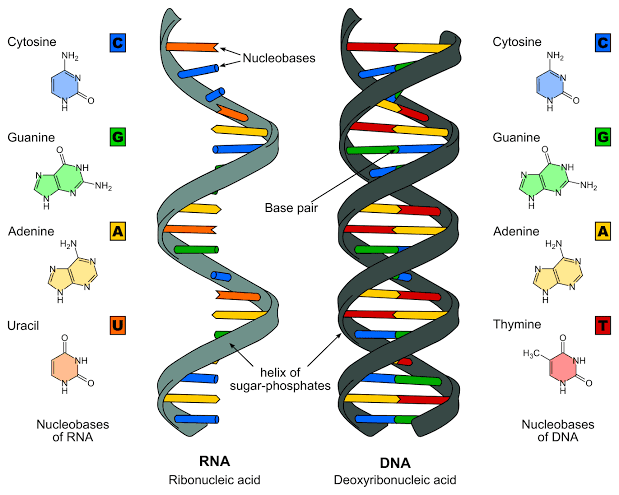
Messenger RNA (mRNA), ribosomal RNA (rRNA), and transfer RNA (tRNA) are the three primary kinds of RNA that are directly involved in protein synthesis.
Messenger RNA, or mRNA, transports genetic information from the DNA to the ribosomal RNA. Ribosomes get blueprints for making proteins from messenger RNA, which is used to construct proteins. Proteins are made up of amino acids. The transfer RNA (tRNA) transports each amino acid of a protein to the ribosome. Ribosomal RNA (rRNA) builds proteins in the cell using the information in messenger RNA, which links amino acids bound to transfer RNA.
Hence mRNA molecules are involved in the synthesis (making) of a protein.
Note:
Many antibiotics that are used to treat infections bind to bacteria's ribosomal RNA and prevent protein synthesis. Bacteria can't grow because of this. The protein synthesis machinery can also be harmed by errors in RNA generation or sequencing leading to birth of various diseases and deformities.
Complete answer:
To translate genetic information from DNA into the proteins that conduct most of the work in a cell, molecular machinery consisting of RNA and protein are used in all living cells. However, it is RNA and not proteins which are responsible for this protein-making mechanism (protein synthesis) known as a ribosome. RNA gives the ribosome its fundamental structure and functional core.
Image showing RNA and DNA
Messenger RNA (mRNA), ribosomal RNA (rRNA), and transfer RNA (tRNA) are the three primary kinds of RNA that are directly involved in protein synthesis.
Messenger RNA, or mRNA, transports genetic information from the DNA to the ribosomal RNA. Ribosomes get blueprints for making proteins from messenger RNA, which is used to construct proteins. Proteins are made up of amino acids. The transfer RNA (tRNA) transports each amino acid of a protein to the ribosome. Ribosomal RNA (rRNA) builds proteins in the cell using the information in messenger RNA, which links amino acids bound to transfer RNA.
Hence mRNA molecules are involved in the synthesis (making) of a protein.
Note:
Many antibiotics that are used to treat infections bind to bacteria's ribosomal RNA and prevent protein synthesis. Bacteria can't grow because of this. The protein synthesis machinery can also be harmed by errors in RNA generation or sequencing leading to birth of various diseases and deformities.
Recently Updated Pages
Master Class 12 Economics: Engaging Questions & Answers for Success

Master Class 12 English: Engaging Questions & Answers for Success
Master Class 12 Social Science: Engaging Questions & Answers for Success
Master Class 12 Maths: Engaging Questions & Answers for Success
Master Class 12 Physics: Engaging Questions & Answers for Success
Master Class 12 Business Studies: Engaging Questions & Answers for Success
Trending doubts
Which are the Top 10 Largest Countries of the World?
Draw a labelled sketch of the human eye class 12 physics CBSE
Differentiate between homogeneous and heterogeneous class 12 chemistry CBSE
Sulphuric acid is known as the king of acids State class 12 chemistry CBSE
Why is the cell called the structural and functional class 12 biology CBSE
Draw ray diagrams each showing i myopic eye and ii class 12 physics CBSE