




Which part of the human eye controls the amount of light entering the eye?
A.Cornea
B.Retina
C.Pupil
D.Iris
Answer
 Verified
618k+ views
Hint Cornea is the outer covering of the eye. The retina is the part of the eye that senses the light entering our eyes. The pupil is the black hole in the center of the eye that lets the light in the eye. Iris is the part of the eye that controls how much light enters our eye.
Complete answer:
Let’s discuss all the given options
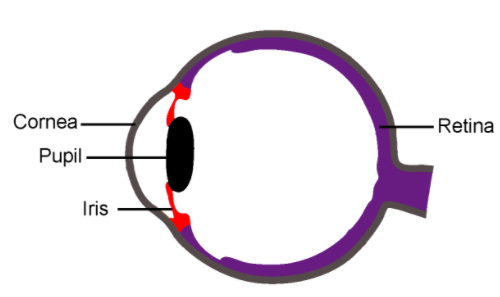
Cornea - The cornea is the front portion of the eye that is translucent and protects the iris, pupil, and anterior chamber.
Retina - The retina is a thin tissue layer that covers the inside of the back of the eye. It is positioned next to the optic nerve. The retina aims to receive light focused by the lens, translate the light into neural signals, and transmit these signals for visual recognition to the brain.
Pupil - The black core of the eye is the pupil. Its job is to let light in and concentrate it on the retina so that you can see.
Iris - Iris is the part of the eye that determines the color of the eye. It is a pigmented muscular ring. The pigment of the iris is due to melanin. The most visible portion of the eye lies in front of the crystalline lens and separates the anterior chamber to the posterior chamber.
Iris is a pigmented muscular ring responsible for controlling the amount of light entering the eye by adjusting the size of the pupil. The pupil is the present center in the iris through which light enters the eye. Pupils vary in size depending upon the intensity of the light. In bright light iris gets relaxed thus the size of the pupil will decrease so the minimum amount of light enters in the eye. In dim light iris contracts so the size of the pupil will increase which promotes the maximum amount of light entering the eye.
Hence, option D is the correct option.
Note Iris consists of two smooth muscles which are contrary to action – dilation (expansion) and contract (constriction). These muscles control the size of the pupil. The size of the pupil increases when we are in a dark environment increasing visibility and the size of the pupil decreases when we are in a bright environment.
Complete answer:
Let’s discuss all the given options
Cornea - The cornea is the front portion of the eye that is translucent and protects the iris, pupil, and anterior chamber.
Retina - The retina is a thin tissue layer that covers the inside of the back of the eye. It is positioned next to the optic nerve. The retina aims to receive light focused by the lens, translate the light into neural signals, and transmit these signals for visual recognition to the brain.
Pupil - The black core of the eye is the pupil. Its job is to let light in and concentrate it on the retina so that you can see.
Iris - Iris is the part of the eye that determines the color of the eye. It is a pigmented muscular ring. The pigment of the iris is due to melanin. The most visible portion of the eye lies in front of the crystalline lens and separates the anterior chamber to the posterior chamber.
Iris is a pigmented muscular ring responsible for controlling the amount of light entering the eye by adjusting the size of the pupil. The pupil is the present center in the iris through which light enters the eye. Pupils vary in size depending upon the intensity of the light. In bright light iris gets relaxed thus the size of the pupil will decrease so the minimum amount of light enters in the eye. In dim light iris contracts so the size of the pupil will increase which promotes the maximum amount of light entering the eye.
Hence, option D is the correct option.
Note Iris consists of two smooth muscles which are contrary to action – dilation (expansion) and contract (constriction). These muscles control the size of the pupil. The size of the pupil increases when we are in a dark environment increasing visibility and the size of the pupil decreases when we are in a bright environment.
Recently Updated Pages
Master Class 12 Business Studies: Engaging Questions & Answers for Success

Master Class 12 Chemistry: Engaging Questions & Answers for Success
Master Class 12 Biology: Engaging Questions & Answers for Success
Class 12 Question and Answer - Your Ultimate Solutions Guide
Master Class 11 English: Engaging Questions & Answers for Success
Master Class 11 Social Science: Engaging Questions & Answers for Success
Trending doubts
Which are the Top 10 Largest Countries of the World?
Draw a labelled sketch of the human eye class 12 physics CBSE
Differentiate between homogeneous and heterogeneous class 12 chemistry CBSE
Why is the cell called the structural and functional class 12 biology CBSE
Draw ray diagrams each showing i myopic eye and ii class 12 physics CBSE
Which is the correct genotypic ratio of mendel dihybrid class 12 biology CBSE