




Which organelle is responsible for the production of energy in a cell?
Answer
 Verified
555.6k+ views
Hint: All living organisms need the energy to grow and reproduce, respire and respond to the environment. Metabolism is the process that makes energy available for cellular processes. Living organisms obtain energy through food, nutrients, or sunlight so as to carry out cellular processes.
Complete answer:
Mitochondria is the organelle responsible for the production of energy. It is also known as the Powerhouse of the cell. It consists of a double membrane-bound organelle and it is found in most eukaryotic organisms. They are found inside the cytoplasm and help in breaking down nutrients and generating energy for the cell.
The mitochondrial matrix is a viscous fluid that is composed of enzymes and proteins. Ribosomes, inorganic ions, mitochondrial DNA, nucleotide cofactors, and organic molecules are present in the mitochondria. The synthesis of ATP molecules is the function of enzymes in the matrix.
The most important function of mitochondria is to produce energy through oxidative phosphorylation. It is also involved in;
- Regulating the metabolic activity of the cell
- Promoting the growth of new cells and cell multiplication
- Detoxification of ammonia in the liver cells
- Helps in apoptosis or programmed cell death
- Responsible for building certain parts of the blood and various hormones like testosterone and oestrogen
- Maintains concentration of calcium ions within the compartments of the cell.
- It is also involved in important cellular activities like cellular differentiation, cell signalling, cell senescence, controlling the cell cycle and also in cell growth.
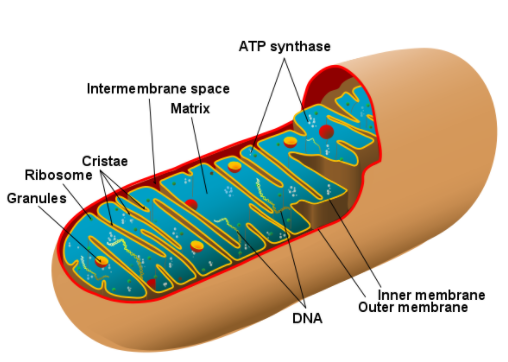
So the organelle responsible for the production of energy is Mitochondria.
Note: Irregularity in the way mitochondria functions can directly affect human health. But it is difficult to identify as the symptoms vary from person to person. Disorders of the mitochondria can be quite severe and can cause organ failure. Mitochondrial diseases include Alpers Disease, Barth Syndrome, Kearns-Sayre syndrome (KSS).
Complete answer:
Mitochondria is the organelle responsible for the production of energy. It is also known as the Powerhouse of the cell. It consists of a double membrane-bound organelle and it is found in most eukaryotic organisms. They are found inside the cytoplasm and help in breaking down nutrients and generating energy for the cell.
The mitochondrial matrix is a viscous fluid that is composed of enzymes and proteins. Ribosomes, inorganic ions, mitochondrial DNA, nucleotide cofactors, and organic molecules are present in the mitochondria. The synthesis of ATP molecules is the function of enzymes in the matrix.
The most important function of mitochondria is to produce energy through oxidative phosphorylation. It is also involved in;
- Regulating the metabolic activity of the cell
- Promoting the growth of new cells and cell multiplication
- Detoxification of ammonia in the liver cells
- Helps in apoptosis or programmed cell death
- Responsible for building certain parts of the blood and various hormones like testosterone and oestrogen
- Maintains concentration of calcium ions within the compartments of the cell.
- It is also involved in important cellular activities like cellular differentiation, cell signalling, cell senescence, controlling the cell cycle and also in cell growth.
So the organelle responsible for the production of energy is Mitochondria.
Note: Irregularity in the way mitochondria functions can directly affect human health. But it is difficult to identify as the symptoms vary from person to person. Disorders of the mitochondria can be quite severe and can cause organ failure. Mitochondrial diseases include Alpers Disease, Barth Syndrome, Kearns-Sayre syndrome (KSS).
Recently Updated Pages
Master Class 11 English: Engaging Questions & Answers for Success

Master Class 11 Social Science: Engaging Questions & Answers for Success
Master Class 11 Maths: Engaging Questions & Answers for Success
Master Class 11 Biology: Engaging Questions & Answers for Success
Master Class 11 Physics: Engaging Questions & Answers for Success
Master Class 11 Chemistry: Engaging Questions & Answers for Success
Trending doubts
In Indian rupees 1 trillion is equal to how many c class 8 maths CBSE
What is BLO What is the full form of BLO class 8 social science CBSE
What are the 12 elements of nature class 8 chemistry CBSE
Citizens of India can vote at the age of A 18 years class 8 social science CBSE
Which of the following leader has given the term insensate class 8 social science CBSE
Name the states through which the Tropic of Cancer class 8 social science CBSE