




Which organelle is absent in Human sperm?
Answer
 Verified
534.9k+ views
Hint: Human sperms consist of subcellular organelles which are mitochondria, centriole & nucleus. But they are devoid of Endoplasmic Reticulum.
Complete answer:
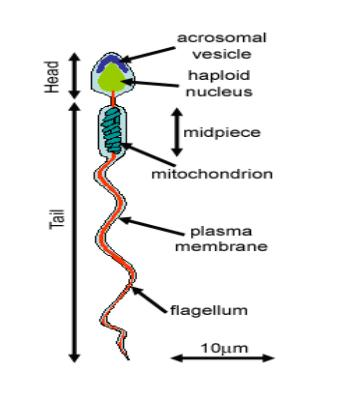
Human sperms are gametes of the male reproductive system developed by the primary sex organ in males, testis. The mature sperm cell’s structure contains the following parts – a head, a spine, a tail & a middle section / body. The entire body is covered by a plasma membrane. In the sperm head, very few amounts of cytoplasm is present & the anterior part of the sperm head is enveloped by a acrosome cap. It has an elongated haploid nucleus.
Two distinct granules i.e. the proximal & distal centrioles are present in the short neck. The proximal centriole plays a crucial role during the first cleavage of the fertilized ovum. The distal centriole gives rise to the axial filament of the long tail of the sperm.
The middle piece of a mammalian sperm cell possesses multiple mitochondria. These mitochondria are 25 to 30 in number which are spirally arranged. They produce energy for the movement of the sperm cell.
However, the mature human sperms do not contain ER i.e. Endoplasmic Reticulum.
The endoplasmic reticulum is present in other cells except sperms. Amidst the membrane bound cell organelles, in case of sperms, mitochondria generate the most of chemical energy required for the biochemical reactions of a cell.
Note:
The process of production of sperms is spermatogenesis. Sperms do not require synthesizing any & this is the probable reason they do not possess any ER.
Complete answer:
Human sperms are gametes of the male reproductive system developed by the primary sex organ in males, testis. The mature sperm cell’s structure contains the following parts – a head, a spine, a tail & a middle section / body. The entire body is covered by a plasma membrane. In the sperm head, very few amounts of cytoplasm is present & the anterior part of the sperm head is enveloped by a acrosome cap. It has an elongated haploid nucleus.
Two distinct granules i.e. the proximal & distal centrioles are present in the short neck. The proximal centriole plays a crucial role during the first cleavage of the fertilized ovum. The distal centriole gives rise to the axial filament of the long tail of the sperm.
The middle piece of a mammalian sperm cell possesses multiple mitochondria. These mitochondria are 25 to 30 in number which are spirally arranged. They produce energy for the movement of the sperm cell.
However, the mature human sperms do not contain ER i.e. Endoplasmic Reticulum.
The endoplasmic reticulum is present in other cells except sperms. Amidst the membrane bound cell organelles, in case of sperms, mitochondria generate the most of chemical energy required for the biochemical reactions of a cell.
Note:
The process of production of sperms is spermatogenesis. Sperms do not require synthesizing any & this is the probable reason they do not possess any ER.
Recently Updated Pages
Master Class 12 Economics: Engaging Questions & Answers for Success

Master Class 12 English: Engaging Questions & Answers for Success
Master Class 12 Social Science: Engaging Questions & Answers for Success
Master Class 12 Maths: Engaging Questions & Answers for Success
Master Class 12 Physics: Engaging Questions & Answers for Success
Master Class 9 General Knowledge: Engaging Questions & Answers for Success
Trending doubts
Which are the Top 10 Largest Countries of the World?
Draw a labelled sketch of the human eye class 12 physics CBSE
Differentiate between homogeneous and heterogeneous class 12 chemistry CBSE
Sulphuric acid is known as the king of acids State class 12 chemistry CBSE
Why is the cell called the structural and functional class 12 biology CBSE
Draw ray diagrams each showing i myopic eye and ii class 12 physics CBSE