




Which ones are ammonotelic animals?
(A) Amphibian and reptiles
(B) Bony fishes and amphibian tadpoles
(C) Cartilaginous and bony fishes
(D) Amphibian and mammals
Answer
 Verified
655.2k+ views
Hint: Ammonia is a very toxic waste product released by the animals and it requires a large amount of water to get easily dissolved in it. Ammonia is extremely soluble in water.
Complete answer:
Organisms that excrete nitrogenous waste in the form of ammonia as a waste product are known as Ammonotelic animals. Ammonotelic organisms consist of the majority of marine animals like tadpoles of amphibians, bony fishes, protozoans, etc.
Nitrogenous waste that is produced in the body needs to be excreted from the body daily as they are toxic to an organism or animal. The organs of our excretory system help in the removal of these wastes. If these wastes are not removed, our cells or tissue will not work effectively. The waste is excreted in 3 forms i.e ammonia, uric acid, and urea.
Other than ammonotelic, two more types of animals are present on the basis of the excretory product they release. They are as follows-
- Uricotelic animals: Organisms that excrete nitrogenous waste in the form of uric acid are known as uricotelic animals. Examples are – Birds, Lizards, etc.
- Ureotelic animals: Organisms that excrete nitrogenous waste in the form of urea are known as ureotelic animals. Examples are – mammals, cartilaginous fishes, etc.
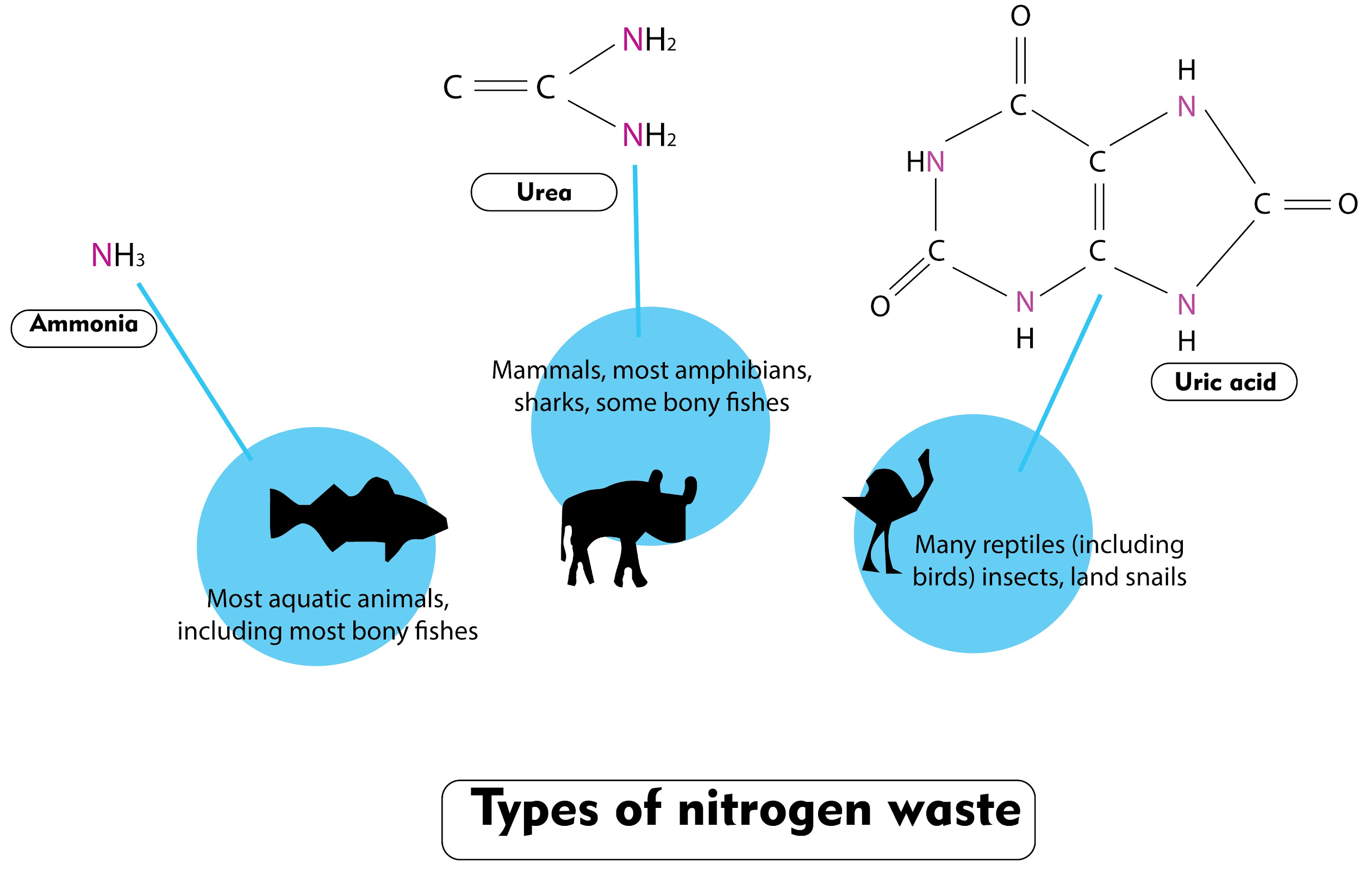
So, the correct answer is ‘(B) Bony fishes and amphibian tadpoles’.
Note: Ammonia is the most water- soluble and most toxic. Urea requires comparatively more energy and is less toxic in nature. Uric acid is the least toxic and is not easily soluble in water. However, it requires a large amount of energy.
Complete answer:
Organisms that excrete nitrogenous waste in the form of ammonia as a waste product are known as Ammonotelic animals. Ammonotelic organisms consist of the majority of marine animals like tadpoles of amphibians, bony fishes, protozoans, etc.
Nitrogenous waste that is produced in the body needs to be excreted from the body daily as they are toxic to an organism or animal. The organs of our excretory system help in the removal of these wastes. If these wastes are not removed, our cells or tissue will not work effectively. The waste is excreted in 3 forms i.e ammonia, uric acid, and urea.
Other than ammonotelic, two more types of animals are present on the basis of the excretory product they release. They are as follows-
- Uricotelic animals: Organisms that excrete nitrogenous waste in the form of uric acid are known as uricotelic animals. Examples are – Birds, Lizards, etc.
- Ureotelic animals: Organisms that excrete nitrogenous waste in the form of urea are known as ureotelic animals. Examples are – mammals, cartilaginous fishes, etc.
So, the correct answer is ‘(B) Bony fishes and amphibian tadpoles’.
Note: Ammonia is the most water- soluble and most toxic. Urea requires comparatively more energy and is less toxic in nature. Uric acid is the least toxic and is not easily soluble in water. However, it requires a large amount of energy.
Recently Updated Pages
If x a + bt + ct2 where x is in meters and t is in class 11 physics CBSE

A car covers the first half distance between two places class 11 physics CBSE
The resultant of two vectors overrightarrow P and overrightarrow class 11 physics CBSE
Find the value of cos 135 class 11 maths CBSE
A mass M is held in place by an applied force F and class 11 physics CBSE
A solution of glucose in water is labelled as 10 dfracwv class 11 chemistry CBSE
Trending doubts
One Metric ton is equal to kg A 10000 B 1000 C 100 class 11 physics CBSE
Find the value of the expression given below sin 30circ class 11 maths CBSE
What do you mean by retardation What is its SI uni class 11 physics CBSE
Draw a diagram of nephron and explain its structur class 11 biology CBSE
10 examples of friction in our daily life
Difference between physical and chemical change class 11 chemistry CBSE