




Which one shows isogamy with non-flagellated gametes?
A. Spirogyra
B. Ulothrix
C. Ectocarpus
D. Sargassum
Answer
 Verified
655.8k+ views
Hint: A filamentous green algae having a characteristic feature that involves the presence of the spirally arranged chloroplasts that help then in the process of photosynthesis making them autotrophs.
Complete answer:
The isogamy with non-flagellated gametes is found in Spirogyra. Spirogyra is commonly known as water silk. They reproduce by both means sexual as well as sexual. During sexual reproduction, the tap non-flagellated gametes come together which are different in structure.
Additional Information: -The gametes which are non-motile and do not have flagella for movement and locomotion are called non-flagellates.
-The gametes produced in algae are of three types: isogametes (both the gametes are motile and of equal size), anisogametes (both the gametes are motile but are of different size), and oogamy (male gamete is small and motile fixed with large and non-motile female gamete).
-The flagella are the hair-like structure present on the outer surface of the gametes which helps in the movement.
-Spirogyra is found in freshwater having clear eutrophic water.
-They grow underwater but when the sunlight is enough a large amount of oxygen is produced forming bubbles in between their filaments.
-They appear to be slimy green colored filaments on the surface of the water bodies.
-The Spirogyra consists of a cell wall, a nucleus, a paranoid, and chloroplasts which are normally arranged.
So, the correct answer is ‘Spirogyra’.
Note: Ulothrix belongs to the green algae but the filaments are unbranched. They are generally found in low temperatures and fresh as well as marine water habitat and reproduce vegetatively. Ectocarpus belongs to the brown algae which are filamentous found mostly in the cold waters with a small body. Sargassum is a small seaweed which belongs to the brown algae. They are generally free-floating and found in deep and shallow waters.
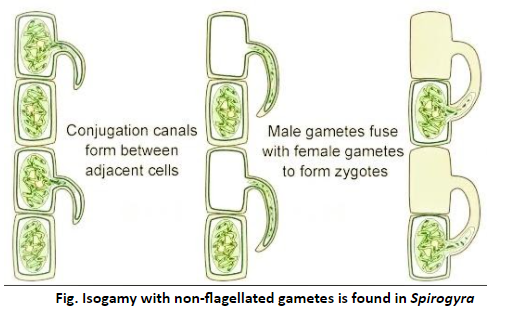
Complete answer:
The isogamy with non-flagellated gametes is found in Spirogyra. Spirogyra is commonly known as water silk. They reproduce by both means sexual as well as sexual. During sexual reproduction, the tap non-flagellated gametes come together which are different in structure.
Additional Information: -The gametes which are non-motile and do not have flagella for movement and locomotion are called non-flagellates.
-The gametes produced in algae are of three types: isogametes (both the gametes are motile and of equal size), anisogametes (both the gametes are motile but are of different size), and oogamy (male gamete is small and motile fixed with large and non-motile female gamete).
-The flagella are the hair-like structure present on the outer surface of the gametes which helps in the movement.
-Spirogyra is found in freshwater having clear eutrophic water.
-They grow underwater but when the sunlight is enough a large amount of oxygen is produced forming bubbles in between their filaments.
-They appear to be slimy green colored filaments on the surface of the water bodies.
-The Spirogyra consists of a cell wall, a nucleus, a paranoid, and chloroplasts which are normally arranged.
So, the correct answer is ‘Spirogyra’.
Note: Ulothrix belongs to the green algae but the filaments are unbranched. They are generally found in low temperatures and fresh as well as marine water habitat and reproduce vegetatively. Ectocarpus belongs to the brown algae which are filamentous found mostly in the cold waters with a small body. Sargassum is a small seaweed which belongs to the brown algae. They are generally free-floating and found in deep and shallow waters.
Recently Updated Pages
If x a + bt + ct2 where x is in meters and t is in class 11 physics CBSE

A car covers the first half distance between two places class 11 physics CBSE
The resultant of two vectors overrightarrow P and overrightarrow class 11 physics CBSE
Find the value of cos 135 class 11 maths CBSE
A mass M is held in place by an applied force F and class 11 physics CBSE
A solution of glucose in water is labelled as 10 dfracwv class 11 chemistry CBSE
Trending doubts
One Metric ton is equal to kg A 10000 B 1000 C 100 class 11 physics CBSE
Find the value of the expression given below sin 30circ class 11 maths CBSE
What do you mean by retardation What is its SI uni class 11 physics CBSE
Draw a diagram of nephron and explain its structur class 11 biology CBSE
10 examples of friction in our daily life
Difference between physical and chemical change class 11 chemistry CBSE