



Which one of the following is laevorotatory?
A.glucose
B.fructose
C.sucrose
D.all the above
Answer
 Verified
603.3k+ views
Hint: Those which rotate the plane polarised light toward counter clockwise direction is known as laevorotatory which is denoted by l or -. Fructose is laevorotatory. It rotates the plane of polarized light in an anticlockwise direction.
Complete answer:
Some chiral compounds which don't have plane of symmetry have some property to rotate plane polarised light in either clockwise or counter clockwise direction.
Those compounds which rotate plane polarised light toward clockwise direction are known as dextrorotatory which is denoted by d or + and those which rotate the plane polarised light toward counter clockwise direction is known as laevorotatory which is denoted by l or -.
Fructose has three chiral centres, that is why it is optically active. Its specific rotation is -92.4. The negative sign shows that light rotates toward counter clockwise direction.
When the fructose solution is placed in a polariser it rotates the plane polarized light in an anti-clockwise direction which is towards the left side. So, it is a laevorotatory nature compound. Honey contains monosaccharides sugar fructose.
This specific rotation is an experimental phenomenon; we can’t predict specific rotation after seeing the structure.
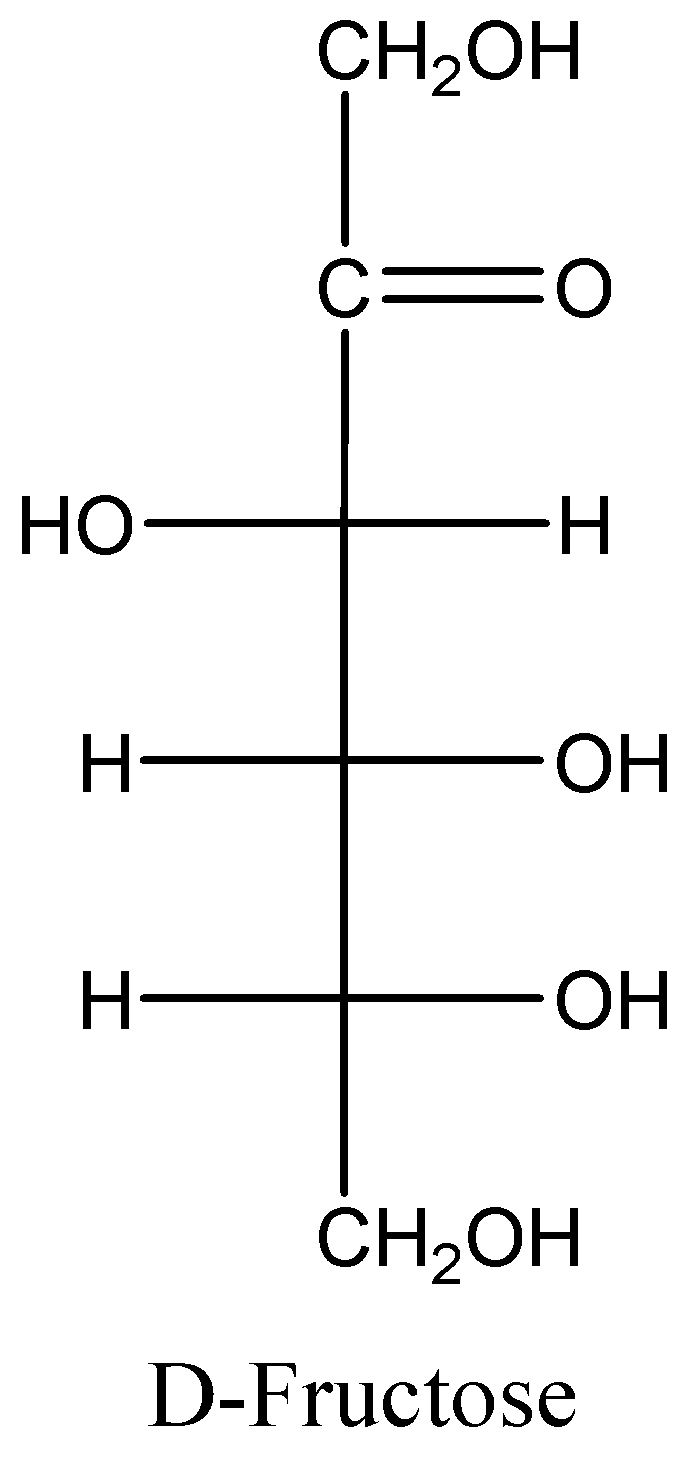
So, the correct answer is option B.
Note: Fructose (fruit sugar) is a ketohexose which is a six-carbon ketonic sugar, and it occurs in sweet fruits and honey. Glucose and fructose have the same molecular formula, i.e. ${C_6}{H_{12}}{O_6}$, but they have different structures. Pure, dry fructose is very sweet in taste, white in colour, odourless and crystalline solid. Fructose is one of the sweetest of all sugars and is combined with glucose to make sucrose, or common table sugar. Fructose’s name is also levulose because of its levorotatory property of rotating plane polarized light to the left.
Complete answer:
Some chiral compounds which don't have plane of symmetry have some property to rotate plane polarised light in either clockwise or counter clockwise direction.
Those compounds which rotate plane polarised light toward clockwise direction are known as dextrorotatory which is denoted by d or + and those which rotate the plane polarised light toward counter clockwise direction is known as laevorotatory which is denoted by l or -.
Fructose has three chiral centres, that is why it is optically active. Its specific rotation is -92.4. The negative sign shows that light rotates toward counter clockwise direction.
When the fructose solution is placed in a polariser it rotates the plane polarized light in an anti-clockwise direction which is towards the left side. So, it is a laevorotatory nature compound. Honey contains monosaccharides sugar fructose.
This specific rotation is an experimental phenomenon; we can’t predict specific rotation after seeing the structure.
So, the correct answer is option B.
Note: Fructose (fruit sugar) is a ketohexose which is a six-carbon ketonic sugar, and it occurs in sweet fruits and honey. Glucose and fructose have the same molecular formula, i.e. ${C_6}{H_{12}}{O_6}$, but they have different structures. Pure, dry fructose is very sweet in taste, white in colour, odourless and crystalline solid. Fructose is one of the sweetest of all sugars and is combined with glucose to make sucrose, or common table sugar. Fructose’s name is also levulose because of its levorotatory property of rotating plane polarized light to the left.
Recently Updated Pages
Master Class 12 Business Studies: Engaging Questions & Answers for Success

Master Class 12 Biology: Engaging Questions & Answers for Success
Master Class 12 Chemistry: Engaging Questions & Answers for Success
Class 12 Question and Answer - Your Ultimate Solutions Guide
Master Class 11 English: Engaging Questions & Answers for Success
Master Class 11 Social Science: Engaging Questions & Answers for Success
Trending doubts
Which are the Top 10 Largest Countries of the World?
Draw a labelled sketch of the human eye class 12 physics CBSE
Differentiate between homogeneous and heterogeneous class 12 chemistry CBSE
Why is the cell called the structural and functional class 12 biology CBSE
Draw ray diagrams each showing i myopic eye and ii class 12 physics CBSE
Which is the correct genotypic ratio of mendel dihybrid class 12 biology CBSE