




Which one of the following is an example of cleistogamy?
(A) Sunflower
(B) Vallisneria
(C) Commelina
(D) Calotropis
Answer
 Verified
577.5k+ views
Hint: The example of cleistogamy is seen in that flower which is also known as Benghal dayflower, tropical spiderwort, or wandering Jew. It is known to have a long flowering period, from spring to fall in subtropical areas, and throughout the year closer to the equator. It is often associated with disturbed soils.
Complete answer:
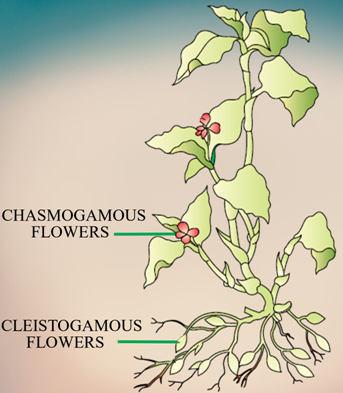
Cleistogamous flowers are known to be closed flowers that do not open and remain in the bud state. The anthers and stigmas are not exposed in this type and lie close to each other. The example of cleistogamy is seen in Commelina.
The reproductive structures are often smaller in this type of flower, thus less pollen needs to be produced. Cross-pollination cannot occur in cleistogamous flowers because they never open. Hence, only self-pollination is possible in these flowers. When the anther dehisces in the flower the pollen grain of that flower comes in close contact with the stigma to affect self-pollination, and hence, there is no chance of cross-pollination and only self-pollination will take place. These flowers are non-showy and inconspicuous and homogamous.
On the other hand, chasmogamous flowers are known to be open flowers having exposed anthers and stigma. Chasmogamous flowers open at maturity. These flowers facilitate cross-pollination (and sometimes cross-pollination) and are dependent on pollinating agents. In these types of flowers, reproductive structures are found to be larger, and thus more pollen needs to be produced. These flowers are showy and highly conspicuous. These flowers are usually dichogamous.
So, the correct answer is ‘Commelina’.
Note:
- Cleistogamous flowers are invariably autogamous.
- Seed production in this type of plant is pre ensured i.e in cleistogamous flowers due to the absence of pollinators.
- Synchrony in the pollen grain release and stigma receptivity are the two very major factors ensuring self-pollination.
Complete answer:
Cleistogamous flowers are known to be closed flowers that do not open and remain in the bud state. The anthers and stigmas are not exposed in this type and lie close to each other. The example of cleistogamy is seen in Commelina.
The reproductive structures are often smaller in this type of flower, thus less pollen needs to be produced. Cross-pollination cannot occur in cleistogamous flowers because they never open. Hence, only self-pollination is possible in these flowers. When the anther dehisces in the flower the pollen grain of that flower comes in close contact with the stigma to affect self-pollination, and hence, there is no chance of cross-pollination and only self-pollination will take place. These flowers are non-showy and inconspicuous and homogamous.
On the other hand, chasmogamous flowers are known to be open flowers having exposed anthers and stigma. Chasmogamous flowers open at maturity. These flowers facilitate cross-pollination (and sometimes cross-pollination) and are dependent on pollinating agents. In these types of flowers, reproductive structures are found to be larger, and thus more pollen needs to be produced. These flowers are showy and highly conspicuous. These flowers are usually dichogamous.
So, the correct answer is ‘Commelina’.
Note:
- Cleistogamous flowers are invariably autogamous.
- Seed production in this type of plant is pre ensured i.e in cleistogamous flowers due to the absence of pollinators.
- Synchrony in the pollen grain release and stigma receptivity are the two very major factors ensuring self-pollination.
Recently Updated Pages
Master Class 12 Economics: Engaging Questions & Answers for Success

Master Class 12 English: Engaging Questions & Answers for Success
Master Class 12 Social Science: Engaging Questions & Answers for Success
Master Class 12 Maths: Engaging Questions & Answers for Success
Master Class 12 Physics: Engaging Questions & Answers for Success
Master Class 9 General Knowledge: Engaging Questions & Answers for Success
Trending doubts
Which are the Top 10 Largest Countries of the World?
Draw a labelled sketch of the human eye class 12 physics CBSE
Differentiate between homogeneous and heterogeneous class 12 chemistry CBSE
Why is the cell called the structural and functional class 12 biology CBSE
Draw ray diagrams each showing i myopic eye and ii class 12 physics CBSE
Which is the correct genotypic ratio of mendel dihybrid class 12 biology CBSE