




Which one of the following is a correct set?
A.\[{H_2}O,\;s{p^3}\],angular
B.\[{H_2}O,\;s{p^2}\],Linear
C.\[N{H_4}^ + ,\;ds{p^2}\],Square planar
D.\[C{H_4},\;ds{p^2}\],Tetrahedral
Answer
 Verified
620.1k+ views
Hint:
We need to find the geometry and hybridization of a given molecule. We can find the hybridization by knowing the number of sigma bonds and lone pairs. Geometry of a molecule can be explained by the arrangement of lone pair and bond pairs.
Complete step by step answer:
Hybridization is the concept of mixing atomic orbitals into new hybrid orbitals with different energies, shapes etc, that are suitable for the pairing of electrons to form chemical bonds in valence bond theory.
${\rm{z}} = \;{\rm{no}}{\rm{.}}\;{\rm{of}}\;\sigma \;{\rm{bond}}\; + \;{\rm{l}}{\rm{.p}}\;{\rm{on}}\;{\rm{central}}\;{\rm{atom}}$
Where, No. of $\sigma $ bond means single bond and l.p is the lone pair present on the central atom.
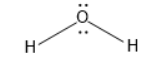
${H_2}O$ have two lone pairs and two bond pairs.
So, z ${H_2}O$ for will be four.
$z = 4$
Hybridisation of ${H_2}O$ is $S{p^3}$ and there are two lone pairs present there. Geometry will be angular or bent because of the electron-electron repulsion.
Geometry for \[N{H_4}^ + \] and \[C{H_4}\] is tetrahedral and they both don’t have lone pair of electrons and \[ds{p^2}\] type of hybridization is generally seen in transition metal ion.
Therefore, Option A is the correct and correct set is \[{H_2}O,\;s{p^3}\], angular.
Note:Geometry of a molecule can be explained by the arrangement of lone pair and bond pairs while shape can be explained by the arrangement of atoms around the atoms, it is not linked with lone pair and hence only deals with bond pairs.
-The molecules which do not have lone pairs of electrons tend to have the same shape as geometry, because the geometry of a molecule is affected by the lone pairs.
We need to find the geometry and hybridization of a given molecule. We can find the hybridization by knowing the number of sigma bonds and lone pairs. Geometry of a molecule can be explained by the arrangement of lone pair and bond pairs.
Complete step by step answer:
Hybridization is the concept of mixing atomic orbitals into new hybrid orbitals with different energies, shapes etc, that are suitable for the pairing of electrons to form chemical bonds in valence bond theory.
${\rm{z}} = \;{\rm{no}}{\rm{.}}\;{\rm{of}}\;\sigma \;{\rm{bond}}\; + \;{\rm{l}}{\rm{.p}}\;{\rm{on}}\;{\rm{central}}\;{\rm{atom}}$
Where, No. of $\sigma $ bond means single bond and l.p is the lone pair present on the central atom.
| Z | Hybridisation |
| $2$ | $Sp$ |
| $3$ | $S{p^2}$ |
| $4$ | $S{p^3}$ |
| $5$ | $S{p^3}d$ |
${H_2}O$ have two lone pairs and two bond pairs.
So, z ${H_2}O$ for will be four.
$z = 4$
Hybridisation of ${H_2}O$ is $S{p^3}$ and there are two lone pairs present there. Geometry will be angular or bent because of the electron-electron repulsion.
Geometry for \[N{H_4}^ + \] and \[C{H_4}\] is tetrahedral and they both don’t have lone pair of electrons and \[ds{p^2}\] type of hybridization is generally seen in transition metal ion.
Therefore, Option A is the correct and correct set is \[{H_2}O,\;s{p^3}\], angular.
Note:Geometry of a molecule can be explained by the arrangement of lone pair and bond pairs while shape can be explained by the arrangement of atoms around the atoms, it is not linked with lone pair and hence only deals with bond pairs.
-The molecules which do not have lone pairs of electrons tend to have the same shape as geometry, because the geometry of a molecule is affected by the lone pairs.
Recently Updated Pages
Basicity of sulphurous acid and sulphuric acid are

Master Class 12 Economics: Engaging Questions & Answers for Success
Master Class 12 Biology: Engaging Questions & Answers for Success
Master Class 11 English: Engaging Questions & Answers for Success
Master Class 11 Physics: Engaging Questions & Answers for Success
Master Class 11 Computer Science: Engaging Questions & Answers for Success
Trending doubts
Draw a labelled sketch of the human eye class 12 physics CBSE
The chemical formula of tear gas is A CO Cl 2 B C 10 class 12 chemistry CBSE
Draw ray diagrams each showing i myopic eye and ii class 12 physics CBSE
Which are the Top 10 Largest Countries of the World?
Differentiate between homogeneous and heterogeneous class 12 chemistry CBSE
Which is the correct genotypic ratio of mendel dihybrid class 12 biology CBSE