



Which one of the following is a ${{2}^{\circ }}$- allylic carbocation?
(A)- $\overset{\oplus }{\mathop{C{{H}_{2}}}}\,-CH=C{{H}_{2}}$
(B)- $C{{H}_{3}}-CH=CH-\overset{\oplus }{\mathop{C}}\,{{H}_{2}}$
(C)- ${{C}_{6}}{{H}_{5}}-CH=\overset{\oplus }{\mathop{CH}}\,$
(D)- $C{{H}_{3}}-\overset{\oplus }{\mathop{C}}\,H-CH=C{{H}_{2}}$
Answer
 Verified
615.9k+ views
Hint: The degree of the carbocation is determined by the number of alkyl or aryl groups attached to the positively charged carbon. Also, the allylic carbon adjacent to the double-bonded carbon.
Complete step by step answer:
Firstly, the allylic carbon is the carbon atom adjacent to the double- bonded carbon atom. And the allylic carbocation is formed by the removal of a hydrogen atom from the allylic carbon.
Depending on the number of alkyl or aryl group attached to the allylic carbon of the carbocation, except for the C-C bond with the adjacent double bonded carbon, it can be divided into:
- Primary or ${{1}^{\circ }}$ allylic carbocation having a positive charge over the carbon having only two hydrogens attached to it. So, compound (A) and (B) are primary allylic carbocation.
- Secondary or ${{2}^{\circ }}$ allylic carbocation has positive charge over the carbon having one alkyl or aryl group and one hydrogen attached to it. So, the compound (D) having a positive charge over the secondary carbon is a ${{2}^{\circ }}$ allylic carbocation.
- Tertiary or ${{3}^{\circ }}$ allylic carbocation has positive charge over the carbon with two alkyl or aryl groups attached to it.
Therefore, the a ${{2}^{\circ }}$- allylic carbocation is option (D)- $C{{H}_{3}}-\overset{\oplus }{\mathop{C}}\,H-CH=C{{H}_{2}}$.
Additional information: There is a presence of the empty p-orbital on the $s{{p}^{2}}$ hybridised carbon atom, adjacent to the double-bonded carbon in allylic carbocation. Due to which resonance takes place and causes the stabilisation, as there is an increase in the dispersion of the positive charge over the structure.
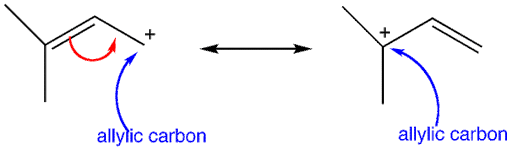
Note: The compound (C) having a positive charge directly over the double-bonded carbon atom, it is a vinylic carbocation. Also, the secondary allylic carbocation has only one alkyl and one hydrogen atom attached to it.
Complete step by step answer:
Firstly, the allylic carbon is the carbon atom adjacent to the double- bonded carbon atom. And the allylic carbocation is formed by the removal of a hydrogen atom from the allylic carbon.
Depending on the number of alkyl or aryl group attached to the allylic carbon of the carbocation, except for the C-C bond with the adjacent double bonded carbon, it can be divided into:
- Primary or ${{1}^{\circ }}$ allylic carbocation having a positive charge over the carbon having only two hydrogens attached to it. So, compound (A) and (B) are primary allylic carbocation.
- Secondary or ${{2}^{\circ }}$ allylic carbocation has positive charge over the carbon having one alkyl or aryl group and one hydrogen attached to it. So, the compound (D) having a positive charge over the secondary carbon is a ${{2}^{\circ }}$ allylic carbocation.
- Tertiary or ${{3}^{\circ }}$ allylic carbocation has positive charge over the carbon with two alkyl or aryl groups attached to it.
Therefore, the a ${{2}^{\circ }}$- allylic carbocation is option (D)- $C{{H}_{3}}-\overset{\oplus }{\mathop{C}}\,H-CH=C{{H}_{2}}$.
Additional information: There is a presence of the empty p-orbital on the $s{{p}^{2}}$ hybridised carbon atom, adjacent to the double-bonded carbon in allylic carbocation. Due to which resonance takes place and causes the stabilisation, as there is an increase in the dispersion of the positive charge over the structure.
Note: The compound (C) having a positive charge directly over the double-bonded carbon atom, it is a vinylic carbocation. Also, the secondary allylic carbocation has only one alkyl and one hydrogen atom attached to it.
Recently Updated Pages
Master Class 12 Business Studies: Engaging Questions & Answers for Success

Master Class 12 Biology: Engaging Questions & Answers for Success
Master Class 12 Chemistry: Engaging Questions & Answers for Success
Class 12 Question and Answer - Your Ultimate Solutions Guide
Master Class 11 Social Science: Engaging Questions & Answers for Success
Master Class 11 English: Engaging Questions & Answers for Success
Trending doubts
Which are the Top 10 Largest Countries of the World?
Draw a labelled sketch of the human eye class 12 physics CBSE
Differentiate between homogeneous and heterogeneous class 12 chemistry CBSE
Why is the cell called the structural and functional class 12 biology CBSE
Draw ray diagrams each showing i myopic eye and ii class 12 physics CBSE
Which is the correct genotypic ratio of mendel dihybrid class 12 biology CBSE