




Which one is the most active and efficient nitrogen fixer?
A. Anabaena
B. Nostoc
C. Aulosira
D. Trichodesmium
Answer
 Verified
608.7k+ views
Hint: Cyanobacteria/Blue-green algae are nitrogen-fixing bacteria. They are found in both aquatic and terrestrial habitat. Some examples are Anabaena, Azolla, Nostoc, Aulosira, Oscillatoria, Trichodesmium, etc.
Step by step answer:Cyanobacteria are a group of photosynthetic bacteria. These bacteria also help in the nitrogen-fixation. They mainly live in damp environments like moist soil or water. Sometimes they are also found in symbiotic relationships with plants and fungi.
-Cyanobacteria range from unicellular forms to filamentous forms to colonial forms. Under harsh conditions, they form climate-resistant spores known as the akinetes.
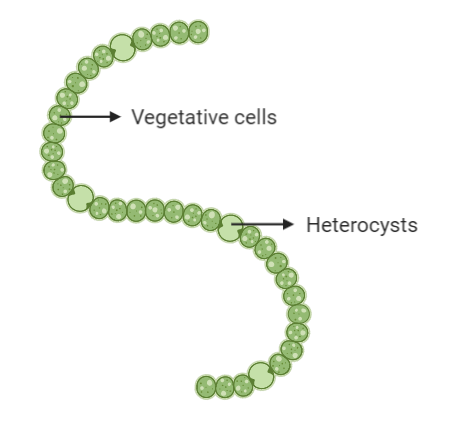
-Cyanobacteria fix the atmospheric nitrogen. Cyanobacteria have specialized cells called heterocysts that help in fixing the atmospheric nitrogen in anaerobic conditions. But sometimes heterocysts also form under suitable and favorable environmental conditions if the fixed nitrogen is scarce.
-Cyanobacteria fix or convert the nitrogen gas into ammonia, nitrites, or nitrates that can be easily absorbed by plants and converted to protein and nucleic acids.
-Anabaena or Anabaena azollae is phototrophic cyanobacteria (blue-green algae) that fixes the atmospheric nitrogen to provide nutrients to plants.
-Nostoc is a genus of cyanobacteria that also fixes atmospheric nitrogen.
-Aulosira is a genus of filamentous cyanobacteria that are active nitrogen fixers in the rice fields.
-Trichodesmium is a filamentous cyanobacterium that is found in the aquatic habitat.
Aulosira is the most active and efficient nitrogen fixer.
Hence option C is correct.
Note: Cyanobacteria are commonly known as blue-green algae or BGA. Not every BGA is bluish-green in colour, for example, Batrachospermum. They were kept along with algae but later it was discovered that they are actually bacteria.
Step by step answer:Cyanobacteria are a group of photosynthetic bacteria. These bacteria also help in the nitrogen-fixation. They mainly live in damp environments like moist soil or water. Sometimes they are also found in symbiotic relationships with plants and fungi.
-Cyanobacteria range from unicellular forms to filamentous forms to colonial forms. Under harsh conditions, they form climate-resistant spores known as the akinetes.
-Cyanobacteria fix the atmospheric nitrogen. Cyanobacteria have specialized cells called heterocysts that help in fixing the atmospheric nitrogen in anaerobic conditions. But sometimes heterocysts also form under suitable and favorable environmental conditions if the fixed nitrogen is scarce.
-Cyanobacteria fix or convert the nitrogen gas into ammonia, nitrites, or nitrates that can be easily absorbed by plants and converted to protein and nucleic acids.
-Anabaena or Anabaena azollae is phototrophic cyanobacteria (blue-green algae) that fixes the atmospheric nitrogen to provide nutrients to plants.
-Nostoc is a genus of cyanobacteria that also fixes atmospheric nitrogen.
-Aulosira is a genus of filamentous cyanobacteria that are active nitrogen fixers in the rice fields.
-Trichodesmium is a filamentous cyanobacterium that is found in the aquatic habitat.
Aulosira is the most active and efficient nitrogen fixer.
Hence option C is correct.
Note: Cyanobacteria are commonly known as blue-green algae or BGA. Not every BGA is bluish-green in colour, for example, Batrachospermum. They were kept along with algae but later it was discovered that they are actually bacteria.
Recently Updated Pages
Master Class 11 English: Engaging Questions & Answers for Success

Master Class 11 Maths: Engaging Questions & Answers for Success
Class 11 Question and Answer - Your Ultimate Solutions Guide
Master Class 11 Biology: Engaging Questions & Answers for Success
Master Class 11 Physics: Engaging Questions & Answers for Success
Master Class 11 Accountancy: Engaging Questions & Answers for Success
Trending doubts
Differentiate between an exothermic and an endothermic class 11 chemistry CBSE
One Metric ton is equal to kg A 10000 B 1000 C 100 class 11 physics CBSE
In what year Guru Nanak Dev ji was born A15 April 1469 class 11 social science CBSE
Difference Between Prokaryotic Cells and Eukaryotic Cells
There are 720 permutations of the digits 1 2 3 4 5 class 11 maths CBSE
Draw a diagram of a plant cell and label at least eight class 11 biology CBSE