




Which one is the first vertebrate to have evolved?
(a) Jawless fish
(b) Monkey
(c) Frog
(d) Horse
Answer
 Verified
652.5k+ views
Hint: The first vertebrate to have evolved belongs to the class Agnatha. They include lampreys and hagfish. These first vertebrates do not have scales. They also lack jaws, fins, and stomach. They have a notochord and paired pouches.
Complete answer
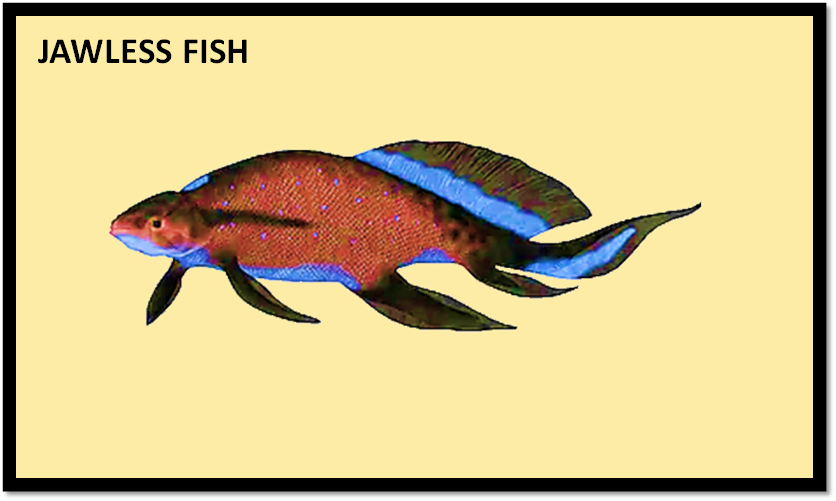
The first vertebrate to have evolved is the jawless fish. Under kingdom Animalia, comes the phylum Chordata. Among the subphylums included under phylum Chordata, comes subphylum Vertebrata. Vertebrata includes all the known large animals and some rare and unusual animals as well. The seven living classes of vertebrates are distinguished majorly on the basis of the skeletal system, general environmental adaptation, and reproductive system. These seven classes are Agnatha, Chondrichthyes, Osteichthyes, Amphibia, Reptilia, Aves, and Mammalia. Three among the vertebrate classes are fish. The most primitive of these is Agnatha. The class Agnatha consists of jawless fish.
Additional information:
- The term monkey is descriptively applied to groups of primates which include families of New World monkeys and Old World monkeys.
- Frogs constitute the order Anura which in ancient Greek literally means without a tail.
So, the correct answer is, ‘Jawless fish.’
Note:
- Monkey is a common name that may refer to a number of species of mammals. They belong to simians of infraorder Simiiformes.
- Frogs are members of a diverse and largely carnivorous group of tail- less, short- bodied amphibians.
- Horses (Equus ferus caballus) are one of the two extant subspecies of Equus ferus. They belong to the class Mammalia under phylum Chordata.
Complete answer
The first vertebrate to have evolved is the jawless fish. Under kingdom Animalia, comes the phylum Chordata. Among the subphylums included under phylum Chordata, comes subphylum Vertebrata. Vertebrata includes all the known large animals and some rare and unusual animals as well. The seven living classes of vertebrates are distinguished majorly on the basis of the skeletal system, general environmental adaptation, and reproductive system. These seven classes are Agnatha, Chondrichthyes, Osteichthyes, Amphibia, Reptilia, Aves, and Mammalia. Three among the vertebrate classes are fish. The most primitive of these is Agnatha. The class Agnatha consists of jawless fish.
Additional information:
- The term monkey is descriptively applied to groups of primates which include families of New World monkeys and Old World monkeys.
- Frogs constitute the order Anura which in ancient Greek literally means without a tail.
So, the correct answer is, ‘Jawless fish.’
Note:
- Monkey is a common name that may refer to a number of species of mammals. They belong to simians of infraorder Simiiformes.
- Frogs are members of a diverse and largely carnivorous group of tail- less, short- bodied amphibians.
- Horses (Equus ferus caballus) are one of the two extant subspecies of Equus ferus. They belong to the class Mammalia under phylum Chordata.
Recently Updated Pages
If x a + bt + ct2 where x is in meters and t is in class 11 physics CBSE

A car covers the first half distance between two places class 11 physics CBSE
The resultant of two vectors overrightarrow P and overrightarrow class 11 physics CBSE
Find the value of cos 135 class 11 maths CBSE
A mass M is held in place by an applied force F and class 11 physics CBSE
A solution of glucose in water is labelled as 10 dfracwv class 11 chemistry CBSE
Trending doubts
One Metric ton is equal to kg A 10000 B 1000 C 100 class 11 physics CBSE
Find the value of the expression given below sin 30circ class 11 maths CBSE
What do you mean by retardation What is its SI uni class 11 physics CBSE
Draw a diagram of nephron and explain its structur class 11 biology CBSE
10 examples of friction in our daily life
Difference between physical and chemical change class 11 chemistry CBSE