




Which one is the bone of the skull?
A) Atlas
B) Femur
C) Tibia
D) Pterygoid
Answer
 Verified
617.4k+ views
Hint:By looking at the skeletal system, we can tell the position of these bones. Out of these options, femur and tibia can be easily said to be wrong choices as they are present in legs. Atlas and pterygoid are present closer to the head as compared to other options.
Complete Answer:
The skull is a structure composed of bones which forms the head in vertebrates. It provides a protective cavity around the brain and also supports the structures of the face. The skull has two parts, the cranium and the mandible which are called the neurocranium and the viscerocranium in humans where the largest bone is mandible. The skull forms the top anterior portion of the skeleton. It is a product of cephalisation which also contains several sensory structures including the eyes, ears, nose, and mouth. These sensory structures are part of the facial skeleton in humans. All of the bones of the skull are fused together by sutures called synarthrodial. The human skull generally consists of twenty-two bones including eight cranial bones and fourteen facial skeleton bones. There are the occipital bones, 2 temporal bones, 2 parietal bones, a sphenoid, ethmoid and frontal bones in the neurocranium. There are fourteen bones of the facial skeleton which are the vomer, 2 inferior nasal conchae, 2 nasal bones, 2 maxilla, the mandible, two palatine bones, 2 zygomatic bones, and 2 lacrimal bones. Sometimes the paired bones are counted as one, or the maxilla counted as two bones. The pterygoid is a paired bone which forms a part of the palate in many vertebrates. It is present behind the palatine bones.
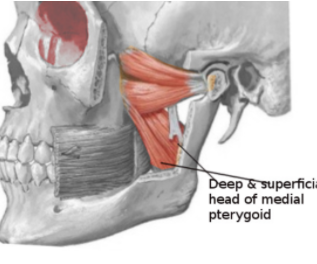
Hence D. Pterygoid is a bone of the skull.
Note:Pterygoid bone is a part of the facial skeleton. In humans, pterygoid bone forms the pterygoid processes of the sphenoid bone. Atlas is a vertebrae which supports the weight of the skull.
Complete Answer:
The skull is a structure composed of bones which forms the head in vertebrates. It provides a protective cavity around the brain and also supports the structures of the face. The skull has two parts, the cranium and the mandible which are called the neurocranium and the viscerocranium in humans where the largest bone is mandible. The skull forms the top anterior portion of the skeleton. It is a product of cephalisation which also contains several sensory structures including the eyes, ears, nose, and mouth. These sensory structures are part of the facial skeleton in humans. All of the bones of the skull are fused together by sutures called synarthrodial. The human skull generally consists of twenty-two bones including eight cranial bones and fourteen facial skeleton bones. There are the occipital bones, 2 temporal bones, 2 parietal bones, a sphenoid, ethmoid and frontal bones in the neurocranium. There are fourteen bones of the facial skeleton which are the vomer, 2 inferior nasal conchae, 2 nasal bones, 2 maxilla, the mandible, two palatine bones, 2 zygomatic bones, and 2 lacrimal bones. Sometimes the paired bones are counted as one, or the maxilla counted as two bones. The pterygoid is a paired bone which forms a part of the palate in many vertebrates. It is present behind the palatine bones.
Hence D. Pterygoid is a bone of the skull.
Note:Pterygoid bone is a part of the facial skeleton. In humans, pterygoid bone forms the pterygoid processes of the sphenoid bone. Atlas is a vertebrae which supports the weight of the skull.
Recently Updated Pages
Master Class 12 Economics: Engaging Questions & Answers for Success

Master Class 12 English: Engaging Questions & Answers for Success
Master Class 12 Social Science: Engaging Questions & Answers for Success
Master Class 12 Maths: Engaging Questions & Answers for Success
Master Class 12 Physics: Engaging Questions & Answers for Success
Master Class 9 General Knowledge: Engaging Questions & Answers for Success
Trending doubts
Which are the Top 10 Largest Countries of the World?
Draw a labelled sketch of the human eye class 12 physics CBSE
Differentiate between homogeneous and heterogeneous class 12 chemistry CBSE
Why is the cell called the structural and functional class 12 biology CBSE
Draw ray diagrams each showing i myopic eye and ii class 12 physics CBSE
Which is the correct genotypic ratio of mendel dihybrid class 12 biology CBSE