




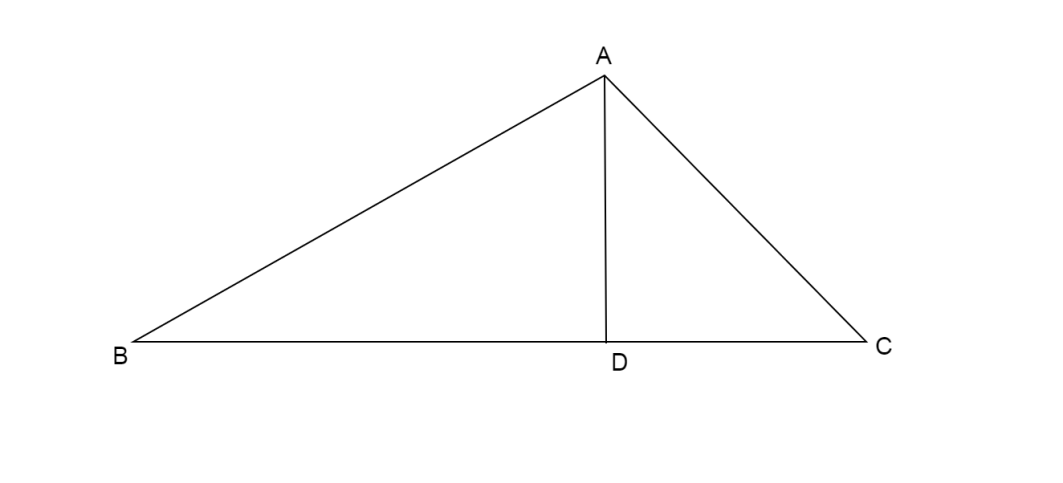
Which of the two triangles have \[\angle B\]common?
Answer
 Verified
591.3k+ views
Hint: We write all the possible triangles that can be seen or formed in the given figure. Select two triangles that have \[\angle B\]as one of their angles.
* A triangle is a figure that has 3 vertices which on joining give us three sides. Each vertex has an angle associated with it.
* Common angle means the angle that exists in both the triangles.
Step-By-Step answer:
We are given the figure
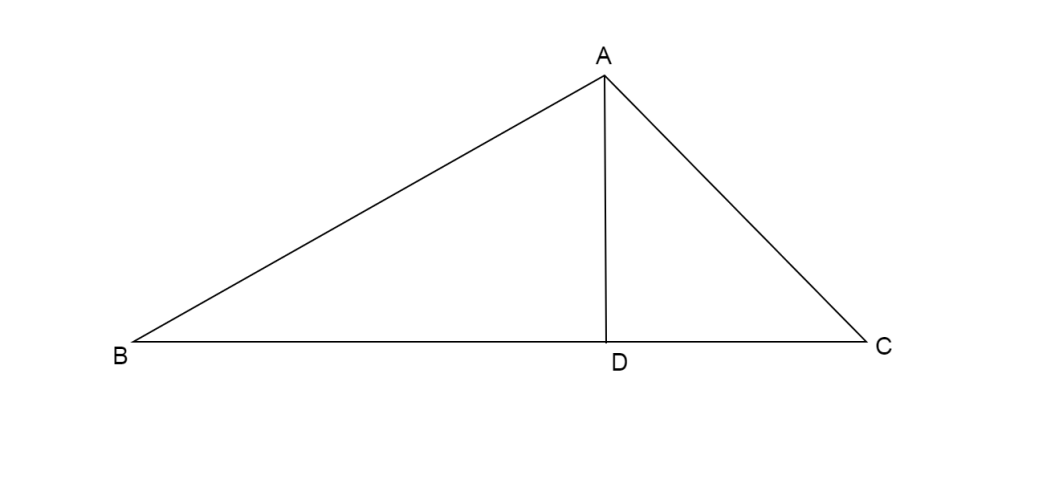
Since there are four points in the figure i.e. A, B, C and D then the number of triangles is greater than one.
We write all possible triangles that can be formed using the given figure
\[\vartriangle ABC;\vartriangle ABD;\vartriangle ACD\]
So there are in total three triangles that can be formed using the given figure
Now we check in which of the two triangles from the three triangles formed we have angle B
In \[\vartriangle ABC\], we have angles A, B and C … (1)
In \[\vartriangle ABD\], we have angles A, B and D … (2)
In \[\vartriangle ACD\], we have angles A, C and D … (3)
Then from equations (1) and (2) we can see that angle B is existing in both triangles \[\vartriangle ABC\] and \[\vartriangle ABD\]
\[\therefore \]Two triangles having \[\angle B\] common are \[\vartriangle ABC\] and \[\vartriangle ABD\].
Note: Many students get confused with the given figure as they see it only as one triangle and write the answer as \[\vartriangle ABC\] and \[\vartriangle ACB\] by replacing the vertices in the name which is wrong. These two triangle names are for the same triangle, we use the line AD and write the two triangles formed by that line and then choose the triangles with common angle B.
* A triangle is a figure that has 3 vertices which on joining give us three sides. Each vertex has an angle associated with it.
* Common angle means the angle that exists in both the triangles.
Step-By-Step answer:
We are given the figure
Since there are four points in the figure i.e. A, B, C and D then the number of triangles is greater than one.
We write all possible triangles that can be formed using the given figure
\[\vartriangle ABC;\vartriangle ABD;\vartriangle ACD\]
So there are in total three triangles that can be formed using the given figure
Now we check in which of the two triangles from the three triangles formed we have angle B
In \[\vartriangle ABC\], we have angles A, B and C … (1)
In \[\vartriangle ABD\], we have angles A, B and D … (2)
In \[\vartriangle ACD\], we have angles A, C and D … (3)
Then from equations (1) and (2) we can see that angle B is existing in both triangles \[\vartriangle ABC\] and \[\vartriangle ABD\]
\[\therefore \]Two triangles having \[\angle B\] common are \[\vartriangle ABC\] and \[\vartriangle ABD\].
Note: Many students get confused with the given figure as they see it only as one triangle and write the answer as \[\vartriangle ABC\] and \[\vartriangle ACB\] by replacing the vertices in the name which is wrong. These two triangle names are for the same triangle, we use the line AD and write the two triangles formed by that line and then choose the triangles with common angle B.
Recently Updated Pages
Master Class 12 Business Studies: Engaging Questions & Answers for Success

Master Class 12 Chemistry: Engaging Questions & Answers for Success
Master Class 12 Biology: Engaging Questions & Answers for Success
Class 12 Question and Answer - Your Ultimate Solutions Guide
Master Class 11 English: Engaging Questions & Answers for Success
Master Class 11 Maths: Engaging Questions & Answers for Success
Trending doubts
Which is more stable and why class 12 chemistry CBSE
Which are the Top 10 Largest Countries of the World?
Draw a labelled sketch of the human eye class 12 physics CBSE
Differentiate between homogeneous and heterogeneous class 12 chemistry CBSE
What are the major means of transport Explain each class 12 social science CBSE
Sulphuric acid is known as the king of acids State class 12 chemistry CBSE