




Which of the following statements is not correct regarding the EcoRI restriction endonuclease enzyme?
(a) It is isolated from Escherichia coli RY13
(b) Its recognition sequence is 5’-GAATTC-3’ 3’-CTTAAG-5’
(c) It produces complementary blunt ends
(d) None of these
Answer
 Verified
612k+ views
Hint: The restriction endonuclease is also known as molecular scissors. It is an important enzyme in recombinant DNA technology. EcoRI restriction endonuclease enzyme is isolated from a gram-negative bacteria and it cleaves its recognition sequence leaving a characteristic pattern of strand behind.
Complete answer:
A restriction endonuclease is an enzyme isolated from bacteria that can cut dsDNA into fragments. It does so by recognizing specific nucleotide sequences as ‘recognition’ or ‘restriction site’. The term ‘restriction’ comes from the observation that these enzymes hamper or obstruct the entry of foreign DNA in the bacteria. EcoRI is a restriction endonuclease that has been isolated and extracted from bacteria E.coli RY13. It recognizes the nucleotide sequence of 5’-GAATTC-3’ and it is complementary 3’-CTTAAG-5’ on the double strand of DNA duplex. After recognizing its target sequence, it cleaves it resulting in sticky ends or 5’ overhangs rather than any blunt ends.
Additional Information: - In 1970, Hamilton-Smith and his coworkers first isolated a restriction enzyme from the bacterium Haemophilus Influenzae and named it HindII which recognizes a six pair dsDNA sequence.
-The naming of restriction endonuclease involves the abbreviations of the bacterial species from which the enzyme is isolated. E.g., Eco- for E. coli and Hin- for H. influenzae. Roman numerals are also used to indicate the sequence of discovery if more than one restriction enzyme has been isolated from the same bacterial strain.
-The action of restriction enzymes is either blunt or staggered cuts. Blunt ends occur when both ends of cut DNA have a base pair. While in staggered cuts, sticky ends wherein the two cut ends of DNA do not possess any base pair. After the staggering cuts, the resulting restriction DNA fragments possess 5’ overhangs or 3’ overhangs.
So, the correct answer is ‘It produces complementary blunt ends.’
Note: -W. Arber was the first scientist who postulated about ‘restriction enzymes.’ He noticed the fragmentation of bacteriophage’s DNA into smaller pieces when bacteriophage injects its DNA into the bacteria
- EcoRII is isolated from gram-negative Escherichia coli. It recognizes a six pair dsDNA sequence 5’-CCWGG-3’ where W= either Adenine(A) or Thymine(T). It produces sticky ends.
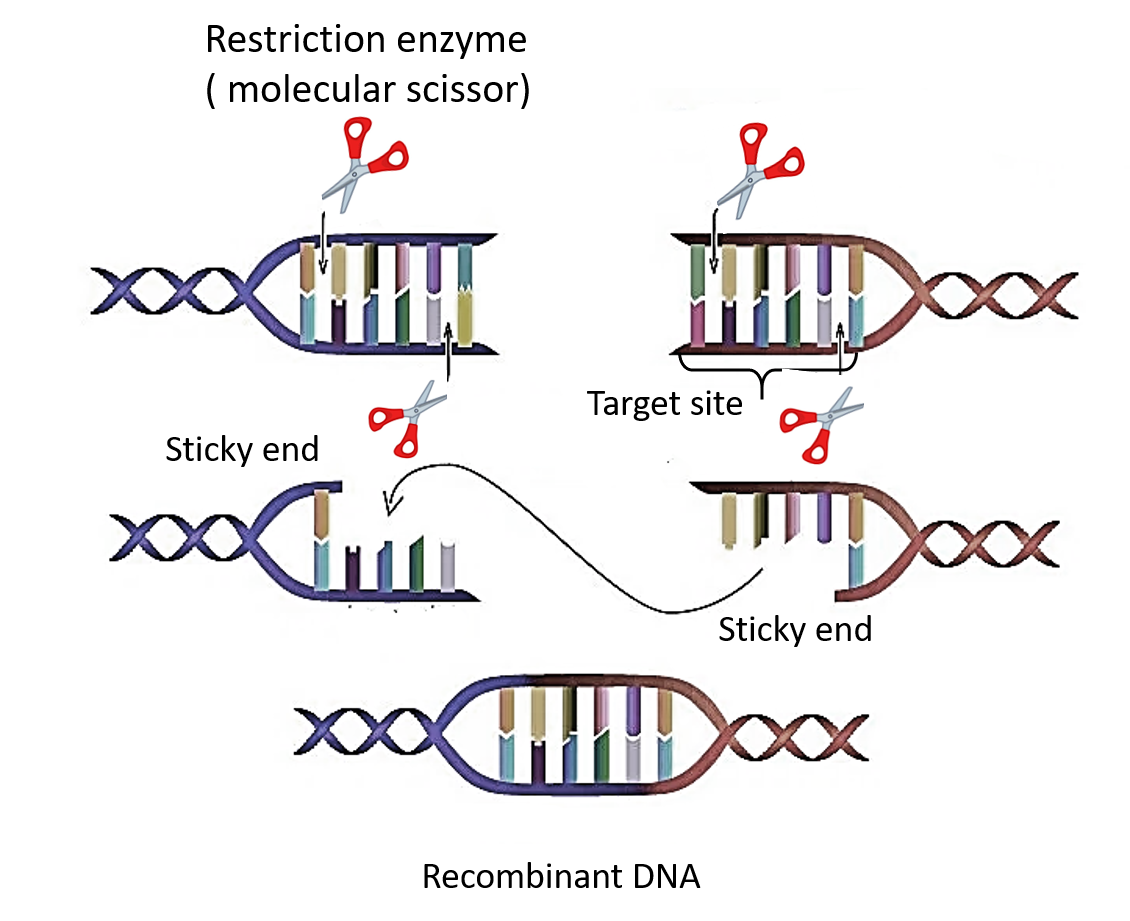
Complete answer:
A restriction endonuclease is an enzyme isolated from bacteria that can cut dsDNA into fragments. It does so by recognizing specific nucleotide sequences as ‘recognition’ or ‘restriction site’. The term ‘restriction’ comes from the observation that these enzymes hamper or obstruct the entry of foreign DNA in the bacteria. EcoRI is a restriction endonuclease that has been isolated and extracted from bacteria E.coli RY13. It recognizes the nucleotide sequence of 5’-GAATTC-3’ and it is complementary 3’-CTTAAG-5’ on the double strand of DNA duplex. After recognizing its target sequence, it cleaves it resulting in sticky ends or 5’ overhangs rather than any blunt ends.
Additional Information: - In 1970, Hamilton-Smith and his coworkers first isolated a restriction enzyme from the bacterium Haemophilus Influenzae and named it HindII which recognizes a six pair dsDNA sequence.
-The naming of restriction endonuclease involves the abbreviations of the bacterial species from which the enzyme is isolated. E.g., Eco- for E. coli and Hin- for H. influenzae. Roman numerals are also used to indicate the sequence of discovery if more than one restriction enzyme has been isolated from the same bacterial strain.
-The action of restriction enzymes is either blunt or staggered cuts. Blunt ends occur when both ends of cut DNA have a base pair. While in staggered cuts, sticky ends wherein the two cut ends of DNA do not possess any base pair. After the staggering cuts, the resulting restriction DNA fragments possess 5’ overhangs or 3’ overhangs.
So, the correct answer is ‘It produces complementary blunt ends.’
Note: -W. Arber was the first scientist who postulated about ‘restriction enzymes.’ He noticed the fragmentation of bacteriophage’s DNA into smaller pieces when bacteriophage injects its DNA into the bacteria
- EcoRII is isolated from gram-negative Escherichia coli. It recognizes a six pair dsDNA sequence 5’-CCWGG-3’ where W= either Adenine(A) or Thymine(T). It produces sticky ends.
Recently Updated Pages
Master Class 9 General Knowledge: Engaging Questions & Answers for Success

Master Class 9 Maths: Engaging Questions & Answers for Success
Master Class 9 Science: Engaging Questions & Answers for Success
Master Class 9 English: Engaging Questions & Answers for Success
Master Class 9 Social Science: Engaging Questions & Answers for Success
Class 9 Question and Answer - Your Ultimate Solutions Guide
Trending doubts
Which are the Top 10 Largest Countries of the World?
Draw a labelled sketch of the human eye class 12 physics CBSE
Differentiate between homogeneous and heterogeneous class 12 chemistry CBSE
Sulphuric acid is known as the king of acids State class 12 chemistry CBSE
Why is the cell called the structural and functional class 12 biology CBSE
A dentist uses a small mirror that gives a magnification class 12 physics CBSE