




Which of the following shows the maximum diversity?
A. Algae
B. Fungi
C. Pteridophytes
D. Bryophytes
Answer
 Verified
617.4k+ views
Hint: Biodiversity is the variety of life on earth. It includes all different plants, animals, and microorganisms. The maximum diversity is seen in members of the group of eukaryotic organisms that includes microorganisms such as yeasts and moulds.
Complete answer: Biodiversity is a term coined by Edward Wilson, a social biologist, to define the collective diversity of organisms at all levels. The most important of these are
a) Genetic Diversity
b) Diversity of organisms
c) Ecological Diversity
Fungi reflect the largest number of species in global biodiversity. They are widely distributed in the world. Most of the fungi are inconspicuous because of their small size structures and their mysterious way of presence in plants, animals, or other fungi in the soil, on dead matter, and as symbionts. Fungi are globally distributed and thrive in a wide variety of habitats, including extreme conditions such as deserts or areas with high concentrations of salt or ionising radiation, as well as deep-sea sediments.
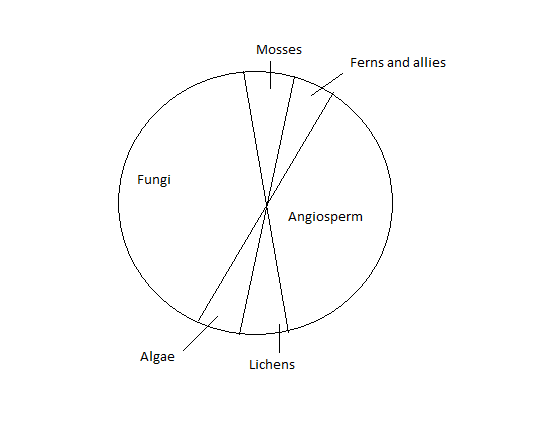
Some can survive the extreme UV and cosmic radiation experienced during space travel. The following figure demonstrates the global biodiversity of mushrooms, moose, fern, algae, lichens and angiosperms. Accordingly, it is obvious from the figure above that the fungi have the highest number of species among the world's biodiversity.
Hence, the correct answer is option B.
Note: Animals are present in huge numbers. They inhabit a range of habitats and are found all over the world. It has been estimated that there are about 7 million animal species in the world out of which 1.5 million have been identified and studied so far. Of these 1,5 million live creatures, 1 million are insects.
Complete answer: Biodiversity is a term coined by Edward Wilson, a social biologist, to define the collective diversity of organisms at all levels. The most important of these are
a) Genetic Diversity
b) Diversity of organisms
c) Ecological Diversity
Fungi reflect the largest number of species in global biodiversity. They are widely distributed in the world. Most of the fungi are inconspicuous because of their small size structures and their mysterious way of presence in plants, animals, or other fungi in the soil, on dead matter, and as symbionts. Fungi are globally distributed and thrive in a wide variety of habitats, including extreme conditions such as deserts or areas with high concentrations of salt or ionising radiation, as well as deep-sea sediments.
Some can survive the extreme UV and cosmic radiation experienced during space travel. The following figure demonstrates the global biodiversity of mushrooms, moose, fern, algae, lichens and angiosperms. Accordingly, it is obvious from the figure above that the fungi have the highest number of species among the world's biodiversity.
Hence, the correct answer is option B.
Note: Animals are present in huge numbers. They inhabit a range of habitats and are found all over the world. It has been estimated that there are about 7 million animal species in the world out of which 1.5 million have been identified and studied so far. Of these 1,5 million live creatures, 1 million are insects.
Recently Updated Pages
Master Class 11 English: Engaging Questions & Answers for Success

Master Class 11 Physics: Engaging Questions & Answers for Success
Master Class 11 Computer Science: Engaging Questions & Answers for Success
Master Class 11 Chemistry: Engaging Questions & Answers for Success
Master Class 11 Social Science: Engaging Questions & Answers for Success
Master Class 11 Accountancy: Engaging Questions & Answers for Success
Trending doubts
Draw a diagram of a plant cell and label at least eight class 11 biology CBSE
Proton was discovered by A Thomson B Rutherford C Chadwick class 11 chemistry CBSE
What is the purity of pure gold in carat class 11 chemistry CBSE
Can anyone list 10 advantages and disadvantages of friction
Lysosomes are known as suicidal bags of cell why class 11 biology CBSE
Derive the equation of motion by the calculus method class 11 physics CBSE