




Which of the following sequences would yield \[m - nitro\] chlorobenzene (Z) from benzene?
(A) \[Benzene\mathop \to \limits^{C{l_2}/FeC{l_3}} (X)\mathop \to \limits_{{H_2}S{O_4}}^{HN{O_3}} (Z)\] $$
(B) \[Benzene\mathop \to \limits^{{H_2}S{O_4}/HN{O_3}} (Z)\]
(C) \[Benzene\mathop \to \limits^{{H_2}S{O_4}/HN{O_3}} (X)\mathop \to \limits^{C{l_2}/FeC{l_3}} (Z)\]
(D) All of these
Answer
 Verified
609k+ views
Hint:m-nitro chlorobenzene is an organic compound having formula ${C_6}{H_4}ClN{O_2}$. It is yellow in colour and acts as a precursor in many reactions. Benzene can be converted into m-nitro chlorobenzene by undergoing nitration and addition of chlorine.
Complete step by step answer:
As we know, benzene is ${C_6}{H_5}$, having structure as shown below

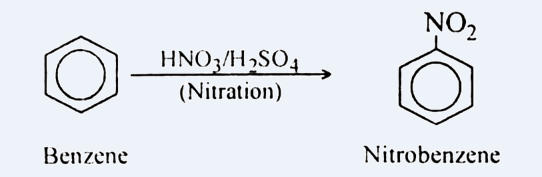
For converting it into m-nitro chlorobenzene, we need to add \[ - nitro\] and \[ - chloro\] groups in benzene. For the same, the reaction is carried out in two steps. In first step, we add nitrating mixture i.e. $HN{O_3}$ and ${H_2}S{O_4}$ to benzene, this step is known as nitration. It leads to the addition of $N{O_2}$ on Benzene. It can be shown as:
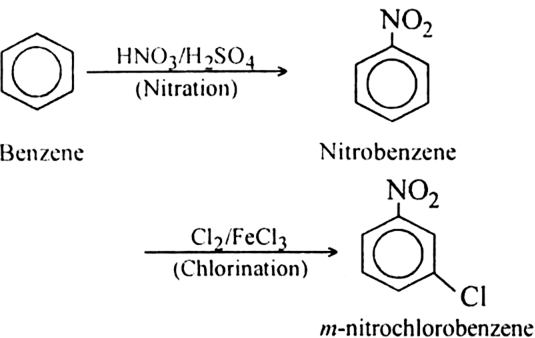
In the next step, $FeC{l_3}$ and $C{l_2}$ are added to nitrobenzene. $N{O_2}$ is an electron withdrawing, meta directing group. Therefore, it will add the chlorine at meta position, forming the desired product i.e. \[m - nitro\] chlorobenzene. The overall reaction is
The meta isomer of nitro chlorobenzene is not active towards nucleophilic substitution at chlorine center. m-nitro chlorobenzene can be reduced to \[3 - chloroaniline\;\] with \[Fe/HCl\] mixture, this reaction is called Bechamp reduction.
Hence, the correct option is C.
Additional information:
m-nitro chlorobenzene is also known as \[3 - nitro\] chlorobenzene. It’s IUPAC name is \[1 - chloro{\text{ }}3 - nitrobenzene\] . This compound generally does not have any direct application, but it acts as a precursor of other compounds such as \[3 - chloroaniline\] .
Note:
If we do the two above mentioned steps in reverse order i.e. firstly we add $FeC{l_3}$ and $C{l_2}$ into Benzene, it will form chlorobenzene. In the second step, if nitration is to be done we should first note that chlorine is the \[ortho/para\] directing group. Therefore, it will add the $N{O_2}$ at \[ortho/para\] position, forming \[o - nitro\] chlorobenzene or \[p - nitro\] p-nitro chlorobenzene but not m-nitro chlorobenzene.
Complete step by step answer:
As we know, benzene is ${C_6}{H_5}$, having structure as shown below
For converting it into m-nitro chlorobenzene, we need to add \[ - nitro\] and \[ - chloro\] groups in benzene. For the same, the reaction is carried out in two steps. In first step, we add nitrating mixture i.e. $HN{O_3}$ and ${H_2}S{O_4}$ to benzene, this step is known as nitration. It leads to the addition of $N{O_2}$ on Benzene. It can be shown as:
In the next step, $FeC{l_3}$ and $C{l_2}$ are added to nitrobenzene. $N{O_2}$ is an electron withdrawing, meta directing group. Therefore, it will add the chlorine at meta position, forming the desired product i.e. \[m - nitro\] chlorobenzene. The overall reaction is
The meta isomer of nitro chlorobenzene is not active towards nucleophilic substitution at chlorine center. m-nitro chlorobenzene can be reduced to \[3 - chloroaniline\;\] with \[Fe/HCl\] mixture, this reaction is called Bechamp reduction.
Hence, the correct option is C.
Additional information:
m-nitro chlorobenzene is also known as \[3 - nitro\] chlorobenzene. It’s IUPAC name is \[1 - chloro{\text{ }}3 - nitrobenzene\] . This compound generally does not have any direct application, but it acts as a precursor of other compounds such as \[3 - chloroaniline\] .
Note:
If we do the two above mentioned steps in reverse order i.e. firstly we add $FeC{l_3}$ and $C{l_2}$ into Benzene, it will form chlorobenzene. In the second step, if nitration is to be done we should first note that chlorine is the \[ortho/para\] directing group. Therefore, it will add the $N{O_2}$ at \[ortho/para\] position, forming \[o - nitro\] chlorobenzene or \[p - nitro\] p-nitro chlorobenzene but not m-nitro chlorobenzene.
Recently Updated Pages
Three beakers labelled as A B and C each containing 25 mL of water were taken A small amount of NaOH anhydrous CuSO4 and NaCl were added to the beakers A B and C respectively It was observed that there was an increase in the temperature of the solutions contained in beakers A and B whereas in case of beaker C the temperature of the solution falls Which one of the following statements isarecorrect i In beakers A and B exothermic process has occurred ii In beakers A and B endothermic process has occurred iii In beaker C exothermic process has occurred iv In beaker C endothermic process has occurred

Master Class 12 Social Science: Engaging Questions & Answers for Success
Master Class 12 Physics: Engaging Questions & Answers for Success
Master Class 12 Maths: Engaging Questions & Answers for Success
Master Class 12 Economics: Engaging Questions & Answers for Success
Master Class 12 Chemistry: Engaging Questions & Answers for Success
Three beakers labelled as A B and C each containing 25 mL of water were taken A small amount of NaOH anhydrous CuSO4 and NaCl were added to the beakers A B and C respectively It was observed that there was an increase in the temperature of the solutions contained in beakers A and B whereas in case of beaker C the temperature of the solution falls Which one of the following statements isarecorrect i In beakers A and B exothermic process has occurred ii In beakers A and B endothermic process has occurred iii In beaker C exothermic process has occurred iv In beaker C endothermic process has occurred
Master Class 12 Social Science: Engaging Questions & Answers for Success
Master Class 12 Physics: Engaging Questions & Answers for Success
Trending doubts
Which are the Top 10 Largest Countries of the World?
Draw a labelled sketch of the human eye class 12 physics CBSE
Differentiate between homogeneous and heterogeneous class 12 chemistry CBSE
What are the major means of transport Explain each class 12 social science CBSE
Sulphuric acid is known as the king of acids State class 12 chemistry CBSE
Why should a magnesium ribbon be cleaned before burning class 12 chemistry CBSE