




Which of the following represents an infrared wavelength?
A) ${10^{ - 4}}$ cm
B) ${10^{ - 5}}$ cm
C) ${10^{ - 6}}$ cm
D) ${10^{ - 7}}$ cm
Answer
 Verified
621.9k+ views
Hint:Infrared radiations are electromagnetic radiations and thus is a part of the electromagnetic spectrum where all the radiations (electromagnetic) are distributed according to frequency and wavelength. The wavelength table of the electromagnetic spectrum can be used to identify which of the given options represents an infrared wavelength.
We need to carry out the conversions as all the options are given in cm.
Complete step by step answer:Electromagnetic spectrum is the range of all electromagnetic radiations and these radiations are distributed according to frequency and wavelength.
Infrared radiation is invisible to the eyes as these are beyond the red end of the visible spectrum.
Wavelength table of electromagnetic spectrum:
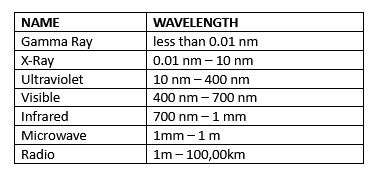
From the table it can be observed the range of Infrared radiations is:
700 nm to 1 mm
Converting this range into cm:
$700 \times {10^{ - 7}} = 7 \times {10^{ - 5}}cm$
$1 \times {10^{ - 1}} = 0.1cm({10^{ - 1}})$
Range in cm = $7 \times {10^{ - 5}}$ cm - ${10^{ - 1}}$
The only option falling under this range is ${10^{ - 4}}$ cm (Rest all does not fall into this range; either have lower or higher values)
Checking on number line:
From here, we can see that ${10^{ - 4}}$ satisfies this range but ${10^{ - 5}}$ cm, ${10^{ - 6}}$ cm, ${10^{ - 7}}$ cm does not.
Therefore, the correct answer is option A) ${10^{ - 4}}$ cm.
Note:Infrared radiations cannot be seen (as it is beyond visible rays wavelength) but can be felt due to its warmth.
It can be classified as near, middle and far depending upon its distance with respect to the visible spectrum.
We need to carry out the conversions as all the options are given in cm.
Complete step by step answer:Electromagnetic spectrum is the range of all electromagnetic radiations and these radiations are distributed according to frequency and wavelength.
Infrared radiation is invisible to the eyes as these are beyond the red end of the visible spectrum.
Wavelength table of electromagnetic spectrum:
From the table it can be observed the range of Infrared radiations is:
700 nm to 1 mm
Converting this range into cm:
$700 \times {10^{ - 7}} = 7 \times {10^{ - 5}}cm$
$1 \times {10^{ - 1}} = 0.1cm({10^{ - 1}})$
Range in cm = $7 \times {10^{ - 5}}$ cm - ${10^{ - 1}}$
The only option falling under this range is ${10^{ - 4}}$ cm (Rest all does not fall into this range; either have lower or higher values)
Checking on number line:
From here, we can see that ${10^{ - 4}}$ satisfies this range but ${10^{ - 5}}$ cm, ${10^{ - 6}}$ cm, ${10^{ - 7}}$ cm does not.
Therefore, the correct answer is option A) ${10^{ - 4}}$ cm.
Note:Infrared radiations cannot be seen (as it is beyond visible rays wavelength) but can be felt due to its warmth.
It can be classified as near, middle and far depending upon its distance with respect to the visible spectrum.
Recently Updated Pages
Master Class 12 Business Studies: Engaging Questions & Answers for Success

Master Class 12 Chemistry: Engaging Questions & Answers for Success
Master Class 12 Biology: Engaging Questions & Answers for Success
Class 12 Question and Answer - Your Ultimate Solutions Guide
Master Class 11 English: Engaging Questions & Answers for Success
Master Class 11 Social Science: Engaging Questions & Answers for Success
Trending doubts
Which are the Top 10 Largest Countries of the World?
Draw a labelled sketch of the human eye class 12 physics CBSE
The end of compass needle which points towards north class 12 physics CBSE
Differentiate between homogeneous and heterogeneous class 12 chemistry CBSE
In order to find out the different types of gametes class 12 biology NEET_UG
Why is the cell called the structural and functional class 12 biology CBSE