




Which of the following plants shows a dimorphic chloroplast?
(a)Mango
(b)Castor
(c)Banyan
(d)Amaranthus
Answer
 Verified
540.3k+ views
Hint: A dimorphic chloroplast means two structurally different chloroplasts present in one plant. This type of dimorphism is present in plants that carry out a specific type of carbon fixation.
Complete answer:
- Chloroplasts in $C_4$ plants are concentrated in two concentric sheaths of cells around each vascular bundle. The inner sheath of cells is known as the bundle sheath and the outer sheath is the mesophyll sheath.
- In $C_4$ plants, mesophyll cell chloroplasts contain grana and lack in starch while the bundle sheath cell chloroplasts are lacking in grana and are rich in starch. Therefore, the chloroplasts are dimorphic in nature. The bundle sheath cells possess abundant thylakoids which do not stack into grana. Mesophyll sheath cells are similar to $C_3$ plants by showing grana but do not show the presence of starch grains.
- Amaranthus is a $C_4$ plant and thus shows a dimorphic chloroplast.
- $C_4$ fixation requires more ATP than $C_3$ counterparts, hence the plants are able to fix carbon more efficiently in drought, high temperatures, and limitations of nitrogen or ${ CO }_{ 2 }$.
Additional Information: - Flowering plants that carry out $C_4$ carbon fixation belong to the Amaranthaceae, Aizoaceae, Chenopodiaceae, Compositae, Cyperaceae, Euphorbiaceae, Gramineae, Nyctaginaceae, Portulacaceae, and Zygophyllaceae families.
- Another common example of a $C_4$ plant is Maize.
- Grana formation can be induced in bundle sheath cells in plants by manipulating environmental conditions.
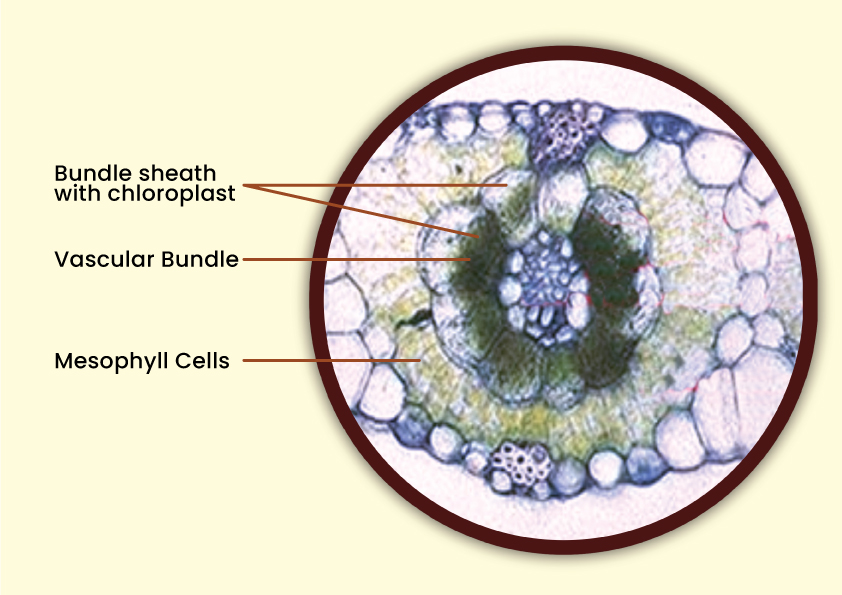
So, the correct answer is ‘Amaranthus’.
Note: - $C_4$ carbon fixation is also known as the Hatch–Slack pathway.
- In the first step of carbon fixation in $C_4$ plants, unlike $C_3$ plants whose primary carbon fixation product is 3-phosphoglycerate, oxaloacetate, malate, and aspartate are produced.
- The three types of plants based on carbon fixation are $C_3$, $C_4$, and CAM plants.
Complete answer:
- Chloroplasts in $C_4$ plants are concentrated in two concentric sheaths of cells around each vascular bundle. The inner sheath of cells is known as the bundle sheath and the outer sheath is the mesophyll sheath.
- In $C_4$ plants, mesophyll cell chloroplasts contain grana and lack in starch while the bundle sheath cell chloroplasts are lacking in grana and are rich in starch. Therefore, the chloroplasts are dimorphic in nature. The bundle sheath cells possess abundant thylakoids which do not stack into grana. Mesophyll sheath cells are similar to $C_3$ plants by showing grana but do not show the presence of starch grains.
- Amaranthus is a $C_4$ plant and thus shows a dimorphic chloroplast.
- $C_4$ fixation requires more ATP than $C_3$ counterparts, hence the plants are able to fix carbon more efficiently in drought, high temperatures, and limitations of nitrogen or ${ CO }_{ 2 }$.
Additional Information: - Flowering plants that carry out $C_4$ carbon fixation belong to the Amaranthaceae, Aizoaceae, Chenopodiaceae, Compositae, Cyperaceae, Euphorbiaceae, Gramineae, Nyctaginaceae, Portulacaceae, and Zygophyllaceae families.
- Another common example of a $C_4$ plant is Maize.
- Grana formation can be induced in bundle sheath cells in plants by manipulating environmental conditions.
So, the correct answer is ‘Amaranthus’.
Note: - $C_4$ carbon fixation is also known as the Hatch–Slack pathway.
- In the first step of carbon fixation in $C_4$ plants, unlike $C_3$ plants whose primary carbon fixation product is 3-phosphoglycerate, oxaloacetate, malate, and aspartate are produced.
- The three types of plants based on carbon fixation are $C_3$, $C_4$, and CAM plants.
Recently Updated Pages
Basicity of sulphurous acid and sulphuric acid are

Master Class 11 Business Studies: Engaging Questions & Answers for Success
Master Class 11 Computer Science: Engaging Questions & Answers for Success
Master Class 11 Economics: Engaging Questions & Answers for Success
Master Class 11 Social Science: Engaging Questions & Answers for Success
Master Class 11 English: Engaging Questions & Answers for Success
Trending doubts
The largest wind power cluster is located in the state class 11 social science CBSE
Explain zero factorial class 11 maths CBSE
Which among the following are examples of coming together class 11 social science CBSE
Can anyone list 10 advantages and disadvantages of friction
State the laws of reflection of light
Draw a diagram of a plant cell and label at least eight class 11 biology CBSE