




Which of the following lenses is used to correct hypermetropia?
A) Convex lens
B) Concave lens
C) Cylindrical lens
D) None of these
Answer
 Verified
662.7k+ views
Hint: Hypermetropia or far-sightedness is a condition of the eye in which a person cannot see nearby objects clearly. The near point of the eye increases and objects closer than the near point are not focused properly on the retina of the eye.
Complete step by step answer:
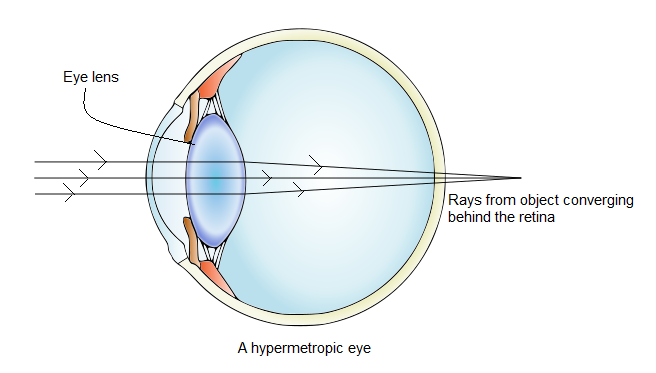
Hypermetropia or far-sightedness is an eye condition where light rays from a nearby object are not focused upon the retina properly, but focused behind the retina. This happens due to the change in the shape of the eye lens or the curvature of the eye. The eye becomes taller axially and less curvier. The convex lens of the eye cannot converge light rays from a nearby object and hence, the near point of the eye (least distance of object which the eye lens can properly focus upon) increases.
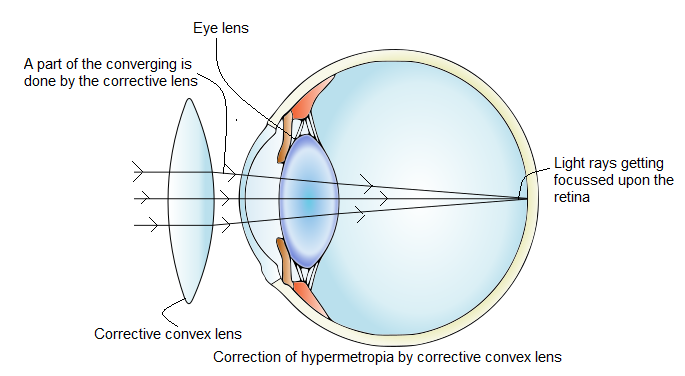
By using a corrective convex lens, we can fix hypermetropia. The corrective convex lens converges the rays from the object so that the eye lens does not have to do more converging than it is capable of. This makes the rays from nearby objects to get properly converged upon the retina of the eye and they can be focused properly.
Therefore, the correct answer is A) convex lens.
Note: Students should not memorize which kind of corrective lens is used for correcting which eye defect but instead understand the effect of the corrective lens and then decide which kind of corrective lens will help in focusing the rays on the retina properly and compensate for the lack of ability of the eye lens to do so. For example, students should not memorize that hypermetropia is corrected by using convex lenses but understand that in hypermetropia, the eye lens loses its power to converge rays upon the retina and hence, a lens that can help in converging the rays, that is, a convex lens, must be used as a corrective lens.
Complete step by step answer:
Hypermetropia or far-sightedness is an eye condition where light rays from a nearby object are not focused upon the retina properly, but focused behind the retina. This happens due to the change in the shape of the eye lens or the curvature of the eye. The eye becomes taller axially and less curvier. The convex lens of the eye cannot converge light rays from a nearby object and hence, the near point of the eye (least distance of object which the eye lens can properly focus upon) increases.
By using a corrective convex lens, we can fix hypermetropia. The corrective convex lens converges the rays from the object so that the eye lens does not have to do more converging than it is capable of. This makes the rays from nearby objects to get properly converged upon the retina of the eye and they can be focused properly.
Therefore, the correct answer is A) convex lens.
Note: Students should not memorize which kind of corrective lens is used for correcting which eye defect but instead understand the effect of the corrective lens and then decide which kind of corrective lens will help in focusing the rays on the retina properly and compensate for the lack of ability of the eye lens to do so. For example, students should not memorize that hypermetropia is corrected by using convex lenses but understand that in hypermetropia, the eye lens loses its power to converge rays upon the retina and hence, a lens that can help in converging the rays, that is, a convex lens, must be used as a corrective lens.
Recently Updated Pages
Which of the following graphs shows the variation of class 12 physics CBSE

Draw a labelled diagram of the human male reproductive class 12 biology CBSE
Describe the experiment to compare the emf of two cells class 12 physics CBSE
What is standard hydrogen electrode
What is conventional current and electric current class 12 physics CBSE
2Bromopentane is treated with an alcoholic KOH solution class 12 chemistry CBSE
Trending doubts
Draw a labelled sketch of the human eye class 12 physics CBSE
Which are the Top 10 Largest Countries of the World?
Differentiate between homogeneous and heterogeneous class 12 chemistry CBSE
Draw ray diagrams each showing i myopic eye and ii class 12 physics CBSE
Which is the correct genotypic ratio of mendel dihybrid class 12 biology CBSE
What is the Full Form of PVC, PET, HDPE, LDPE, PP and PS ?