




Which of the following is/are true about P, Q and R?
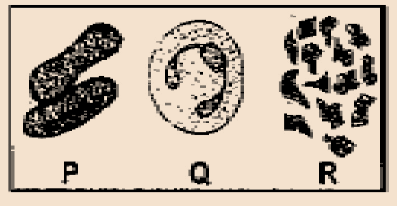
A. P-transports oxygen, Q-kills bacteria, R-clots blood
B. P-transports carbon dioxide, Q-produces antibodies, R-clots blood
C. P-transports bacteria, Q-eats foreign material, R-clots blood
D. P-transports food, Q-develops immunity, R-clots blood
Answer
 Verified
574.8k+ views
Hint:-Blood is a red, mobile and vascular connective tissue, consisting of two components- plasma and formed elements or blood corpuscles. Plasma forms the 55-60% of the blood volume and blood corpuscles form the remaining blood volume
Complete answer: In the given figure, P is red blood cells, Q is neutrophils and R is platelets.
Red blood cells or erythrocytes are the most numerous formed elements of the blood in the human body. They have a red, oxygen carrying pigment called haemoglobin in their cytoplasm. The shape of the RBCs vary in different vertebrates. In mammals they are circular, biconcave, denucleated discs. The hemoglobin in the blood carries about 97-99 percent of oxygen from the lungs to the body tissues as oxyhemoglobin. It also transports about 23 percent of carbon dioxide as carbamino-haemoglobin.
Leukocytes or White blood cells are rounded or amoeboid, nucleated, non-pigmented blood corpuscles. On the basis of cytoplasmic granule, they are divided into two types- granulocytes and agranulocytes.
Granulocytes include neutrophils, basophils and acidophils while agranulocytes include lymphocytes and monocytes. Neutrophils have quite large and many lobed nuclei and abundant fine granules in the cytoplasm. They are phagocytic in action and engulf microbes.
Blood platelets are the smallest sized blood corpuscles that are formed form the giant cells called megakaryocytes of bone marrow. They play a major role in the process of blood clotting.
So the correct answer is A. P-transports oxygen, Q-kills bacteria, R-clots blood.
Note:- The formation of red blood corpuscles is called erythropoiesis and the formation of white blood corpuscles is leukopoiesis. The WBCs have a life of 3-4 days only while the RBCs have a life of around 120 days.
Complete answer: In the given figure, P is red blood cells, Q is neutrophils and R is platelets.
Red blood cells or erythrocytes are the most numerous formed elements of the blood in the human body. They have a red, oxygen carrying pigment called haemoglobin in their cytoplasm. The shape of the RBCs vary in different vertebrates. In mammals they are circular, biconcave, denucleated discs. The hemoglobin in the blood carries about 97-99 percent of oxygen from the lungs to the body tissues as oxyhemoglobin. It also transports about 23 percent of carbon dioxide as carbamino-haemoglobin.
Leukocytes or White blood cells are rounded or amoeboid, nucleated, non-pigmented blood corpuscles. On the basis of cytoplasmic granule, they are divided into two types- granulocytes and agranulocytes.
Granulocytes include neutrophils, basophils and acidophils while agranulocytes include lymphocytes and monocytes. Neutrophils have quite large and many lobed nuclei and abundant fine granules in the cytoplasm. They are phagocytic in action and engulf microbes.
Blood platelets are the smallest sized blood corpuscles that are formed form the giant cells called megakaryocytes of bone marrow. They play a major role in the process of blood clotting.
So the correct answer is A. P-transports oxygen, Q-kills bacteria, R-clots blood.
Note:- The formation of red blood corpuscles is called erythropoiesis and the formation of white blood corpuscles is leukopoiesis. The WBCs have a life of 3-4 days only while the RBCs have a life of around 120 days.
Recently Updated Pages
Master Class 12 Economics: Engaging Questions & Answers for Success

Master Class 12 Physics: Engaging Questions & Answers for Success
Master Class 12 English: Engaging Questions & Answers for Success
Master Class 12 Social Science: Engaging Questions & Answers for Success
Master Class 12 Maths: Engaging Questions & Answers for Success
Master Class 12 Business Studies: Engaging Questions & Answers for Success
Trending doubts
Which are the Top 10 Largest Countries of the World?
What are the major means of transport Explain each class 12 social science CBSE
Draw a labelled sketch of the human eye class 12 physics CBSE
Why cannot DNA pass through cell membranes class 12 biology CBSE
Differentiate between insitu conservation and exsitu class 12 biology CBSE
Draw a neat and well labeled diagram of TS of ovary class 12 biology CBSE