




Which of the following is true for the reversible process?
A) It is a quasi-static process.
B) Both the system and surroundings will return to their original state.
C) Only the system will return to the original state.
D) It is a very fast process.
Answer
 Verified
586.5k+ views
Hint: To know which of the given statements is true, we need to check out the definition and conditions for a process to be reversible and observe option wise which of them satisfy the same.
Complete step by step answer:
In general, the processes in which the material after undergoing reactions (suffers a change in temperature, pressure, etc.) return to their original state are called irreversible processes.
In thermodynamics, we use terms:
System: Consist of particles that undergoes reaction which is studied and observed.
Surroundings: The rest of the things reacting with the system are part of the surroundings.
Universe: It is a combination of both the system and the surroundings.
So, a thermodynamic reaction is reversible when both the system and the surroundings return to their original states.
Other conditions for a process to be reversible includes:
i) Dissipative forces (responsible for loss of energy) should be absent.
ii) The process should take place in infinitely slow time.
Graphically, it can be represented as:
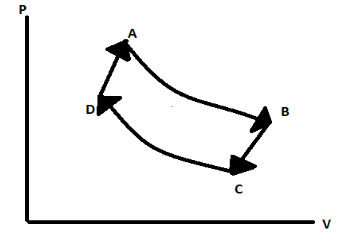
Checking the options:
A) Quasi-static process: A process or a change taking place in a thermodynamic system at an infinitely slow rate is called a quasi-static process
This satisfies the second condition for a reaction to be reversible and thus is true.
B) Both the system and surroundings will return to their original state: This statement is true according to the definition stating that initial and final states (properties) of the system and surroundings should be the same.
C) Only the system will return to the original state: This statement contradicts the definition of the reversible process and hence is not true.
D) It is a very fast process: This statement contradicts the ii) condition of a reversible process and hence is not true.
Therefore, both options A) and B) are true for the reversible process.
Note: Reversible process is not real but an ideal process as the changes are small and difficult to notice in an extremely small duration of time.The changes taking place are always in equilibrium
Complete step by step answer:
In general, the processes in which the material after undergoing reactions (suffers a change in temperature, pressure, etc.) return to their original state are called irreversible processes.
In thermodynamics, we use terms:
System: Consist of particles that undergoes reaction which is studied and observed.
Surroundings: The rest of the things reacting with the system are part of the surroundings.
Universe: It is a combination of both the system and the surroundings.
So, a thermodynamic reaction is reversible when both the system and the surroundings return to their original states.
Other conditions for a process to be reversible includes:
i) Dissipative forces (responsible for loss of energy) should be absent.
ii) The process should take place in infinitely slow time.
Graphically, it can be represented as:
Checking the options:
A) Quasi-static process: A process or a change taking place in a thermodynamic system at an infinitely slow rate is called a quasi-static process
This satisfies the second condition for a reaction to be reversible and thus is true.
B) Both the system and surroundings will return to their original state: This statement is true according to the definition stating that initial and final states (properties) of the system and surroundings should be the same.
C) Only the system will return to the original state: This statement contradicts the definition of the reversible process and hence is not true.
D) It is a very fast process: This statement contradicts the ii) condition of a reversible process and hence is not true.
Therefore, both options A) and B) are true for the reversible process.
Note: Reversible process is not real but an ideal process as the changes are small and difficult to notice in an extremely small duration of time.The changes taking place are always in equilibrium
Recently Updated Pages
Master Class 12 Economics: Engaging Questions & Answers for Success

Master Class 12 Physics: Engaging Questions & Answers for Success
Master Class 12 English: Engaging Questions & Answers for Success
Master Class 12 Social Science: Engaging Questions & Answers for Success
Master Class 12 Maths: Engaging Questions & Answers for Success
Master Class 12 Business Studies: Engaging Questions & Answers for Success
Trending doubts
Which are the Top 10 Largest Countries of the World?
What are the major means of transport Explain each class 12 social science CBSE
Draw a labelled sketch of the human eye class 12 physics CBSE
Why cannot DNA pass through cell membranes class 12 biology CBSE
Differentiate between insitu conservation and exsitu class 12 biology CBSE
Draw a neat and well labeled diagram of TS of ovary class 12 biology CBSE