




Which of the following is true about the charge acquired by p-type semiconductors?
a.) Positive
b.) Neutral
c.) Negative
d.) Depends on concentration of p impurity
Answer
 Verified
617.1k+ views
Hint: p- Type semiconductors are created by doping of an intrinsic semiconductor by acceptor impurities. In p- type semiconductors the electrons are the minority carries and the holes are the majority carriers.
Complete step by step answer:
Semiconductors are the materials which have the conductivity between the insulators and the conductors or non-conductors. It is of two type intrinsic and extrinsic semiconductors.
The semiconductor which is pure is known as intrinsic semiconductor and the semiconductor in which impurities are added to make it conductive is known as extrinsic semiconductor.
P-type semiconductor is formed when a trivalent impurity is added to an intrinsic semiconductor the trivalent impurity can be silicon, germanium etc. The amount of impurity added in p-type semiconductor is very small as compared to the amount of semiconductor.
The p-type semiconductor has a large number of holes, when a potential difference is applied the holes which are present in the valence band are directed towards the negative terminal. As the current flow in p-type semiconductor is by holes which is known as the carrier of positive charge therefore the type of conductivity is also positive.
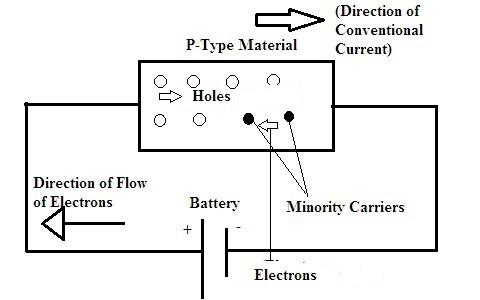
As the charge which is on the donor ion is equal and opposite to the charge of the electron, the crystal remains electrically neutral, that’s why the p type semiconductor are electrically neutral.
So, the correct answer is “Option B”.
Note: The impurity atoms in germanium takes the position of germanium atoms in the crystal, the three electrons form covalent bond by the sharing of atoms with three neighboring atoms of germanium and fourth covalent bond is left which creates a hole. When a pentavalent impurity is added to a pure semiconductor the type of semiconductor form is known as n type semiconductor. Like p type semiconductors, n type semiconductors are also neutral in charge.
Complete step by step answer:
Semiconductors are the materials which have the conductivity between the insulators and the conductors or non-conductors. It is of two type intrinsic and extrinsic semiconductors.
The semiconductor which is pure is known as intrinsic semiconductor and the semiconductor in which impurities are added to make it conductive is known as extrinsic semiconductor.
P-type semiconductor is formed when a trivalent impurity is added to an intrinsic semiconductor the trivalent impurity can be silicon, germanium etc. The amount of impurity added in p-type semiconductor is very small as compared to the amount of semiconductor.
The p-type semiconductor has a large number of holes, when a potential difference is applied the holes which are present in the valence band are directed towards the negative terminal. As the current flow in p-type semiconductor is by holes which is known as the carrier of positive charge therefore the type of conductivity is also positive.
As the charge which is on the donor ion is equal and opposite to the charge of the electron, the crystal remains electrically neutral, that’s why the p type semiconductor are electrically neutral.
So, the correct answer is “Option B”.
Note: The impurity atoms in germanium takes the position of germanium atoms in the crystal, the three electrons form covalent bond by the sharing of atoms with three neighboring atoms of germanium and fourth covalent bond is left which creates a hole. When a pentavalent impurity is added to a pure semiconductor the type of semiconductor form is known as n type semiconductor. Like p type semiconductors, n type semiconductors are also neutral in charge.
Recently Updated Pages
Master Class 12 Economics: Engaging Questions & Answers for Success

Master Class 12 English: Engaging Questions & Answers for Success
Master Class 12 Social Science: Engaging Questions & Answers for Success
Master Class 12 Maths: Engaging Questions & Answers for Success
Master Class 12 Physics: Engaging Questions & Answers for Success
Master Class 9 General Knowledge: Engaging Questions & Answers for Success
Trending doubts
Which are the Top 10 Largest Countries of the World?
Draw a labelled sketch of the human eye class 12 physics CBSE
Differentiate between homogeneous and heterogeneous class 12 chemistry CBSE
Why is the cell called the structural and functional class 12 biology CBSE
Draw ray diagrams each showing i myopic eye and ii class 12 physics CBSE
Which is the correct genotypic ratio of mendel dihybrid class 12 biology CBSE