




Which of the following is the separation technique to separate mercury and water?
(A) separating funnel
(B) sublimation
(C) filtration followed by evaporation
(D) separating funnel followed by evaporation or distillation.
Answer
 Verified
662.4k+ views
Hint: The various components of a mixture of two liquids have different physical properties such as density, solubility, size of particles, volatility, boiling point, and melting point, etc. there are different methods to separate the mixture of two liquids that are miscible or immiscible between them.
Complete step by step solution:
The physical properties of liquids in a mixture, the separation techniques differ from miscible liquids from immiscible liquids. Miscible liquid means the two liquids are completely soluble with each other. Immiscible liquids are not soluble completely with each other.
The method is used to separate immiscible liquids like mercury and water is the decantation separating technique.
Decantation: this is the process used to the mixture of solid in liquid or two immiscible liquids based on their difference in density. The mixture to be separated is gradually poured from one container to another or using a separating funnel.
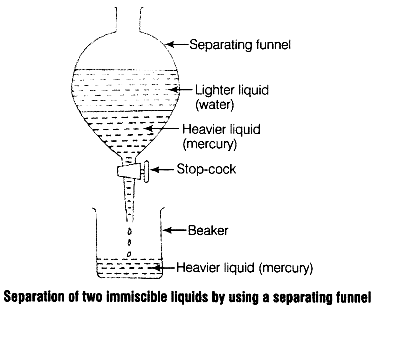
In the given mixture of mercury and water, mercury is denser than water. So, during the separation of this mixture using the decantation technique in a separating funnel, mercury forms the lower layer and separates from the water as shown in the above diagram.
so, the separation technique to separate mercury and water is separating funnels.
The correct answer is option A.
Note: There are many techniques used to separate miscible liquids in a mixture based on their physical properties. For example, the separating mixture of two or more liquids by fraction distillation process based on their boiling points. In this process, the highest boiling comes first and after the next one. Separating the mixtures in petroleum by using this technique is called fractional distillation of petroleum.
Complete step by step solution:
The physical properties of liquids in a mixture, the separation techniques differ from miscible liquids from immiscible liquids. Miscible liquid means the two liquids are completely soluble with each other. Immiscible liquids are not soluble completely with each other.
The method is used to separate immiscible liquids like mercury and water is the decantation separating technique.
Decantation: this is the process used to the mixture of solid in liquid or two immiscible liquids based on their difference in density. The mixture to be separated is gradually poured from one container to another or using a separating funnel.
In the given mixture of mercury and water, mercury is denser than water. So, during the separation of this mixture using the decantation technique in a separating funnel, mercury forms the lower layer and separates from the water as shown in the above diagram.
so, the separation technique to separate mercury and water is separating funnels.
The correct answer is option A.
Note: There are many techniques used to separate miscible liquids in a mixture based on their physical properties. For example, the separating mixture of two or more liquids by fraction distillation process based on their boiling points. In this process, the highest boiling comes first and after the next one. Separating the mixtures in petroleum by using this technique is called fractional distillation of petroleum.
Recently Updated Pages
What are the two major island groups in India class 9 social science CBSE

What is Jhum cultivation class 9 biology CBSE
Write an Article on Save Earth Save Life
Silk is obtained from of the silk moth APupa BLarva class 9 chemistry CBSE
Write chemical formulas of the following compounds class 9 chemistry CBSE
The Indo Gangetic Plains of India are fertile due to class 9 social science CBSE
Trending doubts
Fill the blanks with the suitable prepositions 1 The class 9 english CBSE
Difference Between Plant Cell and Animal Cell
What is the full form of pH?
What is pollution? How many types of pollution? Define it
On an outline map of India show its neighbouring c class 9 social science CBSE
What is momentum with examples class 9 physics CBSE