




Which of the following is the biological scissor?
(a)Restriction endonuclease
(a)Gyrase
(a)DNA ligase
(a)helicase
Answer
 Verified
620.1k+ views
Hint: Biologic scissors are named because they bind (cut) DNA to or close particular detection sequences (restriction sites). They function as an important tool for gene alteration and are commonly used in transformation, transfection, etc.
Complete answer:
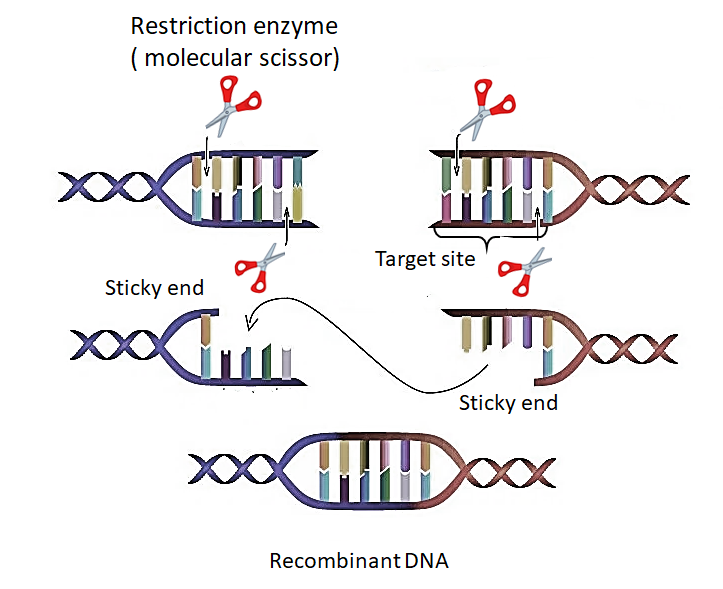
A restriction enzyme, restriction endonuclease, or restriction enzyme is an enzyme that binds DNA to fragments at or near-unique detection sites within molecules known as restriction sites. Restriction enzymes are one class in the larger endonuclease category of enzymes.
Restriction enzymes are typically categorized into five groups that vary in their structure and whether they break down their DNA substrate at their position of recognition or whether the recognition and cleavage sites are distinct from each other. In order to cut DNA, all restriction enzymes make two incisions, one into each sugar-phosphate backbone (i.e. each strand) of the DNA double helix.
Additional Information: Gyrase: DNA gyrase is an important bacterial enzyme that catalyzes ATP-dependent negative supercoiling. Double-stranded, closed-circular DNA. Gyrase belongs to a class of enzymes known as topoisomerases that are involved in the regulation of topological DNA transitions.
DNA ligase: DNA ligase is an enzyme that can bind two strands of DNA together by forming a bond between the phosphate group of one strand and the deoxyribose group of another. It is used in cells to bind together the Okazaki fragments that are formed on the lagging strand during DNA replication.
Helicase: Helicases are enzymes that bind and can even reshape nucleic acid or nucleic acid-protein complexes. There are helicases of DNA and RNA. During DNA replication, DNA helicases are important because they split double-stranded DNA into single strands, allowing each strand to be copied.
So, the correct answer is ‘restriction endonuclease’.
Note: These enzymes are present in bacteria and archaea and provide a protective mechanism against invasive viruses. Within the prokaryote, the restriction enzymes selectively cut off foreign DNA in a process called restriction digestion; in the meantime, host DNA is protected by a modification enzyme (methyltransferase) that modifies prokaryotic DNA and blocks cleavage. These two processes together form a restriction-modification framework.
Complete answer:
A restriction enzyme, restriction endonuclease, or restriction enzyme is an enzyme that binds DNA to fragments at or near-unique detection sites within molecules known as restriction sites. Restriction enzymes are one class in the larger endonuclease category of enzymes.
Restriction enzymes are typically categorized into five groups that vary in their structure and whether they break down their DNA substrate at their position of recognition or whether the recognition and cleavage sites are distinct from each other. In order to cut DNA, all restriction enzymes make two incisions, one into each sugar-phosphate backbone (i.e. each strand) of the DNA double helix.
Additional Information: Gyrase: DNA gyrase is an important bacterial enzyme that catalyzes ATP-dependent negative supercoiling. Double-stranded, closed-circular DNA. Gyrase belongs to a class of enzymes known as topoisomerases that are involved in the regulation of topological DNA transitions.
DNA ligase: DNA ligase is an enzyme that can bind two strands of DNA together by forming a bond between the phosphate group of one strand and the deoxyribose group of another. It is used in cells to bind together the Okazaki fragments that are formed on the lagging strand during DNA replication.
Helicase: Helicases are enzymes that bind and can even reshape nucleic acid or nucleic acid-protein complexes. There are helicases of DNA and RNA. During DNA replication, DNA helicases are important because they split double-stranded DNA into single strands, allowing each strand to be copied.
So, the correct answer is ‘restriction endonuclease’.
Note: These enzymes are present in bacteria and archaea and provide a protective mechanism against invasive viruses. Within the prokaryote, the restriction enzymes selectively cut off foreign DNA in a process called restriction digestion; in the meantime, host DNA is protected by a modification enzyme (methyltransferase) that modifies prokaryotic DNA and blocks cleavage. These two processes together form a restriction-modification framework.
Recently Updated Pages
Master Class 12 Business Studies: Engaging Questions & Answers for Success

Master Class 12 Chemistry: Engaging Questions & Answers for Success
Master Class 12 Biology: Engaging Questions & Answers for Success
Class 12 Question and Answer - Your Ultimate Solutions Guide
Master Class 11 English: Engaging Questions & Answers for Success
Master Class 11 Social Science: Engaging Questions & Answers for Success
Trending doubts
Which are the Top 10 Largest Countries of the World?
Draw a labelled sketch of the human eye class 12 physics CBSE
The end of compass needle which points towards north class 12 physics CBSE
Differentiate between homogeneous and heterogeneous class 12 chemistry CBSE
In order to find out the different types of gametes class 12 biology NEET_UG
Why is the cell called the structural and functional class 12 biology CBSE