




Which of the following is related to rectilinear propagation of light?
A) Rainbow
B) Eclipse
C) Shining of diamond
D) None of the above.
Answer
 Verified
577.5k+ views
Hint: The straight-line path followed by light is called light rays. A light journey along a straight line is called rectilinear propagation. The straight line along which light propagates is called a ray. It is indicated by a straight line with an arrow. It is the path of light. This bundle of ray is called the beam of light.
Complete answer:
Now explaining rectilinear propagation of light using an experiment:
Let us take three pieces of cardboard. Place them one on the top of one another and make a hole in the middle of each cardboard by using a thick nail. Erect these cards up on the table at a short distance away from each other.
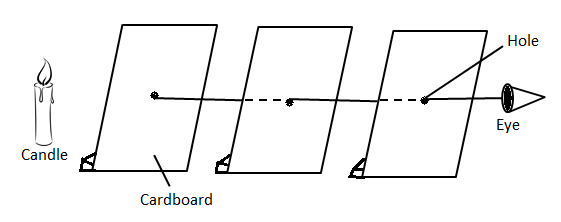
Consider a candle which is of the same size as the holes in the cards. We see that the light of the candle is visible only when the holes on cards lie in a straight line.
If we disturb them the light of the candle will not be visible. This experiment proves that light travels in a straight line.
Therefore eclipses are formed due to rectilinear propagation of light.
Whenever an obstacle is placed in the path of light, the shadow of the obstacle is seen on the other side. A similar thing happens when any celestial body (planet or star) comes in the way of sunlight. During the revolution, sometimes any planet or moon gets in the way of sunlight. This phenomenon is h=known as Eclipse. Based on the position of the planet and moon, there are two types of eclipse. Solar eclipse and Lunar eclipse.
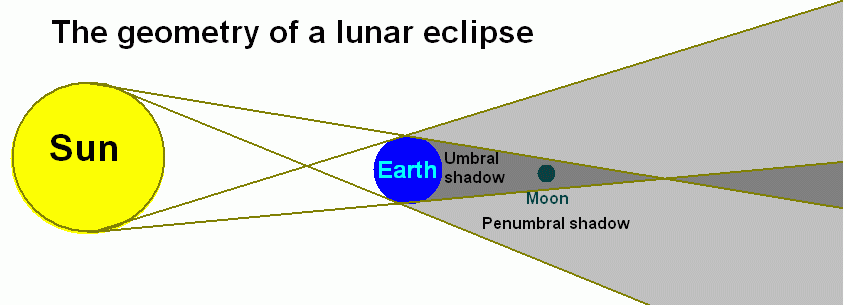
When the moon comes in the way of sunlight and casts shadow on Earth. It is known as a solar eclipse. Solar eclipse can occur two to five times in a year. When Earth comes in between the Sun and Moon, casting a shadow on the moon it is said to be a lunar eclipse. All these eclipses take place in a straight line.
Hence the Correct option is (B).
Note: Let’s see some of the examples of rectilinear propagation of light,
Eclipse is a phenomenon where the celestial body like earth comes in the path of the light which originates from the sun and reaches the moon. In the lunar eclipse, earth forms the shadow on the moon.
When we dip our hand under water, you will see that it appears shorter and closer. It is because light falling on the hand gets reflected in a straight line under the water than that of the air.
Complete answer:
Now explaining rectilinear propagation of light using an experiment:
Let us take three pieces of cardboard. Place them one on the top of one another and make a hole in the middle of each cardboard by using a thick nail. Erect these cards up on the table at a short distance away from each other.
Consider a candle which is of the same size as the holes in the cards. We see that the light of the candle is visible only when the holes on cards lie in a straight line.
If we disturb them the light of the candle will not be visible. This experiment proves that light travels in a straight line.
Therefore eclipses are formed due to rectilinear propagation of light.
Whenever an obstacle is placed in the path of light, the shadow of the obstacle is seen on the other side. A similar thing happens when any celestial body (planet or star) comes in the way of sunlight. During the revolution, sometimes any planet or moon gets in the way of sunlight. This phenomenon is h=known as Eclipse. Based on the position of the planet and moon, there are two types of eclipse. Solar eclipse and Lunar eclipse.
When the moon comes in the way of sunlight and casts shadow on Earth. It is known as a solar eclipse. Solar eclipse can occur two to five times in a year. When Earth comes in between the Sun and Moon, casting a shadow on the moon it is said to be a lunar eclipse. All these eclipses take place in a straight line.
Hence the Correct option is (B).
Note: Let’s see some of the examples of rectilinear propagation of light,
Eclipse is a phenomenon where the celestial body like earth comes in the path of the light which originates from the sun and reaches the moon. In the lunar eclipse, earth forms the shadow on the moon.
When we dip our hand under water, you will see that it appears shorter and closer. It is because light falling on the hand gets reflected in a straight line under the water than that of the air.
Recently Updated Pages
Master Class 8 Social Science: Engaging Questions & Answers for Success

Master Class 8 Science: Engaging Questions & Answers for Success
Master Class 8 Maths: Engaging Questions & Answers for Success
Class 8 Question and Answer - Your Ultimate Solutions Guide
Master Class 9 Social Science: Engaging Questions & Answers for Success
Master Class 9 Science: Engaging Questions & Answers for Success
Trending doubts
What are gulf countries and why they are called Gulf class 8 social science CBSE
What is BLO What is the full form of BLO class 8 social science CBSE
Give full form of LPG and CNG class 8 chemistry CBSE
Citizens of India can vote at the age of A 18 years class 8 social science CBSE
Advantages and disadvantages of science
Give me the opposite gender of Duck class 8 english CBSE