




Which of the following is not a coloured cation?
A) $F{e^{ + 2}}$
B) $C{a^{ + 2}}$
C) $F{e^{ + 3}}$
D) $N{i^{ + 2}}$
Answer
 Verified
598.2k+ views
Hint:We know that transitions metals are placed in d-block. The presence of unpaired electrons in d-block shows d-d transition in d-orbital emit colour. Anyway when the metal begins holding with different ligands, this changes. Because of the d-orbital and inductive impacts of the ligands on the electrons. The d-orbitals split apart and became non-degenerate (have distinct energy levels).
Complete step by step answer:
Reason of colour of ions= Compound of the s and p-block elements are colourless as white if anion is not coloured while compounds of d-block elements are coloured.
It is due to the fact that under the influence of the magnetic field of ligands (like water, ammonia etc.) d subshell is split into two groups namely ${t_{2g}}$ and \[eg\]. This is called d-d splitting.
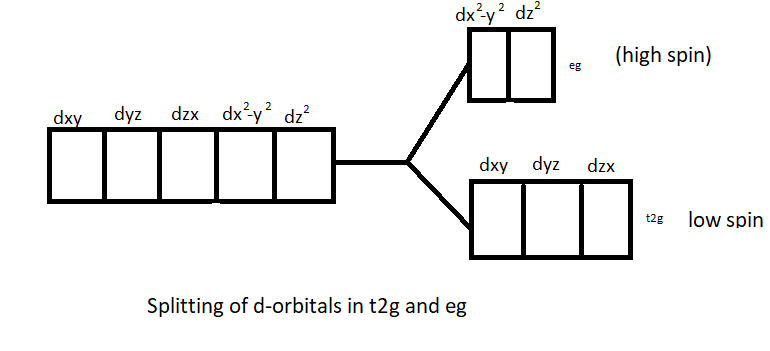
d-d transition= ${t_{2g}}$ and \[eg\] orbitals have different energies and this energy difference lies in the visible region. Thus in a d-d transition (${t_{2g}} \rightleftarrows eg$), some wavelengths of visible region are absorbed by the ions and complementary colour of refractive wavelengths is seen.
S and p-orbital are symmetrical in geometry thus their splitting does not occur and their compounds are colourless.
The ions having ${d^0}$ or ${d^{10}}$ configuration do not show orbital splitting, hence, they are colourless. For the same reason $C{a^{ + 2}}$ ion are colourless.
Colour of metal ions are given below:
Hydrated $F{e^{ + 2}}$= green
Hydrated $F{e^{ + 3}}$= yellow
Hydrated $N{i^{ + 2}}$=green
$C{a^{ + 2}}$ Is colourless. Other cations are coloured.
Hence, option B is correct.
Additional information: This forms the basis crystal field theory (CFT). How these d-orbitals split depends on the geometry of the compound that is formed.
Note:
Transition metals are special in that the energy is different between the non-degenerate, d- orbitals corresponding to the energy of radiation of the visible light spectrum. Due to the presence of unpaired electrons in $F{e^{ + 2}}$, $F{e^{ + 3}}$ and $N{i^{ + 2}}$ ions it shows d-transition.
Complete step by step answer:
Reason of colour of ions= Compound of the s and p-block elements are colourless as white if anion is not coloured while compounds of d-block elements are coloured.
It is due to the fact that under the influence of the magnetic field of ligands (like water, ammonia etc.) d subshell is split into two groups namely ${t_{2g}}$ and \[eg\]. This is called d-d splitting.
d-d transition= ${t_{2g}}$ and \[eg\] orbitals have different energies and this energy difference lies in the visible region. Thus in a d-d transition (${t_{2g}} \rightleftarrows eg$), some wavelengths of visible region are absorbed by the ions and complementary colour of refractive wavelengths is seen.
S and p-orbital are symmetrical in geometry thus their splitting does not occur and their compounds are colourless.
The ions having ${d^0}$ or ${d^{10}}$ configuration do not show orbital splitting, hence, they are colourless. For the same reason $C{a^{ + 2}}$ ion are colourless.
Colour of metal ions are given below:
Hydrated $F{e^{ + 2}}$= green
Hydrated $F{e^{ + 3}}$= yellow
Hydrated $N{i^{ + 2}}$=green
$C{a^{ + 2}}$ Is colourless. Other cations are coloured.
Hence, option B is correct.
Additional information: This forms the basis crystal field theory (CFT). How these d-orbitals split depends on the geometry of the compound that is formed.
Note:
Transition metals are special in that the energy is different between the non-degenerate, d- orbitals corresponding to the energy of radiation of the visible light spectrum. Due to the presence of unpaired electrons in $F{e^{ + 2}}$, $F{e^{ + 3}}$ and $N{i^{ + 2}}$ ions it shows d-transition.
Recently Updated Pages
Master Class 10 Computer Science: Engaging Questions & Answers for Success

Master Class 10 General Knowledge: Engaging Questions & Answers for Success
Master Class 10 English: Engaging Questions & Answers for Success
Master Class 10 Social Science: Engaging Questions & Answers for Success
Master Class 10 Maths: Engaging Questions & Answers for Success
Master Class 10 Science: Engaging Questions & Answers for Success
Trending doubts
Which are the Top 10 Largest Countries of the World?
Draw a labelled sketch of the human eye class 12 physics CBSE
Differentiate between homogeneous and heterogeneous class 12 chemistry CBSE
What are the major means of transport Explain each class 12 social science CBSE
Sulphuric acid is known as the king of acids State class 12 chemistry CBSE
Why should a magnesium ribbon be cleaned before burning class 12 chemistry CBSE