




Which of the following is an example of a direct band gap intrinsic semiconductor?
A. Silicon
B. Germanium
C. Gallium Arsenide
D. None of these
Answer
 Verified
624.9k+ views
Hint:For solving this question, we need to understand the concept of direct band gap. Normally, all semiconductors are classified according to their band gaps into two types: direct band gap and indirect band gap. We will discuss the direct band gap and then see which one of the given options falls under the category of direct band gap.
Complete answer:
Let us first define direct band gap intrinsic semiconductors. The materials for which maximum of valence band and minimum of conduction band lie for the same value of k are called the direct band gap materials. This satisfies the condition of energy and momentum conservation. For example, GaAs, InP and CdS.
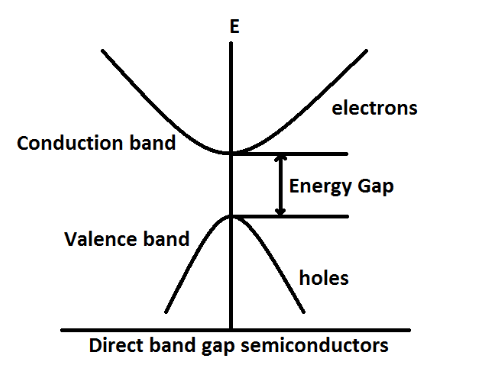
From the figure, we can clearly see that the maximum of valence band and minimum of conduction band lie for the same vector which is called the k-vector.
Indirect band gap materials are defined as the materials for which maximum of valence band and minimum of conduction band do not occur at the same value of k. For example, Si and Ge.
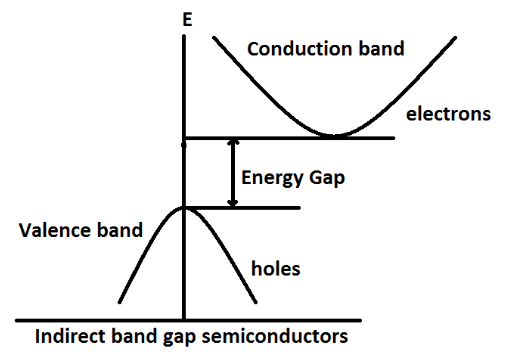
From the figure, we can clearly see that maximum of valence band and minimum of conduction band do not lie for same vector which is called the k-vector.As we have seen, Gallium Arsenide GaAs is a direct band gap semiconductor and other two options Silicon Si and Germanium Ge are an indirect gap semiconductor.
Thus, option C is the right answer.
Note:The difference between direct gap and indirect gap semiconductors is very important. It helps in deciding which semiconductors can be used in devices requiring light output. For instance, generally semiconductor light emitters and lasers must be made of materials capable of direct band to band transactions or of indirect materials with vertical transactions between defect states.
Complete answer:
Let us first define direct band gap intrinsic semiconductors. The materials for which maximum of valence band and minimum of conduction band lie for the same value of k are called the direct band gap materials. This satisfies the condition of energy and momentum conservation. For example, GaAs, InP and CdS.
From the figure, we can clearly see that the maximum of valence band and minimum of conduction band lie for the same vector which is called the k-vector.
Indirect band gap materials are defined as the materials for which maximum of valence band and minimum of conduction band do not occur at the same value of k. For example, Si and Ge.
From the figure, we can clearly see that maximum of valence band and minimum of conduction band do not lie for same vector which is called the k-vector.As we have seen, Gallium Arsenide GaAs is a direct band gap semiconductor and other two options Silicon Si and Germanium Ge are an indirect gap semiconductor.
Thus, option C is the right answer.
Note:The difference between direct gap and indirect gap semiconductors is very important. It helps in deciding which semiconductors can be used in devices requiring light output. For instance, generally semiconductor light emitters and lasers must be made of materials capable of direct band to band transactions or of indirect materials with vertical transactions between defect states.
Recently Updated Pages
Master Class 12 Economics: Engaging Questions & Answers for Success

Master Class 12 Social Science: Engaging Questions & Answers for Success
Master Class 12 English: Engaging Questions & Answers for Success
Master Class 12 Maths: Engaging Questions & Answers for Success
Master Class 12 Physics: Engaging Questions & Answers for Success
Master Class 12 Biology: Engaging Questions & Answers for Success
Trending doubts
Draw a labelled sketch of the human eye class 12 physics CBSE
Which are the Top 10 Largest Countries of the World?
Draw ray diagrams each showing i myopic eye and ii class 12 physics CBSE
Which is the correct genotypic ratio of mendel dihybrid class 12 biology CBSE
Differentiate between homogeneous and heterogeneous class 12 chemistry CBSE
Which animal never drinks water in its entire life class 12 biology CBSE