




Which of the following is always ABSENT in prokaryotic cells?
a. Ribosome
b. Mitochondria
c. DNA
d. Cell wall
Answer
 Verified
432.9k+ views
Hint: Prokaryotes lack a distinct nucleus (where DNA and RNA are stored in eukaryotic cells), mitochondria, the ER, the Golgi apparatus, and other structures. Prokaryotic cells lack a cytoskeleton in addition to lacking organelles.
Complete step by step Answer:
Ribosomes exist as loose particles in both prokaryotic and eukaryotic cells and particles connected to endoplasmic reticulum membranes in eukaryotic cells.
Most prokaryotes carry a modest quantity of genetic material in a single molecule, or chromosome, of circular DNA. In prokaryotes, DNA is found in a central region of the cell termed the nucleoid, which is not surrounded by a nuclear membrane.
Prokaryotic cells are substantially smaller than eukaryotic cells, lack a nucleus, and lack organelles. A cell wall protects all prokaryotic cells.
Outside the cytoplasmic membrane, prokaryotes have a cell wall that provides stiffness and structure to the body. Proteins are synthesized by both free and fixed ribosomes. The nuclear material is a free-floating irregular single molecule of double-stranded DNA. A prokaryotic cell lacks all cell organelles such as mitochondria, ER, etc.
So, the correct answer is option b.
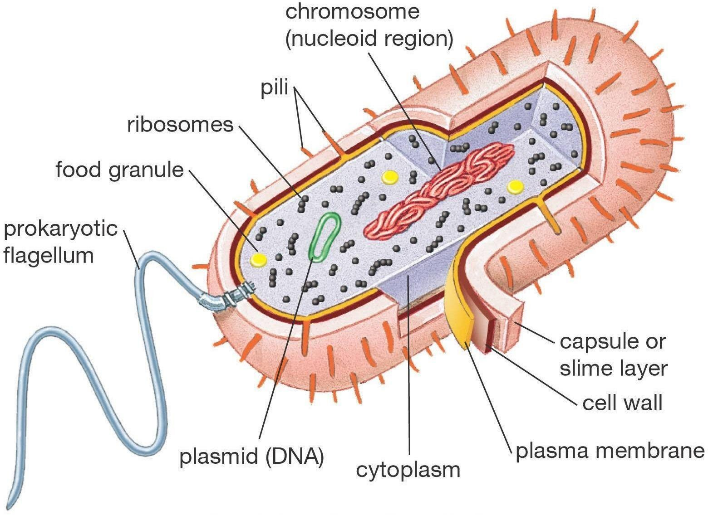
Image: Diagram showing the absence of mitochondria and the presence of the Ribosome, Cell wall, and DNA in prokaryotic cells.
Additional Information: A nucleoid area, DNA and RNA as genetic material, ribosomes that create proteins, and cytoplasm that contains a cytoskeleton that organizes cellular components are all present in all prokaryotic cells. On the other hand, prokaryotic creatures are a tremendously varied group of organisms that exist in a wide range of forms and sizes.
Note: Eukaryotic cells have more structure than prokaryotic cells. They lack a nucleus and instead have free-floating genetic material within the cell. In addition, they lack the many membrane-bound organelles seen in eukaryotic cells. As a result, prokaryotes lack mitochondria.
Complete step by step Answer:
Ribosomes exist as loose particles in both prokaryotic and eukaryotic cells and particles connected to endoplasmic reticulum membranes in eukaryotic cells.
Most prokaryotes carry a modest quantity of genetic material in a single molecule, or chromosome, of circular DNA. In prokaryotes, DNA is found in a central region of the cell termed the nucleoid, which is not surrounded by a nuclear membrane.
Prokaryotic cells are substantially smaller than eukaryotic cells, lack a nucleus, and lack organelles. A cell wall protects all prokaryotic cells.
Outside the cytoplasmic membrane, prokaryotes have a cell wall that provides stiffness and structure to the body. Proteins are synthesized by both free and fixed ribosomes. The nuclear material is a free-floating irregular single molecule of double-stranded DNA. A prokaryotic cell lacks all cell organelles such as mitochondria, ER, etc.
So, the correct answer is option b.
Image: Diagram showing the absence of mitochondria and the presence of the Ribosome, Cell wall, and DNA in prokaryotic cells.
Additional Information: A nucleoid area, DNA and RNA as genetic material, ribosomes that create proteins, and cytoplasm that contains a cytoskeleton that organizes cellular components are all present in all prokaryotic cells. On the other hand, prokaryotic creatures are a tremendously varied group of organisms that exist in a wide range of forms and sizes.
Note: Eukaryotic cells have more structure than prokaryotic cells. They lack a nucleus and instead have free-floating genetic material within the cell. In addition, they lack the many membrane-bound organelles seen in eukaryotic cells. As a result, prokaryotes lack mitochondria.
Recently Updated Pages
Master Class 11 English: Engaging Questions & Answers for Success

Master Class 11 Social Science: Engaging Questions & Answers for Success
Master Class 11 Maths: Engaging Questions & Answers for Success
Master Class 11 Biology: Engaging Questions & Answers for Success
Master Class 11 Physics: Engaging Questions & Answers for Success
Master Class 11 Chemistry: Engaging Questions & Answers for Success
Trending doubts