




Which of the following is a unisexual organism?
Answer
 Verified
627.3k+ views
Hint: It is osmoconformers. They are dioecious (people are male or female) and they discharge their haploid gametes into the water, a cycle called spawning. Moreover, upon fertilization and mitotic divisions of the zygote, it's a form of a larval stage which is analogous thereto of molluscs – i.e. a trochophore larva.
Complete answer:
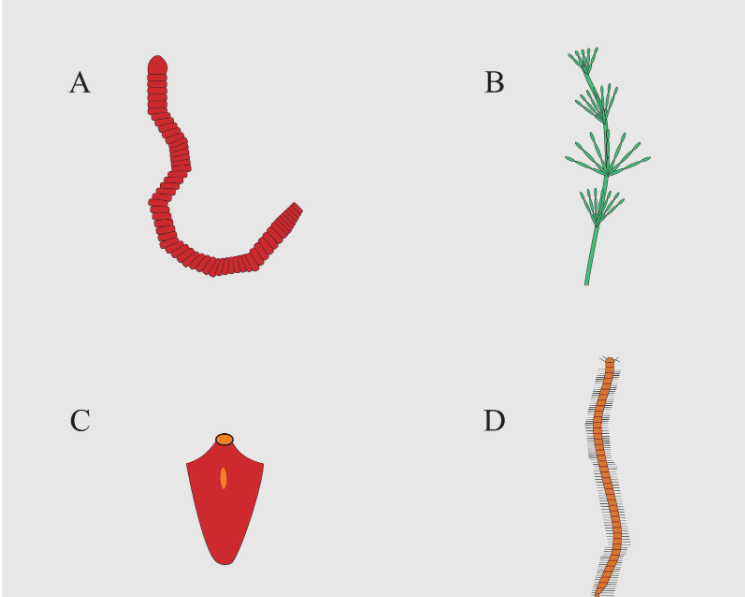
The organism shown in figure (d) is Nereis. It is unisexual or dioecious and its reproductive phase is named 'heteronereis.'
Additional Information: Nereis may be a genus of polychaete worms within the family Nereididae. It contains numerous species, the greater part of which are marine. Nereis possesses setae and parapodia for locomotion. They may have two sorts of setae, which are found on the parapodia. Acicular setae provide support. Locomotor chaetae are for crawling and are the bristle that is noticeable outwardly of the Polychaeta. They are round and hollow fit as a fiddle, found not just in sandy regions, and that they are adjusted to the tunnel. They often hold close seagrass (Posidonia) or other grass on rocks and sometimes take in large groups. They are dangerous to the touch giving very painful long-lasting burns. Nereis worms are commonly known as ragworms or calm worms. The body is long, slim, and dorso-ventrally straightened, arriving at a length of 5-30 cm. The head comprises two sections: a generally three-sided foremost lobe—the prostomium—and a posterior ring-like bit—the peristomium. The last bears a couple of terminal tentacles, dorsally two sets of eyes, and ventrally a couple of short two-jointed palps.
So the correct answer to the above question is ‘D’.
Note: Nereis can crawl, burrow, and swim actively. With the help of parapodia, crawling is completed, while swimming involves lateral undulations of the body, caused by wave-like contractions of longitudinal muscles and the use of parapodia in an oar-like fashion. The alimentary canal is a straight cylinder reaching out from anterior to the posterior end of the body. The front opening is the mouth and the back opening the anus. The mouth is located on the ventral side of the periosteum and opens into the buccal cavity, which carries teeth or dentacles.
Complete answer:
The organism shown in figure (d) is Nereis. It is unisexual or dioecious and its reproductive phase is named 'heteronereis.'
Additional Information: Nereis may be a genus of polychaete worms within the family Nereididae. It contains numerous species, the greater part of which are marine. Nereis possesses setae and parapodia for locomotion. They may have two sorts of setae, which are found on the parapodia. Acicular setae provide support. Locomotor chaetae are for crawling and are the bristle that is noticeable outwardly of the Polychaeta. They are round and hollow fit as a fiddle, found not just in sandy regions, and that they are adjusted to the tunnel. They often hold close seagrass (Posidonia) or other grass on rocks and sometimes take in large groups. They are dangerous to the touch giving very painful long-lasting burns. Nereis worms are commonly known as ragworms or calm worms. The body is long, slim, and dorso-ventrally straightened, arriving at a length of 5-30 cm. The head comprises two sections: a generally three-sided foremost lobe—the prostomium—and a posterior ring-like bit—the peristomium. The last bears a couple of terminal tentacles, dorsally two sets of eyes, and ventrally a couple of short two-jointed palps.
So the correct answer to the above question is ‘D’.
Note: Nereis can crawl, burrow, and swim actively. With the help of parapodia, crawling is completed, while swimming involves lateral undulations of the body, caused by wave-like contractions of longitudinal muscles and the use of parapodia in an oar-like fashion. The alimentary canal is a straight cylinder reaching out from anterior to the posterior end of the body. The front opening is the mouth and the back opening the anus. The mouth is located on the ventral side of the periosteum and opens into the buccal cavity, which carries teeth or dentacles.
Recently Updated Pages
Master Class 12 Economics: Engaging Questions & Answers for Success

Master Class 12 Social Science: Engaging Questions & Answers for Success
Master Class 12 English: Engaging Questions & Answers for Success
Master Class 12 Maths: Engaging Questions & Answers for Success
Master Class 12 Physics: Engaging Questions & Answers for Success
Master Class 12 Biology: Engaging Questions & Answers for Success
Trending doubts
Draw a labelled sketch of the human eye class 12 physics CBSE
Which are the Top 10 Largest Countries of the World?
Draw ray diagrams each showing i myopic eye and ii class 12 physics CBSE
Which is the correct genotypic ratio of mendel dihybrid class 12 biology CBSE
Differentiate between homogeneous and heterogeneous class 12 chemistry CBSE
Which animal never drinks water in its entire life class 12 biology CBSE