




Which of the following groups of animals the heart pumps only deoxygenated blood?
(a)Fishes
(b)Birds
(c)Reptiles
(d)All of the above
Answer
 Verified
603.3k+ views
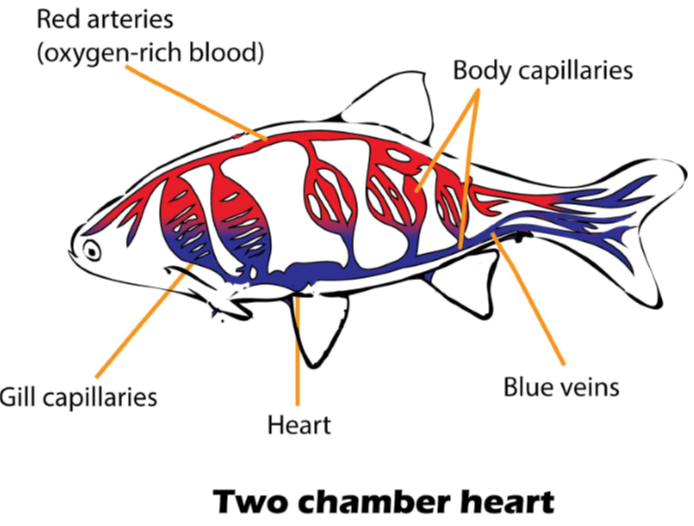
Hint: The heart pump only deoxygenated blood because the heart is two-chambered with an atrium and a ventricle. The heart pumps out deoxygenated blood which is oxygenated by the gills and supplied to other body parts from where deoxygenated blood is returned to the heart.
complete answer:
-Fishes have a single systemic circuit for blood. In this system, the heart pumps the blood to the gills to be re-oxygenated ( gill circulation).
-Later the blood flows to the rest of the body and back to the heart.
-Fishes have a closed-loop circulatory system.
-They have single cycle circulation.
-Amphibians have a three-chambered heart and mixed circulation.
-In amphibians, reptiles, birds, and mammals, both pulmonary well as systemic circulation is present.
Additional information:
-Birds and mammals possess a four-chambered heart. Oxygenated and deoxygenated blood are well separated.
-In reptiles, the circulatory system consists of a three-chambered heart with two atria and one partially divided ventricle. So there is little mixing of both deoxygenated and oxygenated blood.
-In amphibians, there are two pathways. The first pathway is for oxygenation of blood through lungs and skin and another one is to carry oxygen to all other body parts.
So the correct answer is ‘Fishes’.
Note: Different blood types exist in fish just as in humans, although the types are not the same. The fish heart has to generate the driving pressure for both the gills and the body since they are connected in series. The two-chambered heart is the most primitive type of heart system present. It has only one auricle and one ventricle present. The auricle takes in the blood from the gills of the fish which is oxygen-rich in nature and then pumps to the ventricle which then pumps to the rest of the body parts so that they can receive oxygen-rich blood.
complete answer:
-Fishes have a single systemic circuit for blood. In this system, the heart pumps the blood to the gills to be re-oxygenated ( gill circulation).
-Later the blood flows to the rest of the body and back to the heart.
-Fishes have a closed-loop circulatory system.
-They have single cycle circulation.
-Amphibians have a three-chambered heart and mixed circulation.
-In amphibians, reptiles, birds, and mammals, both pulmonary well as systemic circulation is present.
Additional information:
-Birds and mammals possess a four-chambered heart. Oxygenated and deoxygenated blood are well separated.
-In reptiles, the circulatory system consists of a three-chambered heart with two atria and one partially divided ventricle. So there is little mixing of both deoxygenated and oxygenated blood.
-In amphibians, there are two pathways. The first pathway is for oxygenation of blood through lungs and skin and another one is to carry oxygen to all other body parts.
So the correct answer is ‘Fishes’.
Note: Different blood types exist in fish just as in humans, although the types are not the same. The fish heart has to generate the driving pressure for both the gills and the body since they are connected in series. The two-chambered heart is the most primitive type of heart system present. It has only one auricle and one ventricle present. The auricle takes in the blood from the gills of the fish which is oxygen-rich in nature and then pumps to the ventricle which then pumps to the rest of the body parts so that they can receive oxygen-rich blood.
Recently Updated Pages
Master Class 12 Economics: Engaging Questions & Answers for Success

Master Class 12 English: Engaging Questions & Answers for Success
Master Class 12 Social Science: Engaging Questions & Answers for Success
Master Class 12 Maths: Engaging Questions & Answers for Success
Master Class 12 Physics: Engaging Questions & Answers for Success
Master Class 11 Social Science: Engaging Questions & Answers for Success
Trending doubts
Find the value of the expression given below sin 30circ class 11 maths CBSE
Draw a diagram of nephron and explain its structur class 11 biology CBSE
What organs are located on the left side of your body class 11 biology CBSE
Difference between physical and chemical change class 11 chemistry CBSE
Which of the following is the hottest month AMay BJune class 11 social science CBSE
What is the percentage of photosynthetically active class 11 biology CBSE